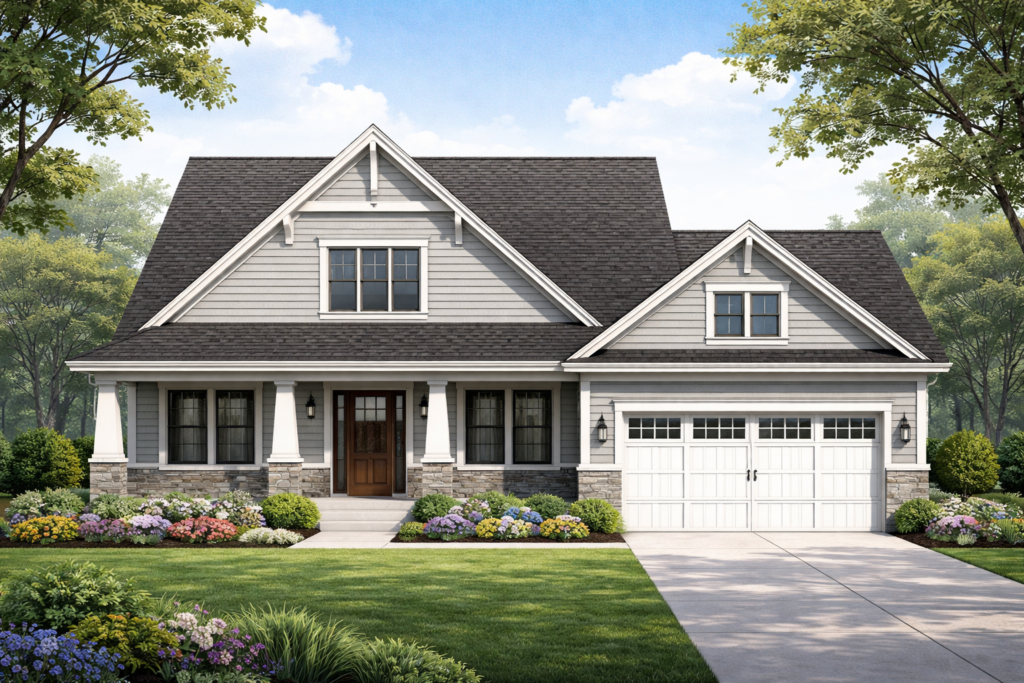
When I designed my first independent house nearly fifteen years ago, I underestimated how much the gable roof elevation would define the building’s personality. I was focused on floor plans and finishes, but once the roof went up, everything changed. That triangular form gave the house instant character, better ventilation, and long-term durability. Since then, after working on dozens of homes, I’ve learned that roof design is never just a technical decision—it’s architectural storytelling.
What Is a Gable Roof and Why It Still Matters
Before diving into ideas, let’s answer a question clients still ask me on site: what is a gable roof? Simply put, it’s a roof with two sloping sides that meet at a ridge, forming a triangle at each end. That triangle is called the gable in roof terminology.
Despite newer flat and curved systems, gable roofs remain popular because they shed water efficiently and work beautifully in both modern and classic homes.
Understanding Gable Roof Structure from Real Projects
In one hillside project I handled in 2018, wind loads were a serious concern. The gable roof structure had to be reinforced with collar ties and ridge beams. A well-designed gable roof section detail saved the client future maintenance costs and prevented uplift issues during monsoon storms.
From experience, structure always comes before style.
Gable Roof Construction: Lessons from the Field
Proper gable roof construction is about alignment, material quality, and ventilation. I’ve seen failures where contractors rushed truss spacing or ignored moisture barriers. The result? Sagging slopes within five years.
Always insist on seasoned timber or certified steel, correct pitch angles, and breathable underlayment. These basics never go out of fashion.
Classic Gable Roof Elevation Ideas
Traditional homes benefit greatly from symmetrical gable roof designs. Clay tiles, exposed rafters, and stone cladding enhance the timeless look. I once restored a 40-year-old bungalow where the original roof gable proportions were perfect—no redesign needed, just material upgrades.
Classic doesn’t mean outdated. It means balanced.
Contemporary Gabled Roof Designs That Actually Work
Modern homes often reinterpret the gabled roof with sharp lines and mixed materials. Metal sheets, fiber cement boards, and large glass panels under the gable transform the elevation instantly.
One of my favorite projects used asymmetrical gable roof designs paired with vertical wooden louvers. Minimalist, yet warm.
Gable Roof Dimensions: Getting the Proportions Right
Clients often overlook gable roof dimensions, but proportions decide everything. A steep pitch (30–45 degrees) works best in heavy rainfall areas, while lower slopes suit dry climates.
I always sketch elevations at real scale. A gable that’s too tall looks awkward. Too flat, and drainage suffers.
Gable Roof Elevation and Climate Performance
A properly designed gable roof elevation improves airflow naturally. Hot air escapes through ridge vents, reducing indoor temperatures. In my own home, attic temperatures dropped by nearly 6°C after adjusting vent placement.
That’s passive design at its best—no machines, no noise.
Integrating Gable Roof Design with Facade Materials
A strong gable roof design must align with wall finishes. Brick pairs well with classic slopes, while concrete and glass suit contemporary elevations. I advise clients to treat roof and facade as one visual unit.
Never design them in isolation.
Roof Gable Details That Elevate Design
Small elements matter. Overhang depth, fascia profile, and gutter alignment can make or break the elevation. A poorly finished roof gable instantly cheapens the house, no matter how good the interiors are.
I personally inspect these details on-site before final handover.
Gable Roof Section Detail for Long-Term Durability
Including insulation layers, vapor barriers, and proper flashing in the gable roof section detail prevents condensation issues. I learned this the hard way on an early project where shortcuts led to ceiling stains.
Experience teaches what textbooks don’t.
Gable Roof Designs for Small and Large Homes
From compact villas to sprawling farmhouses, gable roof designs scale beautifully. For small homes, a single front-facing gable adds height. Larger homes can layer multiple gable roofs for depth and rhythm.
Design is about proportion, not size.
Common Mistakes in Gable Roof Construction
Ignoring expansion joints, misaligning ridges, and poor drainage slopes are common errors. A flawed gable roof construction often looks fine initially but fails structurally over time.
Hire professionals who understand both design and execution.
Final Thoughts from Years on Site
After years of designing, building, and repairing homes, I can say this confidently: a well-executed gable roof elevation never goes out of style. It’s practical, expressive, and adaptable.