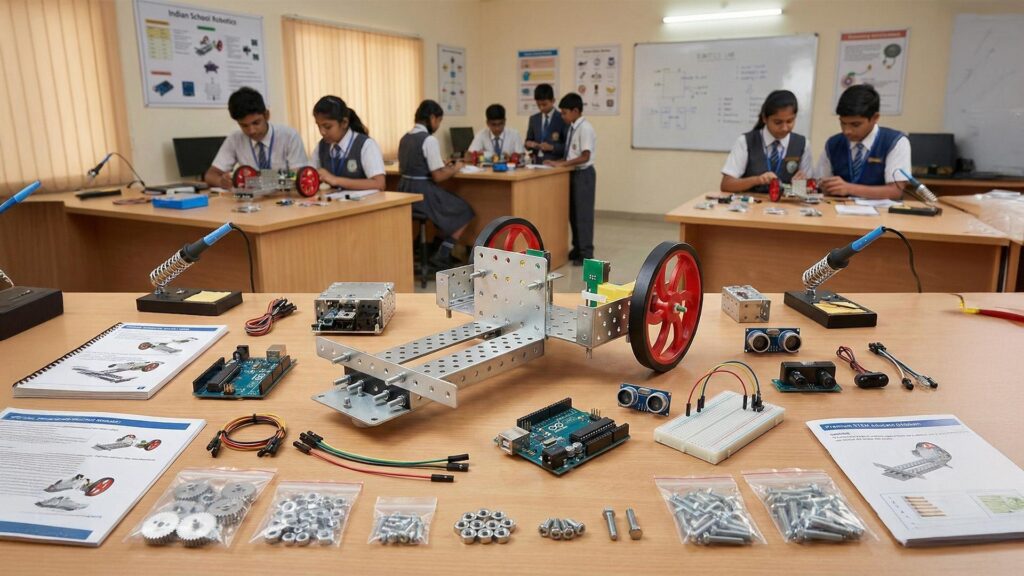
Classrooms are constantly changing with educational systems allowing innovation and looking beyond textbooks. Students need practical experience to flourish in today’s world. Hence, schools are changing their learning environment with such initiatives as Atal Robotics Lab.
The Vision Behind Atal Robotics Labs
The objective here is to develop curiosity by practice and not by passive memorisation. Next, the schools introduce them to various tools and projects that trigger critical and creative thinking. Furthermore, this vision also supports other skills such as coding, robotics, and design thinking.
Most importantly, it develops confidence in young learners to solve real-world problems. As a result, students learn to collaborate, experiment, and iterate on ideas in a supportive environment. This is an expansion of an Atal tinkering lab with a modern innovation focus.
Core Technologies That Power an Atal Robotics Lab
Modern STEM hubs leverage a range of supportive technologies that deeply engage students. These assist students to advance from concepts to real prototypes with confidence and creativity.
-
Robotics Platforms & Controllers
Robotics kits include sensors, actuators, and microcontrollers to help students assemble and program robots. These systems are inspiring computational thinking as students write code to operate physical devices. In doing so, students apply logic, debugging, and design skills in a real context.
-
3D Printers and Digital Fabrication
With 3D printers, students bring digital designs into physical form in an ever-quicker way. They learn to apply CAD principles while also understanding engineering constraints such as material strength. Learners thereby immediately see the results of their creations, deepening both curiosity and skill.
-
Electronics & Sensor Modules
Labs comprise circuits, sensors, and simple electronics, which introduce basic STEM concepts. Children also get to experiment with these modules, which enhances their understanding of current, voltage, and data gathering. Moreover, when combined with robotics, these tools enhance creative problem-solving skills.
-
Hands-On Fabrication Tools
Many spaces also incorporate STEM tinkering lab tools for design, testing, and fabrication, adding to an even more effective play to learn experience. This includes tools for soldering, construction, and prototyping. Therefore, students gain hands-on skills that resemble real engineering workflows.
-
Emerging Tech Modules
Advanced technology modules like AI, IoT, AR, VR, and drone systems give wider exposure to the students. These tools let learners explore smart systems, immersive simulations, and autonomous flight. Therefore, students develop future-ready skills that go beyond mere robotics and coding.
Long-Term Impact on Schools and Learning Outcomes
Students derive better engagement from a project-based method that transcends the book. Besides that, there is more collaboration among the learners as they work in groups to create projects. In addition, problem-solving and creativity feature as key components of school activities.
Importantly, the Atal Robotics Lab helps students prepare for their futures by making these STEM fields tangible and exciting. Consequently, schools nurture confident innovators prepared for challenges ahead.
Conclusion
Undoubtedly, making classrooms vibrant spaces of innovation also enhances the learning experience. Across schools, these facilities fuel curiosity, creativity, and collaboration. Hence, they prepare students for the future with the Atal Robotics Lab at the heart of this evolution.

.png)