A familiar scenario continues to surface across growing brokerages. Revenue is increasing, teams are expanding, and yet operations feel more complex than before. The underlying issue is rarely market demand. It is the growing mismatch between business scale and the systems used to support it.
This is where modern insurance broker software solutions become critical. They are no longer optional tools that sit alongside operations. They are foundational systems that determine how efficiently a brokerage can acquire clients, service policies, manage risk, and ultimately grow.
Here is a comprehensive view of leading platforms that agencies should evaluate, based on capabilities, benefits, and strategic fit.
What a Modern Insurance Broker Platform Must Deliver
Before assessing various individual insurance broker software, the leadership team has to be clear about what they expect from such solutions. Essentially, the right insurance broker platform ought to combine, within a single system, those processes that have, in the past, been separated across different tools and departments.
A good platform will have several capabilities, including:
- Centralized access
- Workflow automation
- Effortless communication
- Real-time insights
- Seamless scalability
If these capabilities are missing, agencies are, in most instances, left with no other option but to increase their headcount to make up for process inefficiencies, and this, over time, will lead to margin reduction and a slowdown in decision-making.
Best Insurance Broker Software Solutions for Growing Agencies
There is a range of insurance broker software systems available in the market. Here is a deeper, more practical look at the platforms worth considering, based on real capabilities, market positioning, and reviews. These platforms solve different bottlenecks, so choose wisely.
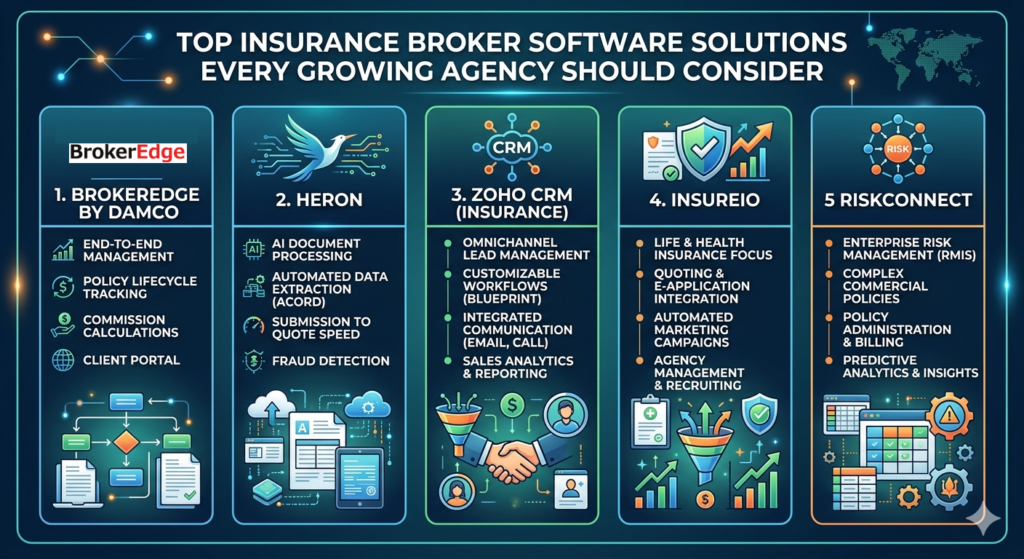
1. BrokerEdge by Damco
The most common leadership question at scale is whether a single system can manage the entire brokerage lifecycle without creating dependencies on multiple disconnected tools. BrokerEdge is designed to address that requirement by functioning as a comprehensive insurance broker software that integrates core operations into a single platform.
What it does well
BrokerEdge brings together policy lifecycle management, customer relationship management, and workflow automation into a unified environment. It enables brokers to manage everything from quote generation to policy renewals without switching systems.
Key strengths include:
- End-to-end lifecycle management from quote to bind to renew
- Built-in CRM that delivers a 360-degree customer view
- Automated workflows for servicing, endorsements, and renewals
- Real-time connectivity with insurers through APIs and EDI
- Centralized dashboards for tracking performance and productivity
Strategic value
BrokerEdge is particularly effective for agencies dealing with fragmented systems and looking to consolidate operations. It creates consistency across processes and reduces dependency on manual coordination between teams.
- Reduces tool sprawl and integration challenges
- Improves turnaround time across the policy lifecycle
- Enables insurers and brokers to monitor business performance in real time
2. Heron
In many brokerages, the intake process remains one of the most resource-intensive functions. Staff spend a lot of time gathering and confirming data from submissions, which increases the time required to complete underwriting and can even influence how clients perceive the service. Heron makes it a point to remove this stumbling block with the help of automation.
What it does well
Heron is equipped with state-of-the-art data extraction functionality that can parse details from not only highly structured but also unstructured documents such as ACORD forms, PDFs, and email submissions. Besides automatically arranging and classifying the data, it also detects missing or inconsistent fields and generates clean datasets that can be used directly for underwriting and quoting.
Its core capabilities include:
- Automated extraction of data from emails, PDFs, and ACORD forms
- Intelligent classification and organization of submission documents
- Detection of missing or inconsistent data fields
- Seamless integration with downstream systems such as AMS and PAS
Strategic value
Heron is best suited for brokerages that handle high submission volumes and want to scale operations without proportionally increasing headcount. It improves speed, reduces errors, and allows teams to focus on higher-value tasks such as risk evaluation and client engagement.
- Accelerates quote turnaround time
- Reduces manual workload for underwriting teams
- Improves data accuracy and consistency
3. Zoho CRM
Sales inefficiency is another area where many agencies struggle. If lead management and client communication are handled across multiple channels without a structured system, agencies face sales inefficiencies.
Zoho CRM has a flexible framework that can be customized to insurance workflow.
What it does well
Zoho CRM not only centralizes lead, client, and policy information but also allows workflow automation for follow-ups, renewals, and servicing tasks. It offers omnichannel communication, allowing teams to connect with clients across various touchpoints through a single interface.
Key capabilities include:
- Lead and client lifecycle management in a single system
- Automated workflows for follow-ups, renewals, and servicing
- Communication through different channels, including email, phone, chat, and social media
- Analytics and forecasting for pipeline visibility and performance tracking
- Option to customize workflows according to business needs
Strategic value
Zoho CRM is an excellent choice for agencies building or reworking their sales processes. It provides the necessary framework to increase lead conversion and client retention while remaining flexible to adapt to the business.
- Provides enhanced transparency and accountability for the sales pipeline
- Helps to improve client engagement and ensure consistent follow-up
- Enables growth without hard system limitations
4. Insureio
Agencies operating in life insurance face a distinct set of challenges, in which sales, marketing, and application management often operate in silos. Insureio addresses this gap by providing a purpose-built solution for life insurance broker software needs.
What it does well
Insureio unifies various activities into a single platform. These include lead management, marketing automation, quoting, and application tracking. Thus, the platform streamlines the sales journey. It also ensures that brokers have full visibility into each stage of the client lifecycle.
Core features include:
- Integrated lead and campaign management
- Built-in quoting tools across multiple carriers
- Automated marketing workflows and drip campaigns
- Application and case tracking within a centralized system
- Client engagement tools for improved communication
Strategic value
Insureio is especially effective for agencies that rely heavily on marketing-driven growth. It also helps brokerages that need tighter alignment between lead generation and policy conversion.
- Reduces friction between marketing and sales teams
- Improves lead-to-policy conversion rates
- Provides better visibility into client journeys
5. Riskonnect
As brokerages grow, their focus shifts from operational efficiency to strategic insight. While many agencies gather large amounts of data, they struggle with turning that data into useful intelligence.
Riskonnect is tailored to serve as a bridge between those two points.
What it does well
Riskonnect brings together all the information concerning risk, claims, and exposures in one place, thus allowing brokers to identify patterns and make decisions based on facts.
It also speeds up work related to compliance and reporting, so that the safety of procedures is maintained at a high level and they remain clear.
The main capabilities are:
- One place to store risk and claims data
- Highly sophisticated analytics and reporting dashboards that can be configured
- Automation of workflows for compliance and servicing
- Analysis of exposures at a portfolio level
- Up-to-date insights into risk trends and the effectiveness of performance metrics
Strategic Value
Riskonnect allows brokerages to change their role from merely selling products or completing transactions to becoming trusted advisors by leveraging data more effectively.
- Makes client discussions more valuable through supporting evidence from the data
- Enables higher quality risk evaluation and portfolio oversight
- Gives the agency a tool with which to make proactive decisions
How to Choose the Right Insurance Broker Software Solution?
Shortlisting and then choosing right insurance broker software isn’t easy. You need to have a clear understanding of current operational gaps and future growth plans.
A practical approach includes:
- Identifying where time and resources are currently being lost
- Evaluating which processes require automation or integration
- Assessing scalability requirements for future growth
- Ensuring ease of adoption for internal teams
Different solutions serve different purposes, and the best choice depends on the agency’s stage and priorities.
Final Thoughts
Incremental improvements no longer drive the evolution of brokerage operations. It is driven by systemic change.
The right insurance broker software does not simply digitize existing workflows. It redefines how work gets done by removing inefficiencies. Moreover, it improves visibility, and enablds better decision-making. It also,
- Reduces operational friction across teams
- Creates clarity in data and performance
- Allows leadership to focus on growth rather than coordination
In a competitive and fast-moving market, those advantages are not incremental. They are foundational.