Market Overview:
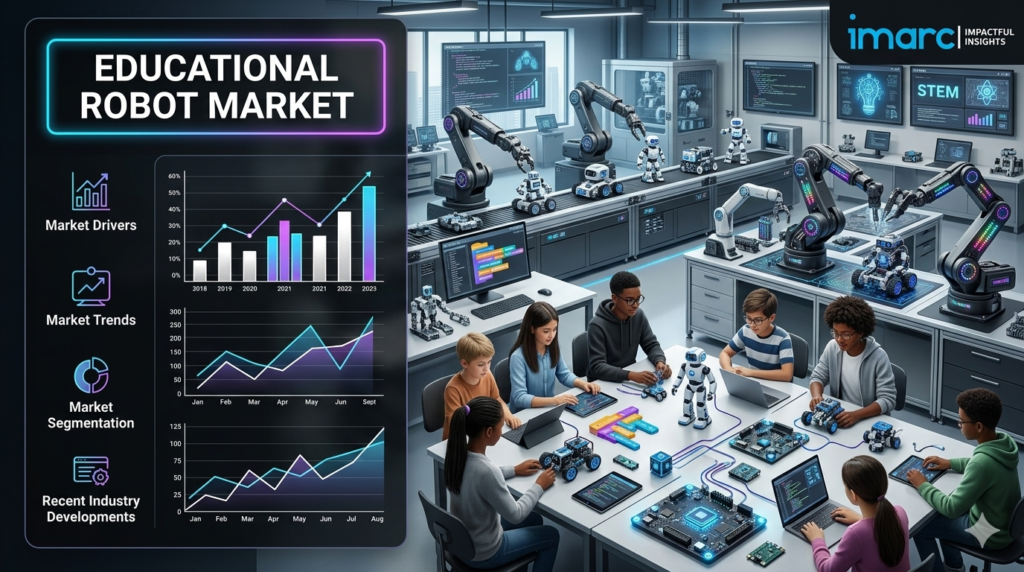
The educational robot market is experiencing rapid growth, driven by integration of robotics into national curricula, expansion of specialized ai-enabled social robots, and rising investment in steam and competitive learning. According to IMARC Group’s latest research publication, “Educational Robot Market Size, Share, Trends and Forecast by Component, Product Type, End-User and Region, 2026-2034”, the global educational robot market size was valued at USD 2.1 Billion in 2025. The market is projected to reach USD 6.3 Billion by 2034, exhibiting a CAGR of 12.56% from 2026-2034.
This detailed analysis primarily encompasses industry size, business trends, market share, key growth factors, and regional forecasts. The report offers a comprehensive overview and integrates research findings, market assessments, and data from different sources. It also includes pivotal market dynamics like drivers and challenges, while also highlighting growth opportunities, financial insights, technological improvements, emerging trends, and innovations. Besides this, the report provides regional market evaluation, along with a competitive landscape analysis.
Download a sample PDF of this report: https://www.imarcgroup.com/educational-robot-market/requestsample
Our report includes:
- Market Dynamics
- Market Trends and Market Outlook
- Competitive Analysis
- Industry Segmentation
- Strategic Recommendations
Growth Factors in the Educational Robot Market
- Integration of Robotics into National Curricula
- Expansion of Specialized AI-Enabled Social Robots
The rapid advancement of artificial intelligence has catalyzed the demand for social and humanoid robots designed specifically for language tutoring and special education. Humanoid platforms currently command nearly 50% of the educational robot market share, largely due to their ability to provide human-like interaction and high levels of engagement. In regions like East Asia, these robots are being deployed as cost-effective alternatives to one-to-one human instruction to address demographic pressures such as aging teacher populations and shrinking class sizes. Furthermore, special education applications are seeing a surge in utilization, where robots serve as patient, consistent therapy aids for children with neurodiverse needs. Real-world data indicates that schools are increasingly investing in these sophisticated units because they offer personalized feedback and emotional recognition capabilities that traditional tablets or computers cannot replicate, making them indispensable for interactive and inclusive classroom environments.
- Rising Investment in STEAM and Competitive Learning
The global emphasis on Science, Technology, Engineering, Arts, and Mathematics (STEAM) education has created a massive market for modular and programmable robotic kits. Organizations like UNESCO report that over 65% of K-12 schools worldwide have integrated STEAM modules, with robotics serving as the physical bridge for abstract coding concepts. This growth is further fueled by the proliferation of international robotics competitions, such as the FIRST LEGO League and the World Robot Olympiad, which attract participants from dozens of countries annually. These events drive the sales of high-performance components, including sensors, controllers, and 3D-printed robot parts, as students and hobbyists seek competitive advantages. In 2026 alone, the number of national-level robotics championships has increased significantly, encouraging academic institutions to invest in advanced mechatronics labs and innovation centers to prepare students for high-demand technical careers in an increasingly automated global economy.
Key Trends in the Educational Robot Market
- Generative AI and Adaptive Tutoring
A transformative trend in the market is the integration of generative artificial intelligence into educational robot software. Unlike older models that relied on pre-programmed scripts, modern robots utilize large language models to engage in natural, context-aware conversations with students. For example, robots now act as personalized study assistants that can generate unique coding challenges or explain complex physics concepts based on a student’s specific level of understanding. Educational entities are leveraging these AI-driven systems to provide real-time feedback and behavioral analysis, allowing the robot to adjust its teaching pace and style. This shift toward adaptive learning ensures that every student receives a customized educational experience, effectively turning a single classroom robot into a versatile, multi-subject tutor capable of supporting diverse learning paths simultaneously.
- Modular and DIY Open-Source Hardware
There is a growing movement toward modularity and open-source hardware within the robotics education sector. Rather than purchasing “closed” proprietary systems, many schools and universities are opting for 3D-printable kits and platforms based on Arduino or Raspberry Pi. This trend allows students to build robots from the ground up, providing a deeper understanding of mechanical engineering and circuitry. In 2026, DIY kits like mini CNC laser engravers and spider robots have become popular in middle and high schools because they are easily repairable and highly customizable. This “maker” culture encourages students to experiment with different sensors and actuators, fostering a sense of ownership over their creations. By utilizing open-source software libraries, these kits remain affordable and accessible, lowering the barrier to entry for resource-constrained districts while maintaining a high ceiling for advanced engineering projects.
- Cloud-Connected Collaborative Learning
The emergence of cloud-connected robotics is redefining how students collaborate on technical projects across different geographical locations. Modern educational robots are increasingly equipped with IoT capabilities, allowing multiple users to program and control a single robot through a shared web interface. This trend is particularly evident in higher education, where research-grade robots are shared between departments or even between international partner universities. For instance, students in different countries can co-develop code for a collaborative robot (cobot) located in a centralized lab, testing their algorithms in real-time via high-definition telepresence. This connectivity also enables vendors to provide “Robotics-as-a-Service,” where schools access the latest software updates and curriculum content through the cloud, ensuring their hardware remains relevant without the need for frequent physical replacements.
Leading Companies Operating in the Global Educational Robot Industry:
- Adele Robots
- Aisoy Robotics
- Arrick Robotics
- Blue Frog Robotics
- DST Robot Co.
- Hanson Robotics
- Idmind
- Macco Robotics
- Pal Robotics
- Primo Toys
- Probotics America
- Qihan Technology Co.
- Robobuilder
- Robotis
- Softbank Robotics Corp.
Educational Robot Market Report Segmentation:
By Component:
- Hardware
- Sensors
- Actuators
- Power Source
- Control System
- Others
- Software
Hardware holds 74% market share, providing essential components like sensors and actuators that enable interactive learning experiences through hands-on engagement in STEM education.
By Product Type:
- Humanoid
- Non-Humanoid
Non-Humanoid accounts for 68% of the market share, offering practicality and cost-effectiveness while facilitating hands-on learning and problem-solving skills without the complexities of humanoid robots.
By End-User:
- K-12
- Universities
- Others
K-12 holds 58% market share, leveraging interactive robots to enhance engagement and understanding of STEM concepts, supported by government initiatives and a focus on early skill development.
Regional Insights:
- North America (United States, Canada)
- Asia Pacific (China, Japan, India, South Korea, Australia, Indonesia, Others)
- Europe (Germany, France, United Kingdom, Italy, Spain, Russia, Others)
- Latin America (Brazil, Mexico, Others)
- Middle East and Africa
Asia-Pacific leads the market with a 30% share, driven by a large student population, strong government support for robotics in education, and increasing affordability of educational robots.
Note: If you require specific details, data, or insights that are not currently included in the scope of this report, we are happy to accommodate your request. As part of our customization service, we will gather and provide the additional information you need, tailored to your specific requirements. Please let us know your exact needs, and we will ensure the report is updated accordingly to meet your expectations.
About Us:
IMARC Group is a global management consulting firm that helps the world’s most ambitious changemakers to create a lasting impact. The company provide a comprehensive suite of market entry and expansion services. IMARC offerings include thorough market assessment, feasibility studies, company incorporation assistance, factory setup support, regulatory approvals and licensing navigation, branding, marketing and sales strategies, competitive landscape and benchmarking analyses, pricing and cost research, and procurement research.
Contact Us:
IMARC Group
134 N 4th St. Brooklyn, NY 11249, USA
Email: sales@imarcgroup.com
Tel No:(D) +91-120-433-0800
United States: +1-201-971-6302