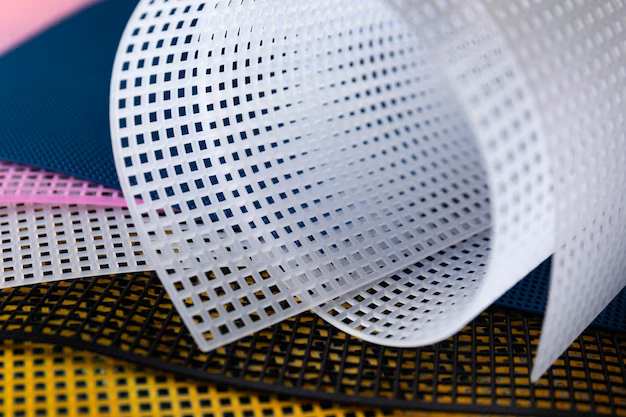
vibro sifter mesh sieves
Every vibrating sifter performs exactly as well as the screen installed inside it — and no better. The motor, the frame, the drive unit, and the housing can all be specified correctly, but if the screen type is mismatched to the material and application, the separation quality will disappoint regardless of everything else the machine does right. For production managers and quality control teams across Pakistan’s food, pharmaceutical, and chemical processing sectors, the choice between the two primary vibro sifter mesh sieves options — woven wire mesh and perforated plate — is one of the most practically consequential equipment decisions made at the screening stage. Both have genuine strengths. Both have clear limitations. And the wrong choice in either direction produces screening results that no amount of machine tuning can fully correct.
What are Vibro Sifter Mesh Sieves?
Vibro sifter mesh sieves are the interchangeable screen elements installed within vibratory sifting machines to perform the actual particle separation function. They are the physical barrier through which fine particles pass and against which oversized particles are retained — making them the most operationally critical component of any vibrating screening system.
Two fundamentally different construction types dominate industrial sifting applications: woven wire mesh screens, in which stainless steel wire is woven in a grid pattern to create uniform apertures between the wire intersections; and perforated plate screens, in which precisely sized holes are punched or laser-cut into a flat sheet of stainless steel or other metal plate. Each construction method produces screens with distinct aperture geometry, open area percentage, structural strength, and surface characteristics — all of which interact with your material’s particle size, shape, density, and surface properties to determine the accuracy, throughput, and durability of your screening operation.
Key Features & Benefits
Understanding what each screen type contributes before making a comparison helps frame the decision in operational rather than purely technical terms:
- Wide Aperture Range Across Both Types: Woven wire mesh is available in aperture sizes from a few microns to several millimetres, covering an exceptionally wide separation range. Perforated plate is typically available from approximately 0.5mm upward, making wire mesh the only option for fine powder separation while perforated plate takes over for coarser, heavier materials.
- Higher Open Area in Wire Mesh: Woven wire mesh typically offers a higher percentage of open area relative to total screen surface than equivalent perforated plate — meaning more of the screen surface is available for particle passage, which translates into higher throughput capacity per unit of screen area at comparable aperture sizes.
- Superior Structural Strength in Perforated Plate: Perforated plate is significantly more rigid and impact-resistant than woven wire mesh of comparable aperture size — making it the preferred choice for heavy, abrasive, or angular materials that would rapidly wear or distort a wire mesh screen under the same operating conditions.
- More Precise Aperture Definition in Perforated Plate: Punched or laser-cut apertures in perforated plate maintain highly consistent hole dimensions across the entire screen surface, with minimal variation from the specified size. Woven wire mesh aperture size is subject to variation introduced by wire diameter tolerance and weave tension — a consideration for applications where tight separation precision is required.
- Food and Pharma Grade Certification Available for Both: Both woven wire mesh and perforated plate screens are available in certified food-grade 304 and 316 stainless steel with documented material specifications — making both types suitable for regulated food, pharmaceutical, and nutraceutical processing environments when correctly specified and sourced.
Industrial Applications
Vibro sifter mesh sieves — in both wire mesh and perforated plate configurations — serve a wide range of industries across Pakistan’s food and industrial processing sectors:
- Flour and Grain Milling using fine woven wire mesh screens to separate refined flour by particle size, grade semolina by granule size, and remove bran specks from finished flour streams — applications where the fine aperture range of wire mesh is essential and perforated plate cannot achieve the required separation cut points
- Spice and Seasoning Processing screening finely ground masalas, chilli powder, turmeric, and blended seasonings with wire mesh screens that separate stem fragments, seed particles, and coarse material from on-specification ground spice — a fine-particle application where wire mesh dominates
- Salt and Mineral Processing using perforated plate screens to grade coarser rock salt and mineral crystals by size at the primary screening stage, transitioning to wire mesh for fine salt grading at later stages — a multi-stage application where both screen types contribute at different points in the processing line
- Sugar and Confectionery Manufacturing grading granulated sugar crystals with woven wire mesh at fine grade stages and perforated plate for coarser industrial sugar grades — with the choice driven by the crystal size range and the throughput volume at each stage
- Pharmaceutical and Nutraceutical Production using precision woven wire mesh screens to achieve tight particle size cuts on active ingredient powders, granulated excipients, and dietary supplement blends — where aperture precision and material certification are both regulatory requirements
- Plastic and Polymer Processing screening extruded polymer granules and recycled plastic flake with perforated plate screens that withstand the angular, abrasive nature of plastic material without the mesh distortion and breakage that wire screens develop under the same conditions
Wire Mesh vs Perforated Plate: A Direct Comparison
Aperture Size Range Wire mesh screens are available in aperture sizes from as fine as 20 microns up to 10mm or more, making them the only viable screen type for fine powder separation in pharmaceutical, flour milling, and spice processing applications. Perforated plate is practically limited to aperture sizes of 0.5mm and above — ruling it out entirely for any application requiring fine particle separation below this threshold.
Open Area and Throughput Capacity Woven wire mesh typically achieves open area percentages of 30 to 60 percent depending on wire diameter and weave pattern. Perforated plate typically achieves 20 to 40 percent open area depending on hole size, pitch, and plate thickness. The higher open area of wire mesh translates into greater throughput capacity per unit of screen surface — an advantage in high-volume continuous processing applications where screening capacity directly affects line output.
Structural Durability and Wear Resistance Perforated plate is substantially more durable than woven wire mesh when handling heavy, coarse, abrasive, or angular materials. The solid plate structure resists impact, abrasion, and deformation under bulk material loading in ways that woven wire — where individual wires are the only structural element at each aperture — cannot match. For applications involving rock salt, plastic granules, fertiliser pellets, or similar materials, perforated plate service life significantly exceeds that of equivalent wire mesh.
Separation Accuracy and Aperture Consistency Perforated plate maintains consistent aperture dimensions across the screen surface with minimal variation — laser-cut holes in particular achieve aperture tolerance that approaches the precision of laboratory sieves. Woven wire mesh aperture size varies slightly across the screen due to wire diameter tolerance and weave pattern variability — a consideration in pharmaceutical and analytical applications where tight particle size specifications must be met and documented.
Cleaning and Hygiene Performance Wire mesh screens present a more complex surface geometry than perforated plate — the interstices between woven wires can retain fine material and resist complete cleaning in hygroscopic or sticky product applications. Perforated plate presents a flat, smooth surface on both faces that is easier to clean thoroughly and inspect visually for residual material — an advantage in food-grade and pharmaceutical applications where between-run cleaning validation is required.
Cost and Replacement Frequency Wire mesh screens are generally less expensive to purchase than perforated plate screens of equivalent size and aperture. However, wire mesh screens wear and require replacement more frequently when handling abrasive or heavy materials — making the total cost of ownership comparison dependent on your specific material and operating conditions rather than the screen purchase price alone.
Why Quality Matters
The performance of a vibro sifter mesh sieve is inseparable from the quality of its manufacture. In wire mesh screens, wire diameter consistency, weave tension uniformity, and edge finishing quality determine whether the screen delivers its specified aperture size across the full screen area or develops high- and low-tension zones that compromise separation accuracy. A poorly tensioned wire mesh screen that appears intact on visual inspection may be delivering aperture sizes 20 to 30 percent larger than specified in its low-tension zones — allowing off-specification particles through with no visible indication of the problem.
In perforated plate screens, hole diameter consistency, burr removal after punching, and plate flatness are the quality variables that determine separation accuracy and surface hygiene. Incompletely deburred holes retain product and resist cleaning. Non-flat plate distorts under vibration loading, creating contact points with the screen frame that accelerate wear and compromise the sealing between the screen and the frame — allowing fine material to bypass the screen entirely at the frame perimeter.
For food and pharmaceutical manufacturers whose product quality, batch release decisions, and regulatory compliance all depend on the accuracy of their screening stage, screen quality is not a procurement detail — it is a product quality and compliance assurance requirement.
Conclusion
The choice between wire mesh and perforated plate vibro sifter mesh sieves is not a default decision — it is an application-specific selection that directly determines the accuracy, throughput, durability, and hygiene performance of your entire screening operation. Wire mesh excels in fine particle applications, high open-area throughput, and wide aperture range. Perforated plate leads in structural durability, aperture consistency, and cleanability for coarser, heavier, or abrasive materials. In many processing lines, both types are used at different stages for precisely this reason. For production managers and procurement teams ready to specify the right screen for their application, you can explore certified, application-matched options for precision-built Vibro Sifter Mesh Sieves in both wire mesh and perforated plate configurations to find the specification that delivers the separation performance your process demands.