If you have ever watched the Masters go down to the wire, you already know that feeling. Your stomach tightens. The commentators go quiet for a second. And suddenly, two players who have been grinding all week are standing on the same score, staring at each other across one of the most beautiful and brutal golf courses in the world.
That moment right there is where the masters playoff format takes over. And honestly, the story behind how that format came to be is something most golf fans have never really sat down and thought about.
It Did Not Always Look Like This
When the Masters first started back in 1934, nobody was sitting in a boardroom saying, “Okay, what happens if two guys tie?” The tournament was brand new. Augusta National was still finding its identity. The whole thing was more of an invitational gathering than the global spectacle it is today.
So ties? They were kind of an afterthought.
Golf back then had its own way of handling things. If the round is over and nobody has won, you come back tomorrow and play another full 18 holes. Simple. Clean. A little exhausting, maybe but nobody questioned it. That was just the culture of the sport.
The Monday Playoff Days
For decades, that is exactly what the Masters did. If two or more players finished tied after 72 holes, they came back on Monday for a full 18-hole playoff. No shortcuts. No drama compressed into a single hole. Just another full round of golf to figure out who really deserved the green jacket.
And some of those Monday playoffs were genuinely wonderful.
In 1954, you had Ben Hogan and Sam Snead two of the biggest names the sport has ever produced going at it head to head. That is not just a playoff. That is a piece of history. Snead came out on top, but even the people who watched Hogan lose that day probably walked away feeling like they had witnessed something rare.
Then came 1962, and Arnold Palmer found himself in a three-way playoff against Gary Player and Dow Finsterwald. Palmer won, but the whole affair had this cinematic quality to it. Three legendary players, one Monday morning, Augusta National. It felt like it belonged in a movie.
Those 18-hole playoffs had something that the modern format does not always offer time. Players had a night to breathe, think, and reset. Fans had something to look forward to on Monday. There was a slow-burn tension to it that a lot of golf traditionalists genuinely loved.
Then Everything Changed in 1976
Augusta National looked at where professional golf was heading and made a call. Television was bigger than ever. Audiences wanted resolution. And frankly, sudden death is just a different kind of electricity raw, immediate, and terrifying in the best possible way.
So in 1976, the Masters switched to sudden-death playoffs.
One hole at a time. You tie that hole, you go to the next one. You win a hole, you are the champion. It is that simple and that brutal.
The first time it actually played out was in 1979. Fuzzy Zoeller, Ed Sneed, and Tom Watson all finished tied. They headed to the extra holes, and Zoeller calm, smiling, completely unbothered by the weight of the moment birdied his way to the title on the second playoff hole. He became the first Masters champion to win in sudden death, and he did it in the most Fuzzy Zoeller way imaginable.
So How Does It Actually Work?
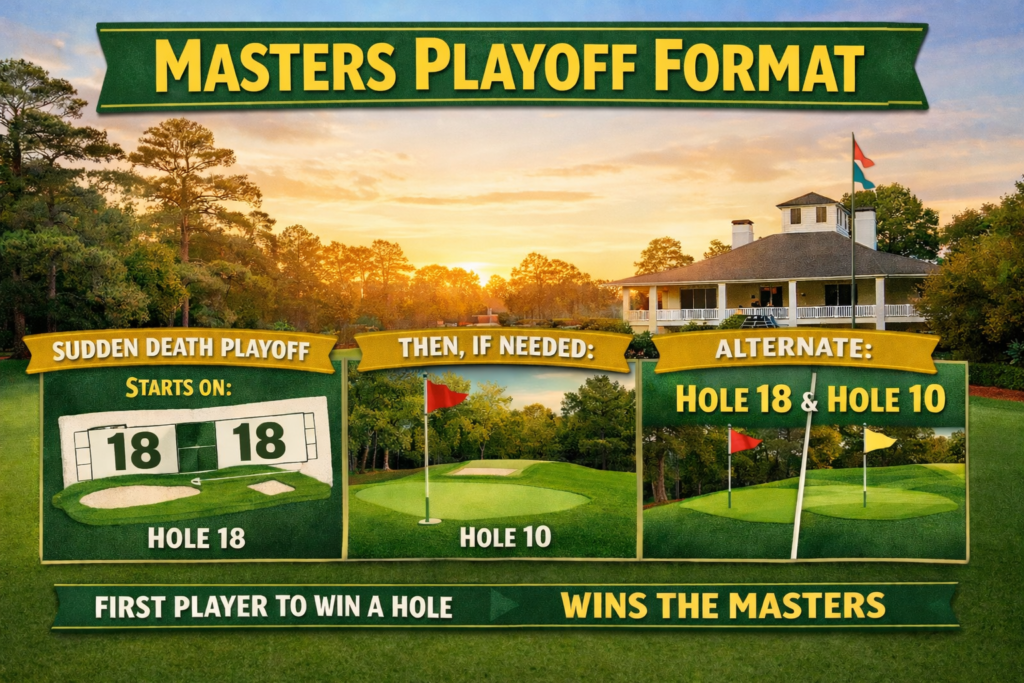
Under the current masters playoff format, if players are tied after the final round, they start at the 18th hole. If nobody wins there, they move to the 10th. Then back to 18 if needed. And so on, back and forth between those two holes, until someone finally makes a lower score.
That is not a random choice of holes. Both the 18th and 10th at Augusta are genuinely tough. The 18th goes uphill, and the green is not forgiving if your approach is off. The 10th is one of the most nerve-wracking downhill par-fours you will find anywhere in major championship golf. Between the two of them, there is no hiding. You either make the shot or you do not.
There is also no limit. The playoff goes on as long as it needs to.
The Moments That Made It Legendary
Here is the thing about sudden death it creates memories in a way that drawn-out playoffs sometimes cannot.
Take 1987. Larry Mize, a local boy from Augusta, was in a three-way playoff with Greg Norman and Seve Ballesteros. Ballesteros was already eliminated. It was down to Mize and Norman on the 11th hole. Mize was off the green, well away from the flag, facing a chip that most people in that situation would be happy just to get close. Instead, he holed it. The ball went in from miles away. Norman stood there completely stunned. The crowd lost their minds.
That chip shot has been played back so many times that it almost does not feel real anymore. But it happened. And it happened because of the sudden-death format.
Then there is 2005. Tiger Woods and Chris DiMarco tied, and they went to a playoff. But before they even got there, Tiger had already produced one of the single greatest shots in golf history that chip on 16 where the ball crept toward the hole, stopped right on the edge for what felt like forever, and then dropped in. Pure theater.
And 2017 Sergio Garcia and Justin Rose, sudden death on the first extra hole. Garcia, a man who had come so heartbreakingly close to winning a major so many times, finally got it done. Grown men were crying. Garcia was crying. It was one of those golf moments that reminds you why people fall in love with this sport in the first place.
Why Fans Are More Connected to It Than Ever?
Something has shifted in the way people watch golf. It is not just about sitting in front of a TV anymore. People follow tournaments on their phones, check the leaderboard between holes, and track every shot as it happens.
A lot of fans now use a golf scoring app to stay on top of everything in real time live scores, shot-by-shot updates, who just made a birdie, who just made a bogey. When Sunday afternoon gets tight and the top of the leaderboard starts bunching up, that kind of instant information makes the whole experience so much richer. You are not waiting for the broadcast to catch up. You already know.
It changes how you feel the tension. And when a playoff looks like it might be coming, that tension goes through the roof.
Is Sudden Death Actually Fair?
This is a debate that has never really gone away, and it is worth taking seriously.
The argument against sudden death is reasonable one hole is not enough of a sample size. A player might be the better golfer over four rounds and then lose everything because of one bad bounce or one moment of nerves on a single extra hole. An 18-hole playoff, the old way, gave the better player more room to prove it.
But Augusta National has stuck with sudden death for nearly 50 years now. And when you watch those moments Mize’s chip, Tiger’s walk across the 18th green, Garcia finally holding a major trophy it is hard to say they made the wrong choice. The format does not just decide a winner. It creates stories.
Final Thoughts
The story of the Masters playoff is really a story about golf growing up. It went from a handshake tradition of coming back Monday morning to the breathless, sudden-death drama that has given us some of the most unforgettable moments in all of sports.
Neither approach is wrong. The old way had its own beauty. But the current format one shot, one hole, everything on the line fits perfectly with what the Masters has become: the most watched, most talked about, most emotionally charged week in professional golf.
So the next time you find yourself watching April turn tense, and two players walk to the 18th tee all square, just remember what happens next has been decades in the making. And it is going to be something worth remembering.
FAQ
Q:1 How does the Masters playoff actually work?
It is sudden death, starting on the 18th hole. If the players tie that hole, they move to the 10th, and it keeps going between those two holes until someone wins one outright.
Q:2 Did the Masters always use sudden death?
Not at all. Before 1976, tied players came back on Monday and played a full 18-hole playoff round. The switch to sudden death happened in 1976, and the first actual sudden-death playoff was in 1979.
Q:3 Who won the very first sudden-death playoff at the Masters?
Fuzzy Zoeller, in 1979. He beat Ed Sneed and Tom Watson on the second extra hole to win his only Masters title.
Q:4 What is the most memorable Masters playoff moment?
Most people point to Larry Mize chipping in from off the green to beat Greg Norman in 1987. It is one of those moments that still feels unreal, even decades later.