Traffic volume is rarely the biggest issue in modern Casino Affiliate Marketing. Most affiliates can buy clicks. The harder challenge is finding traffic that converts into depositing players instead of low-intent registrations, bonus hunters, or short-session users who disappear after sign-up. This becomes even more visible once campaigns begin scaling across competitive GEOs where acquisition costs rise faster than player value.
In many cases, affiliates blame the offer when the real problem sits inside the traffic mix itself. A campaign may generate strong CTRs and cheap registrations while still failing economically because deposit intent is weak. This is why experienced operators and media buyers spend more time evaluating source quality than simply chasing low CPCs.
Across the gambling advertisement ecosystem, platform like 7SearchPPC are often discussed as part of broader traffic acquisition strategies because affiliates increasingly need multiple traffic environments instead of depending on one unstable source. Understanding how different channels behave is now central to sustainable casino affiliate marketing execution.
Which Traffic Source Converts Best for Casino Affiliate Marketing?
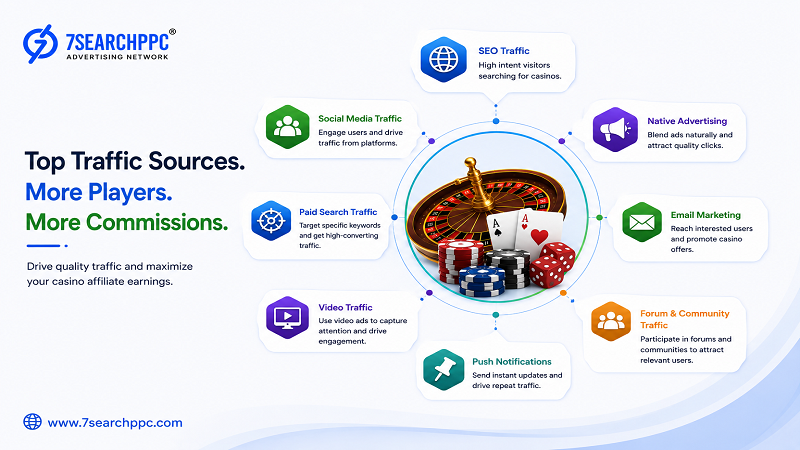
No single traffic source universally performs best for every casino affiliate campaign. Search traffic usually delivers the highest intent, native advertising often scales more smoothly, and push traffic can produce strong registration volume at lower costs. The best-performing source depends on GEO, compliance flexibility, deposit quality targets, and funnel optimization capabilities.
Affiliates focused only on cheap acquisition costs often encounter retention problems later. Higher-intent traffic generally costs more upfront but tends to generate stronger player value over time.
Why Traffic Quality Matters More Than Traffic Volume
One recurring issue in online casino affiliate marketing is the disconnect between registration metrics and actual monetization. Many campaigns appear profitable at first because sign-ups increase quickly. However, once deposit behavior is analyzed, the traffic often reveals poor engagement quality.
This usually happens when affiliates prioritize scale before validating behavioral signals such as:
- First-time deposit frequency
- Average session duration
- Retention after bonus redemption
- Repeat wagering behavior
- Device-level conversion consistency
- GEO-specific churn rates
In gambling campaigns, cheap traffic can become expensive very quickly if user intent is weak. The most sustainable affiliates understand that casino player acquisition is not simply about registrations — it is about acquiring players capable of long-term value generation.

Search Traffic Still Produces the Highest Intent
Search-based acquisition remains one of the strongest traffic sources for affiliates targeting high-intent users. People actively searching casino-related queries are often already in the decision stage, which reduces educational friction inside the funnel.
For affiliates running PPC for casino affiliates campaigns, search traffic performs particularly well when:
- The offer matches localized search intent
- Landing pages reduce trust friction
- Payment methods align with regional behavior
- Bonus positioning avoids misleading claims
- Mobile loading speed is optimized
However, search traffic also introduces serious competition pressure. CPC inflation becomes especially aggressive during major sports events, cricket tournaments, or seasonal betting spikes. Across Indian traffic environments, advertisers often notice that broad gambling terms become economically unstable during IPL periods because bidding competition compresses margins rapidly.
Another challenge is moderation sensitivity. Gambling-related ad approvals can fluctuate depending on region, policy updates, and creative wording. This is where affiliates frequently experiment with softer positioning strategies and educational-style funnels instead of direct promotional messaging.
Native Advertising Works Well for Scale-Oriented Casino Campaigns
Native advertising has become one of the more adaptable traffic sources for affiliates trying to scale beyond search limitations. Unlike highly restrictive environments, native inventory often allows broader audience testing and more flexible creative positioning.
For many casino affiliate marketing campaigns, native ads perform best when the creative behaves more like editorial content than aggressive casino promotion. Curiosity-driven headlines, betting trend analysis, strategy-style hooks, and comparison angles tend to outperform overt “win money fast” messaging.
Affiliates researching effective casino ad ideas usually discover that moderation-safe creativity matters almost as much as targeting itself. The best campaigns often reduce promotional pressure while increasing perceived legitimacy and trust.
Native advertising also supports broader funnel experimentation:
- Pre-lander testing
- Geo-localized storytelling
- Sportsbook affiliate campaigns
- Deposit incentive framing
- Behavior-based segmentation
That flexibility is particularly useful in Tier 1 gambling traffic markets where user skepticism is higher and aggressive ad styles fatigue quickly.
Key Factors Behind High-Converting Casino Traffic
High-converting gambling traffic usually shares several behavioral characteristics: clear entertainment intent, familiarity with real-money gaming, mobile transaction comfort, and willingness to engage beyond sign-up bonuses. Traffic sources that produce only registration spikes without sustained engagement often fail once retention metrics are analyzed.
Campaign optimization becomes more effective when affiliates evaluate post-click quality signals rather than relying only on front-end acquisition metrics.
Push Traffic Can Generate Fast Volume — But Quality Varies Heavily
Push ads continue to attract affiliates because they offer relatively inexpensive reach and rapid testing capabilities. In lower-budget environments, push traffic can help validate offers quickly without the cost pressure associated with premium search inventory.
But push traffic also creates one of the largest quality gaps in the gambling sector.
At lower budgets this problem can stay hidden. Once campaigns scale, however, affiliates often discover that high registration volume masks weak deposit behavior. Bonus-led low-intent traffic becomes especially common in push ecosystems where users interact impulsively rather than intentionally.
The affiliates who succeed with push ads for gambling offers usually control three variables carefully:
- Frequency caps
- Audience filtering
- Pre-qualification inside landing pages
Without aggressive filtering, cheap push inventory can distort performance data and damage optimization decisions.
Social Traffic Is Powerful but Increasingly Unstable
Social media remains attractive for gambling affiliate marketing because audience targeting capabilities can still uncover profitable behavioral clusters. Mobile-heavy gambling audiences often respond well to short-form visual content, sports-focused creatives, and influencer-style positioning.
The challenge is consistency.
Moderation tightening has made direct gambling promotion more difficult across many social ecosystems. Affiliates increasingly rely on indirect funnels, educational angles, prediction content, or betting discussion environments instead of direct casino acquisition ads.
Creative fatigue also develops faster on social traffic compared to search-driven intent traffic. What performs strongly for two weeks may collapse rapidly once audiences overexpose to the same messaging pattern.
Many affiliates underestimate how quickly social acquisition economics deteriorate without constant creative rotation.
Casino Advertising Networks Help Diversify Traffic Risk
One mistake many affiliates make is depending too heavily on a single acquisition channel. Traffic volatility is common in the gambling industry because policy shifts, GEO restrictions, and moderation changes can disrupt campaigns unexpectedly.
This is one reason affiliates explore specialized environments such as a casino advertising network where gambling-focused traffic acquisition is already part of the ecosystem. Platforms like 7SearchPPC are often referenced in these discussions because affiliates frequently need alternative inventory sources when mainstream environments become unstable or prohibitively expensive.
Diversification matters because:
- Approval conditions change frequently
- Traffic costs fluctuate seasonally
- Certain GEOs become saturated quickly
- Deposit quality differs across sources
- Creative compliance standards evolve constantly
Affiliates who spread risk across multiple channels generally adapt faster when traffic conditions shift.

What Most Affiliates Get Wrong About Traffic Scaling
Scaling is where many profitable campaigns begin failing.
Early-stage profitability often comes from small pockets of high-quality inventory. Once budgets increase, affiliates naturally expand into broader targeting pools where traffic quality weakens. The visible metrics may still look healthy — impressions rise, CTR remains stable, registrations continue — but deposit efficiency quietly deteriorates.
This usually becomes visible once campaigns begin scaling beyond tightly filtered audience segments.
Several patterns repeatedly appear in underperforming scaling attempts:
- Expanding GEOs too quickly
- Using generic creatives across different markets
- Ignoring device-level conversion differences
- Over-prioritizing CPC reductions
- Scaling before validating retention quality
In most campaigns, sustainable growth comes from improving conversion quality before increasing spend volume.
How GEO Targeting Changes Traffic Source Performance
Traffic source effectiveness changes dramatically by region.
For example, search traffic may dominate in mature gambling markets where users already understand betting products. In emerging regions, however, native advertising or push campaigns may outperform because audience education still plays a larger role inside the funnel.
Across mobile-first gambling markets, affiliates often notice that:
- Payment friction affects conversion more than ad creative
- Localized trust signals improve deposit behavior
- Sportsbook traffic behaves differently from casino traffic
- Weekend traffic quality differs from weekday behavior
- Bonus messaging performs inconsistently by GEO
Gambling GEO targeting is rarely universal. What converts efficiently in one market may fail entirely in another due to cultural trust patterns, payment preferences, or legal sensitivity.
The Most Sustainable Traffic Sources Usually Look “Expensive” Early
One of the more counterintuitive realities in iGaming affiliate marketing is that high-quality traffic often appears inefficient during early testing.
Premium traffic sources usually:
- Generate fewer registrations initially
- Cost more per acquisition
- Require stronger landing page execution
- Produce slower optimization feedback loops
But over time, those same users frequently demonstrate better retention, stronger deposit consistency, and higher lifetime value.
Platform such as 7SearchPPC are often part of broader testing frameworks precisely because affiliates increasingly compare traffic not only on front-end CPA metrics but also on downstream monetization quality.
The affiliates who survive long term rarely optimize for the cheapest traffic. They optimize for the most economically durable players.
Also Read On: Advanced Online Betting Ads Strategies for Scaling Sportsbook and iGaming Brands
Frequently Asked Questions (FAQs)
What is the best traffic source for casino affiliate marketing beginners?
Ans. Search and native traffic are usually safer starting points because intent quality tends to be stronger. Push traffic can generate fast volume, but beginners often struggle with filtering low-quality users effectively.
Are push ads still effective for gambling affiliate marketing?
Ans. Yes, but quality control is critical. Push ads can produce inexpensive registrations, although weak deposit intent becomes common without proper audience filtering and pre-qualification.
Why do some casino affiliate campaigns get many sign-ups but low deposits?
Ans. This usually indicates traffic-quality mismatch. Bonus-driven users, misleading creatives, or low-intent sources often inflate registrations without generating meaningful player value.
Do native ads work better than social ads for casino traffic?
Ans. In many markets, native ads scale more consistently because moderation pressure is lower and editorial-style creatives tend to build stronger trust with gambling audiences.
How important is GEO selection in casino affiliate marketing?
Ans. Extremely important. Payment behavior, regulation sensitivity, mobile usage patterns, and user trust levels vary heavily between regions, directly affecting conversion quality.