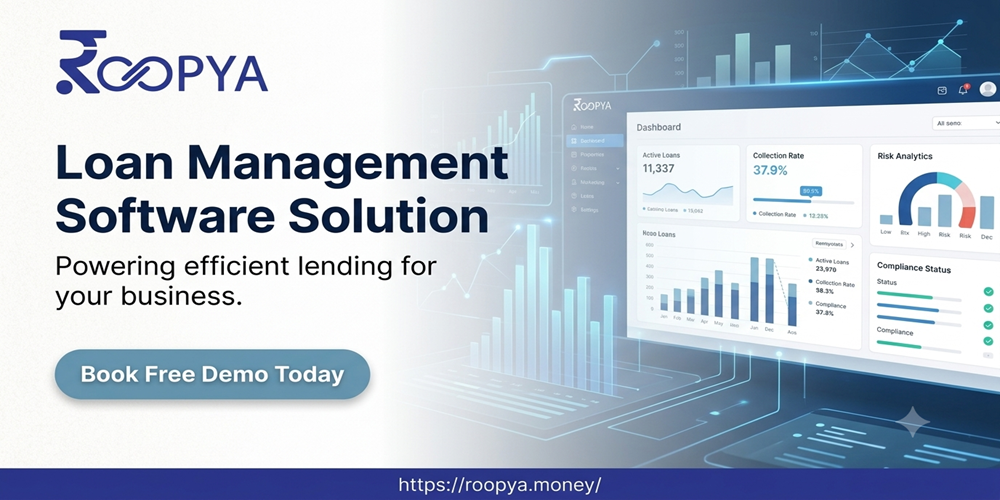
Manage your entire loan portfolio with Roopya's AI-powered Loan Management Software Solution. Automate servicing, collections & compliance. Go live in days.
The lending industry in India is undergoing a fundamental shift. Borrowers expect instant approvals, NBFCs and banks are under pressure to scale loan books without scaling headcount, and regulators continue to tighten compliance requirements around reporting, data privacy, and fair lending practices. Sitting at the center of all this change is one piece of infrastructure that decides whether a lender thrives or struggles: the loan management software solution.
A loan management software solution is no longer a back-office convenience. It is the operational backbone that determines how fast you can disburse, how accurately you can track repayments, how effectively you recover overdue amounts, and how confidently you can demonstrate compliance to auditors and regulators. Lenders still relying on spreadsheets, disconnected tools, or legacy on-premise systems are finding themselves outpaced by digital-first competitors who can onboard a borrower, underwrite a loan, and disburse funds in minutes rather than days.
This guide explains what a loan management software solution actually does, why it matters, what to look for when evaluating one, and how a modern, no-code, AI-first platform like Roopya is built specifically to solve these problems for NBFCs, banks, MFIs, and loan service providers operating in India.
What Is a Loan Management Software Solution?
A loan management software solution is a technology platform that handles the entire post-disbursement lifecycle of a loan — and, in comprehensive platforms, the pre-disbursement journey as well. It covers everything from the moment a loan is sanctioned through to final closure, including EMI scheduling, interest accrual, payment processing, collections, delinquency tracking, customer servicing, and regulatory reporting.
In practice, this means a loan management software solution typically handles:
Loan account creation and amortization scheduling, where the system automatically calculates EMI breakdowns, interest accrual, and principal reduction over the loan tenure. Payment processing and reconciliation, integrating with payment gateways, NACH/eNACH mandates, and UPI Autopay to collect EMIs and reconcile them against the right loan account automatically. Collections and recovery, using automated reminders across SMS, email, and WhatsApp, along with delinquency bucket management for accounts that fall behind. Customer self-service, giving borrowers a portal or app where they can check balances, download statements, request NOCs, and make payments without calling a support line. Regulatory and MIS reporting, generating the reports lenders need to submit to the RBI and other regulatory bodies, including NPA classification, ALM statements, and credit bureau reporting.
Some platforms bundle loan management with loan origination (LOS) and collections into a single unified system — this is increasingly the preferred approach, because it eliminates the data silos and integration headaches that come from stitching together multiple point solutions from different vendors.
Why Lenders Need a Dedicated Loan Management Software Solution
Manual Processes Don’t Scale
When a lender is processing a handful of loans a month, spreadsheets and manual tracking can technically work. But the moment loan volumes grow — which is the goal of every lending business — manual processes break down. EMI calculation errors creep in, payment reconciliation becomes a full-time job, and collections teams lose visibility into who’s overdue and by how much. A loan management software solution automates these calculations and workflows, removing the operational ceiling that manual processes impose.
Compliance Is Becoming More Demanding, Not Less
NBFCs and banks in India operate under continuous regulatory scrutiny from the RBI, covering everything from Fair Practices Code adherence to NPA classification norms, provisioning requirements, and data localization rules. A loan management software solution with built-in regulatory reporting capabilities means compliance reports are generated from real transactional data automatically, rather than being manually compiled — reducing both the effort and the risk of error or omission.
Borrower Expectations Have Changed
Borrowers today compare their lending experience to the apps they use for everything else — instant, mobile-first, and transparent. A modern loan management software solution gives borrowers a self-service portal to track their loan, make payments, and access documents on demand, which directly improves repayment behavior and reduces inbound servicing calls.
Collections Efficiency Directly Impacts Profitability
For any lending business, the difference between a healthy portfolio and a stressed one often comes down to collections discipline. A loan management software solution with automated reminder workflows, bucket-based delinquency management, and agent tracking helps recovery teams prioritize the right accounts and intervene earlier, before a 30-day-past-due account becomes a write-off.
Disconnected Systems Create Risk
Many lenders still run origination on one system, servicing on another, and collections through a third — often connected by manual exports and imports. Every handoff between systems is a point where data can be lost, duplicated, or become inconsistent. A unified loan management software solution that covers the full lifecycle eliminates these handoff risks entirely.
Core Features to Look for in a Loan Management Software Solution
When evaluating a loan management software solution, lenders should look beyond the marketing copy and assess capability across a few critical dimensions.
Loan Servicing and Account Management. The platform should support complete lifecycle tracking from disbursement to closure, accurate EMI scheduling and amortization, handling of prepayments and foreclosures, loan restructuring and top-up loans, and support for co-lending or syndication arrangements if relevant to your business model.
Payment Processing. Look for integration with multiple payment gateways and NACH/eNACH providers, automated payment reconciliation against the correct loan account, support for auto-debit scheduling, and real-time visibility into payment status across the portfolio.
Collections and Delinquency Management. A strong solution will offer automated, multi-channel reminders (SMS, email, WhatsApp), configurable collection buckets based on days-past-due, agent assignment and field visit tracking, and tools for payment promise tracking and settlement negotiation.
Customer Self-Service. Borrowers should be able to log into a dedicated portal to view their loan status, download statements, make payments, raise service requests, and generate documents like NOCs without needing to contact support.
Regulatory and Business Reporting. The platform should generate RBI-mandated reports (NPA, ALM, CRR/SLR where applicable), support audit trails for every transaction, and offer customizable dashboards so management has real-time visibility into portfolio health.
Integration Capabilities. Since a loan management software solution rarely operates in isolation, it should offer pre-built or easy integrations with credit bureaus (CIBIL, Experian, Equifax, CRIF), payment gateways, KYC providers, and accounting systems like Tally or SAP.
Security and Data Privacy. Given the sensitivity of financial and personal data being processed, the platform should meet recognized security standards (such as ISO 27001), encrypt data at rest and in transit, support role-based access control, and align with Indian data protection requirements.
Configurability Without Code. Lending businesses change products, pricing, and policies frequently. A platform that requires a developer to make every change creates friction and delay. No-code configuration for loan products, workflows, and business rules lets your operations team adapt quickly without engineering dependency.
How Roopya’s Loan Management Software Solution Is Different
Roopya was built specifically for the realities NBFCs, banks, MFIs, and loan service providers face in the Indian lending market — not adapted from a generic global platform.
No-Code, Truly Configurable. Roopya lets business teams configure loan products, interest structures, approval workflows, and credit policy rules through a visual interface, with zero coding required. This means changes that would normally take weeks of development time can be made in hours.
AI-First Infrastructure. Roopya embeds AI across the loan lifecycle — from document analysis that extracts and verifies data with high accuracy, to a self-learning business rule engine that identifies patterns in approvals and rejections, to intelligent credit decisioning that evaluates alternative data alongside traditional credit scores. On the collections side, AI-driven strategies help optimize recovery based on borrower behavior rather than one-size-fits-all reminder schedules.
Built for Indian Lending Compliance. Roopya’s reporting capabilities are designed around RBI requirements, including NPA classification, ALM reporting, and credit bureau submissions, helping NBFCs and banks stay compliant without building reporting infrastructure from scratch.
300+ Pre-Integrated APIs. Rather than each integration being a multi-week project, Roopya comes with credit bureaus, KYC providers, payment gateways, and verification services pre-integrated, so lenders can connect what they need without custom development.
Fast Go-Live. Where legacy LMS implementations can take months, Roopya’s onboarding is structured around a days-not-months timeline: account setup, product and workflow configuration, integration setup, testing, and go-live, typically completed within roughly a week, with the platform capable of basic setup in as little as a day.
Pay-As-You-Use Pricing. Instead of large upfront licensing costs, Roopya’s pricing model scales with actual usage, making it accessible for newer NBFCs and loan service providers as well as established lenders scaling their books.
Full Lifecycle Coverage. Beyond loan management, Roopya also offers loan origination, collections, early warning systems, and lending analytics on the same platform — meaning lenders aren’t forced to stitch together multiple vendors and manage fragile integrations between them.
Who Uses a Loan Management Software Solution
A loan management software solution serves a range of lending businesses, each with somewhat different priorities:
NBFCs need robust portfolio management, RBI-compliant reporting, and collections tools that scale as their loan book grows across multiple products and geographies. Banks require enterprise-grade security, integration with core banking systems, and the ability to manage diverse loan categories from retail to SME lending on a single platform. Microfinance institutions (MFIs) benefit from features tailored to small-ticket, high-volume lending, including group loan management and field collection workflows. Loan service providers and fintech lenders often prioritize speed to market, API-driven architecture, and the flexibility to launch new loan products quickly in response to market opportunities.
Across loan categories — personal loans, business and SME loans, gold loans, payday/salary advance loans, home loans, and auto loans — the core need remains the same: a system that tracks every rupee disbursed and collected, accurately and in compliance with regulatory norms.
Implementation: What to Expect
A well-designed loan management software solution shouldn’t require a multi-month implementation project. A modern, no-code platform typically follows a structure like this:
The process begins with account setup and verification, including entity documentation and compliance checks, usually completed within hours. This is followed by configuration of loan products, approval workflows, document checklists, and credit policy rules — work that business teams can largely do themselves on a no-code platform. Integration setup connects the platform to payment gateways, credit bureaus, and KYC providers. Testing and training follow, including end-to-end test loan processing and user acceptance testing. Finally, go-live includes final checks and dedicated support during the initial launch period.
For lenders migrating from an existing system, a phased rollout with parallel run support reduces the risk of business disruption during the transition.
Common Questions About Loan Management Software Solutions
Lenders evaluating a loan management software solution often weigh build-versus-buy decisions, total cost of ownership, and how disruptive a migration will be. The honest answer is that for most NBFCs, banks, and loan service providers, building and maintaining loan servicing infrastructure in-house is rarely cost-effective compared to a purpose-built platform, given the ongoing compliance updates, security requirements, and integration maintenance involved. The better question to ask is not whether to use a dedicated solution, but which one fits your specific loan products, scale, and regulatory obligations.
A loan management software solution is the operational core of any modern lending business. It determines how efficiently you service loans, how effectively you collect on them, how confidently you can demonstrate compliance, and ultimately how profitably you can scale your loan book. As borrower expectations rise and regulatory scrutiny intensifies, lenders that rely on manual processes or fragmented, disconnected systems will find themselves at a structural disadvantage against competitors running on unified, AI-powered, no-code platforms.
Roopya brings loan origination, loan management, collections, early warning, and lending analytics together on a single, configurable platform built for the specific realities of NBFCs, banks, MFIs, and loan service providers in India — with the speed to go live in days and the flexibility to evolve as your lending business grows.
(FAQ)
What is a loan management software solution?
A loan management software solution is a technology platform that manages the full lifecycle of a loan after disbursement, including EMI scheduling, payment processing, collections, delinquency tracking, customer servicing, and regulatory reporting.
Who needs a loan management software solution?
NBFCs, banks, microfinance institutions (MFIs), and loan service providers all need a loan management software solution to efficiently service their loan portfolios, manage collections, and meet regulatory compliance requirements.
How is a Loan Management System (LMS) different from a Loan Origination System (LOS)?
A Loan Origination System (LOS) handles the application, underwriting, and approval process before a loan is disbursed. A Loan Management System (LMS) takes over after disbursement, managing servicing, repayments, collections, and account closure throughout the loan’s life.
How long does it take to implement a loan management software solution?
Implementation timelines vary by vendor and complexity. Traditional legacy systems can take several months, while modern no-code, cloud-native platforms like Roopya can be configured and live within roughly a week, with basic setup possible in as little as a day.
Does a loan management software solution support RBI compliance and regulatory reporting?
A well-built loan management software solution should generate RBI-mandated reports such as NPA classification, ALM statements, and credit bureau submissions automatically from transactional data, reducing manual compliance effort.
Can a loan management software solution integrate with payment gateways and credit bureaus?
Yes. Modern platforms offer pre-built integrations with payment gateways (such as Razorpay, PayU, CCAvenue), NACH/eNACH providers, and credit bureaus (CIBIL, Experian, Equifax, CRIF), allowing lenders to go live faster without custom integration work.
Is coding required to configure a loan management software solution?
With a no-code platform like Roopya, lenders can configure loan products, interest structures, workflows, and business rules through a visual interface without requiring developer involvement.
What does a loan management software solution cost?
Costs vary by vendor and pricing model. Some vendors charge large upfront licensing fees, while others, like Roopya, use a pay-as-you-use model that scales with actual usage, reducing upfront investment for newer or growing lenders.
Can a loan management software solution handle multiple loan products?
Yes, comprehensive platforms support multiple loan categories — including personal loans, business and SME loans, gold loans, payday loans, home loans, and auto loans — each configurable with its own terms, workflows, and documentation requirements.
How does AI improve a loan management software solution?
AI capabilities can improve document verification accuracy and speed, enhance fraud detection, enable smarter credit decisioning using alternative data, and optimize collections strategies based on borrower behavior patterns, rather than relying on uniform manual processes.