hvac contractors rock hill sc
Here’s a hard truth about this industry. The person who sells you the system is often not the person who installs it, and the gap between a great sales pitch and a great install is where most future problems start. You can have the right equipment, the right brand, even the right price, and still end up with a system that never runs the way it should because of how it went in. So how do you actually find someone who installs it right, not just someone who talks a good game?
There’s a Difference Between a Good Salesperson and a Good Installer
Why the Sales Pitch Doesn’t Tell You Much
A confident sales rep can walk you through brochures, SEER ratings, and financing options all day long. None of that tells you whether the crew showing up next week actually knows how to size ductwork correctly or torque a refrigerant line to spec. Charm sells the job. Skill determines whether it works three years from now.
What Actually Happens After You Sign
Once the contract’s signed, ask directly who’s doing the physical install. Is it in-house technicians the company trains and stands behind, or a rotating crew of subcontractors picked up for the week? We’ve seen both, and the difference in workmanship shows up fast once you know what to look for.
The Installation Steps a Good Installer Never Skips
A Real Load Calculation, Not a Guess
A proper install starts with a Manual J load calculation, a formula that factors in your home’s square footage, insulation, windows, and orientation to figure out exactly what size system you need. Skip this step, and you get a system that’s either too big, which short-cycles and never dehumidifies properly, or too small, which runs constantly and never keeps up on the hottest days. If an installer quotes your system size off square footage alone without ever stepping foot in your attic, that’s a shortcut, not a calculation.
Pulling the Permit
Every legitimate HVAC install in South Carolina requires a permit and a follow-up inspection. It’s not just paperwork, it’s a second set of eyes confirming the job meets code. An installer who skips the permit to save time, or worse, save you money, is cutting a corner that protects you, not them.
Checking Static Pressure and Airflow
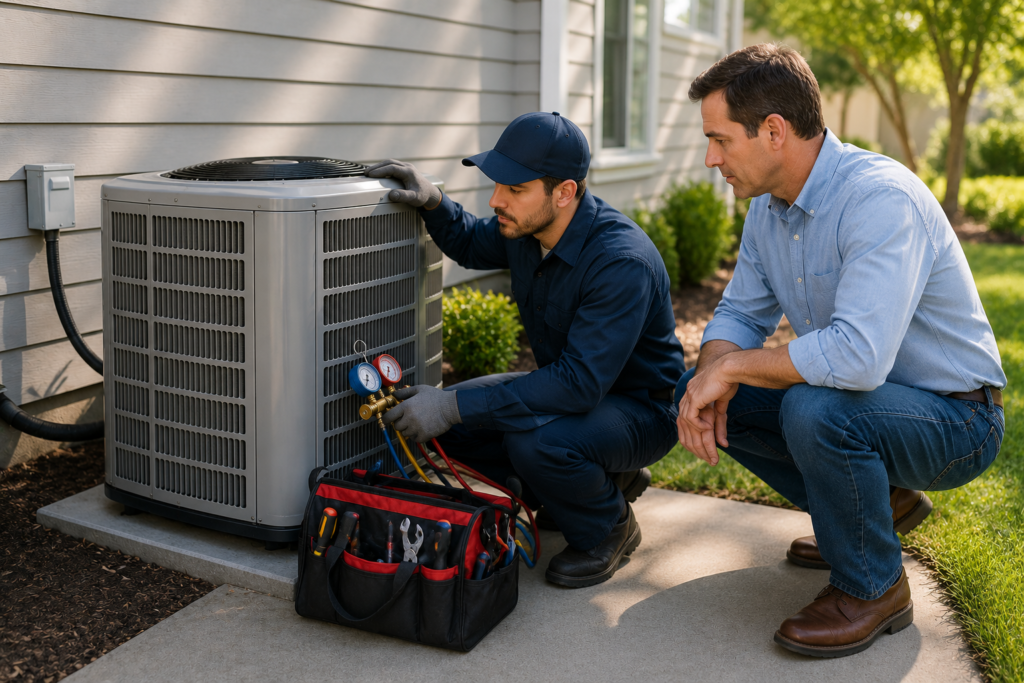
This is the step almost nobody outside the trade has heard of, and it’s one of the biggest indicators of a rushed job. Static pressure testing checks whether your ductwork can actually handle the airflow the new system needs. Skip it, and you can install a brand new, perfectly good unit into ductwork that’s choking its performance from day one. A good installer tests this. A rushed one doesn’t, because it takes extra time they’d rather not spend.
What to Look For on Install Day Itself
How They Treat Your Home
Drop cloths down before carrying equipment through. Boot covers on a hardwood floor. Cleanup that leaves your space looking untouched. It sounds minor, but a crew that respects the small stuff tends to respect the mechanical stuff too. We’ve noticed it holds up as a pretty reliable pattern over the years.
Whether They Explain What They’re Doing
A confident installer isn’t secretive about the process. Ask a question mid-install and you should get a straight answer, not a brush-off. If a technician can’t or won’t explain what they’re doing and why, that’s worth noting.
The Walkthrough Most Installers Skip
Before the crew leaves, you should get a full walkthrough: thermostat programming, filter location and replacement schedule, and what the warranty actually covers in writing. A surprising number of installs end with the crew packing up and driving off without ever explaining any of this. If that happens to you, call the office and ask for it. You’ve earned it.
Signs of a Bad Install You Won’t Notice for Months
Uneven Temperatures Room to Room
If one bedroom runs five degrees warmer than the rest of the house, that’s often a duct sizing or balancing issue from install, not a system defect. It’s one of the most common callbacks we get on other companies’ work.
A System That Runs Constantly
A properly sized, properly installed system cycles on and off in reasonable intervals. One that runs nonstop, even on a mild day, usually points back to something wrong from the start, whether that’s sizing, airflow, or a bad refrigerant charge.
Rising AC Repair Calls After a “New” System
Here’s the frustrating pattern we see more than we’d like. A homeowner gets a new system installed, and within the first year or two, they’re already calling around for AC repair Rock Hill SC because something’s off. A brand new unit shouldn’t need frequent repairs. When it does, the install itself is usually the real culprit, not bad luck.
Questions That Separate Good Installers From Rushed Ones
Ask if they perform a Manual J load calculation on every install. Ask if they test static pressure before and after. Ask who specifically will be in your home and what their certifications are. Ask what the workmanship warranty covers and for how long. A good installer answers all of this without hesitation, because they do it every time anyway. Among HVAC contractors Rock Hill SC homeowners trust for actual installs, these are the details that separate a company doing it right from one just trying to get to the next job.
If you’re comparing installers, our AC installation page outlines exactly what our process includes, load calculations, permits, and static pressure testing among them, so you know what to expect before anyone shows up. For a technical, unbiased breakdown of proper duct sizing and airflow standards, ACCA’s Manual J resource is the industry standard reference most licensed installers are trained against.
Conclusion
Finding a good HVAC installer isn’t about finding the smoothest sales pitch, it’s about finding the crew that still does the boring, unglamorous steps nobody sees: the load calculation, the permit, the static pressure test. Those are the details that decide whether your new system runs quietly and efficiently for the next 15 years or starts generating repair calls within its first summer. Ask the right questions before you sign, watch how the crew treats your home on install day, and don’t let a great sales pitch substitute for a great install. Among HVAC contractors Rock Hill SC has to offer, the ones worth hiring are the ones willing to walk you through every step of that process without flinching.
FAQs
Does a bigger HVAC contractor always mean a better installer?
Not necessarily. Company size doesn’t guarantee the crew on your job follows proper procedure. Ask directly about their install process regardless of how big or small the company is.
How long should a typical HVAC installation take?
Most residential installs take one full day, sometimes closer to a day and a half if ductwork modifications are needed. Anything rushed to a couple of hours for a full system swap is worth questioning.
Is a Manual J load calculation really necessary for every install?
Yes, it should be standard on every job, not just larger or more complex ones. Skipping it is one of the most common reasons systems underperform after installation.
What should I do if my new system isn’t cooling evenly after install?
Call the installer back immediately, since this is typically covered under their workmanship warranty. Uneven cooling shortly after a new install usually points to a sizing or balancing issue from the job itself.
Should I be present during the entire installation?
You don’t have to be, but being available for the walkthrough at the end is worth prioritizing. That’s when you learn how to actually run and maintain the system you just paid for.