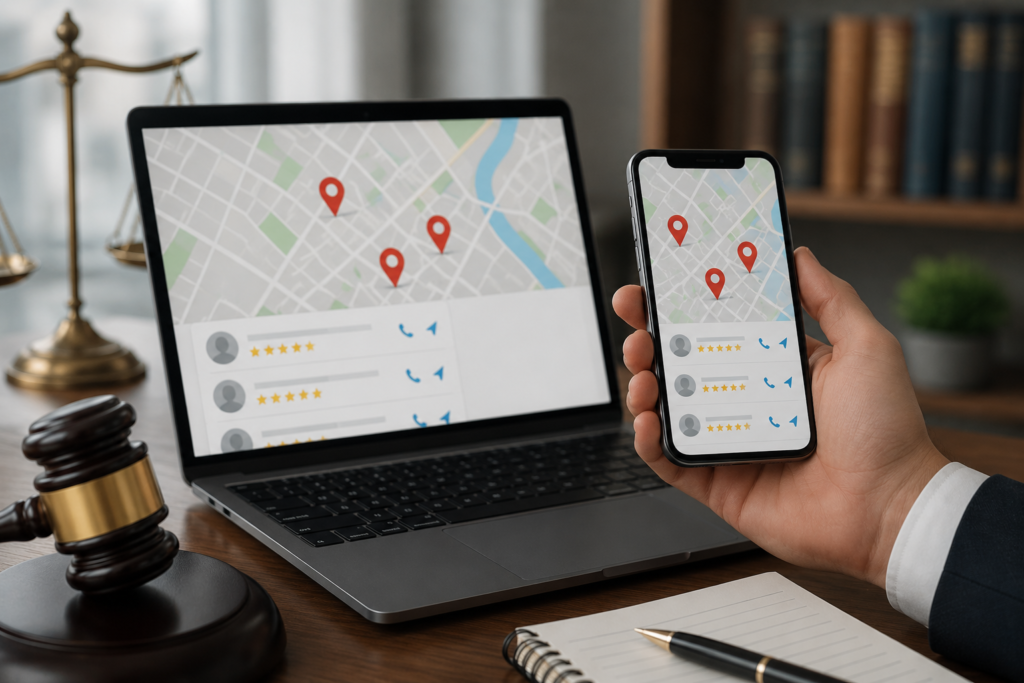
Ask ten attorneys where their best cases come from and at least seven will say referrals. Ask where their next decade of cases will come from and the honest answer is a map. When someone in your city needs a lawyer today, the search happens on a phone, the results open with a map and three firm names, and for a huge share of searchers the decision never goes any further than that.
That little box of three listings is the most valuable real estate in legal marketing. Here is how to earn your place in it and turn it into signed cases.
The Map Pack Is Where Cases Are Won
For searches like divorce lawyer near me or criminal defense attorney plus a city name, the local pack sits above almost everything else and absorbs a huge portion of the clicks and calls. Google ranks those listings on three pillars: proximity, relevance, and prominence. You cannot move your office closer to every searcher, so the battle is fought on the other two.
Relevance means your profile and website clearly describe what you do and where you do it. Prominence means the wider web agrees that your firm matters, through reviews, mentions, links, and brand searches. Everything in this playbook feeds one of those two pillars. A structured approach to SEO for law firms treats the map pack as a primary acquisition channel with its own strategy, not an afterthought bolted onto a website project.
There is a second reason the pack matters: behavior. Mobile searchers tap to call directly from the listing, which means a well built profile can win the case before your website ever loads. Every element of your presence should assume the first interaction happens inside the search results, not on your homepage.
Treat Your Google Business Profile Like a Landing Page
Most firms claim their profile, fill in the basics, and never touch it again. That is like printing business cards and leaving them in a drawer. Your profile is often the first and only impression a potential client gets, so treat it like a landing page that has to convert.
Start with the primary category, because it carries real ranking weight. Personal Injury Attorney will outperform a generic Lawyer category for injury searches. Add every relevant secondary category, complete the services list with the actual case types you want, and write a description in plain language that a stressed person can understand. Then feed the profile continuously: real photos of your office and team, updates about results and community involvement, and answers to the questions people ask before they call. Profiles that look alive get chosen. Profiles that look abandoned get skipped.
Two details punch above their weight. First, the questions and answers feature, which you should seed yourself with the practical things clients ask before calling: consultation fees, parking, languages spoken, typical response time. Second, attributes and service descriptions, which feed the justifications Google displays under your listing when it matches a search. Small fields, real influence.
Reviews Are a Ranking Factor and a Closing Tool
Nothing moves the needle in local search like a steady flow of detailed reviews. Notice the word steady. Fifty reviews collected in one enthusiastic month followed by silence looks worse to both Google and prospects than four fresh reviews arriving every month for years. Build the ask into your process: when a case closes well, the request goes out that day, with a direct link that removes every ounce of friction.
Reviews that mention your practice area and city are small relevance gold mines, so encourage clients to describe what you helped them with in their own words. Then reply to every single review. Thank the happy ones briefly. Address the unhappy ones with calm professionalism, and never confirm that any reviewer was actually a client, because confidentiality rules still apply in public. A composed reply to an unfair review often wins more trust than another five star rating.
Location Pages That Help Instead of Hurt
If your firm has real offices in multiple cities, each office deserves its own dedicated page with its address, directions, parking notes, the courts you appear in, the attorneys based there, and results from that area. Pages like that rank because they deserve to. They give a local searcher genuinely local information. For a working example of the format, look at how specialists structure a page around SEO for lawyers in New York City: one real market, one deep page, local specifics throughout.
The trap is the other kind of location page. Spinning out dozens of thin pages for every suburb where you have no office, each one a copy of the last with the city name swapped, is the classic doorway page pattern that Google’s spam policies have targeted for years. If you serve a wider region from one office, say so honestly on your service pages and let your reviews and content carry the argument. One strong page beats twenty hollow ones.
Citations and the Boring Work That Still Counts
Consistency across the web quietly supports everything above. Your firm name, address, and phone number should match exactly on your website, your profile, the major data platforms, your state bar listing, and the established legal directories. Conflicting details erode the confidence search engines place in your firm as an entity, and cleaning them up is cheap compared to the visibility they protect. This is unglamorous work you do once and then audit twice a year, and it belongs in every serious local campaign.
AI Search Changed the Game. Here Is What Still Works.
AI Overviews and chat assistants now answer many informational legal questions directly, which has thinned out clicks on generic advice content. Panic makes for bad strategy though, because the searches that actually produce clients, the ones where a person is choosing a lawyer nearby, still resolve through maps, profiles, reviews, and websites. Commercial local intent remains yours to win.
What changes is the weight of your brand. AI systems recommend firms that the web talks about: consistent name and contact details everywhere, strong review profiles, mentions in local news and legal directories, and clear practice descriptions on your site. The firms treated as recognizable entities get named in AI answers. The anonymous ones vanish. Local SEO and brand building have officially become the same job.
Frequently Asked Questions
How many reviews does a law firm need to compete locally?
There is no universal number. Look at the top three firms in the map pack for your main search and aim to match their count and beat their recency. Consistent monthly reviews outperform occasional bursts.
Do Google Business Profile posts actually help rankings?
Their direct ranking effect is modest, but they keep the profile active, push fresh proof in front of prospects, and improve conversion. Ten minutes a week is a worthwhile trade.
Can I use a virtual office to rank in another city?
It violates Google’s guidelines for representing your business and profiles built on virtual addresses get suspended regularly. Losing a profile full of reviews costs far more than the shortcut ever earned. Build presence honestly.
Should I list my firm in every directory I can find?
Focus on quality instead of quantity. Established legal directories, your state bar listing, and the major data platforms matter. Hundreds of junk citations no longer move rankings and only create cleanup work.
How fast does local SEO work compared to traditional SEO?
Often faster. Profile optimization and review velocity can shift map pack visibility within weeks, while competitive organic rankings usually take several months of sustained content and authority building.