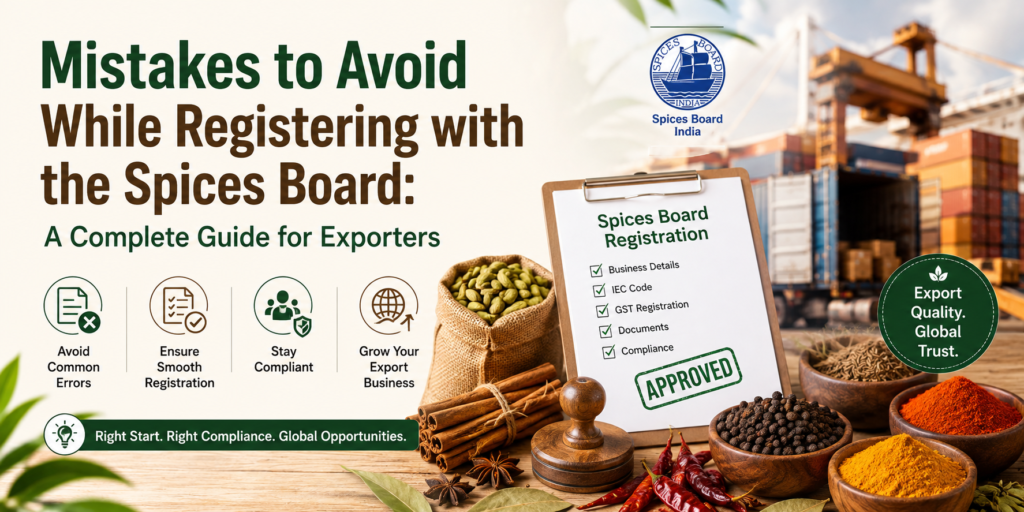
If you’re planning to export Indian spices, registering with the Spices Board of India is one of the first and most important steps. However, many businesses unknowingly make mistakes during the registration process, leading to delays, rejections, or compliance issues later.
Whether you’re a startup, manufacturer, merchant exporter, or spice processor, understanding these common mistakes can save both time and money.
At ChennaiAccounts, we’ve helped businesses simplify registrations, licensing, taxation, and compliance. If you’re planning to begin your export journey, this guide will help you avoid costly errors while ensuring your application moves smoothly.
Why Spices Board Registration Matters?
The Spices Board of India regulates and promotes spice exports from India. Registration is mandatory for exporters dealing with scheduled spices and spice products.
Benefits include:
- Legal authorization to export spices
- Access to export promotion schemes
- International market credibility
- Government support for exporters
- Easier participation in trade fairs and buyer-seller meets
However, getting registered isn’t difficult—provided you avoid the common mistakes discussed below.
Top Mistakes to Avoid While Registering with the Spices Board
1. Registering Before Completing Basic Business Compliance
One of the biggest mistakes is applying for Spices Board registration before completing mandatory business registrations.
Before applying, ensure you have:
- Business registration
- PAN
- GST Registration
- Import Export Code (IEC)
- Bank account in business name
Many businesses rush into the process and later face application rejection due to missing documentation.
Expert Tip: Create a compliance checklist before starting your application.
2. Using Incorrect Business Information
The details entered in your application should exactly match the information available in your:
- GST Registration
- IEC Certificate
- PAN
- Business Registration
Even minor spelling differences can create unnecessary delays.
Common examples include:
| Incorrect Practice | Correct Practice |
|---|---|
| Different business names | Use the exact legal business name |
| Old address | Update all registrations first |
| Wrong email ID | Use active business email |
| Incorrect phone number | Provide permanent contact number |
Consistency is critical for approval.
3. Uploading Poor-Quality Documents
Many applications remain pending because uploaded documents are:
- Blurry
- Cropped
- Password protected
- Expired
- In unsupported formats
Before uploading:
- Scan documents clearly
- Verify every page
- Keep file sizes within limits
- Check document validity
This simple step avoids unnecessary back-and-forth communication.
4. Ignoring Product Classification
Every exporter should verify whether their products fall under the Spices Board’s regulated category.
Some businesses assume all food products qualify.
In reality:
- Whole spices
- Ground spices
- Spice oils
- Oleoresins
- Certain processed spice products
may require registration.
Always verify product eligibility before applying.
5. Forgetting Food Safety Compliance
Many exporters focus only on export registration while ignoring food safety compliance.
If you’re dealing with edible spice products, obtaining an FSSAI licence is equally important.
Many businesses search for Fssai license apply online services only after their export process begins, causing unnecessary delays.
It’s always better to complete food licensing before starting export documentation.
Registration Checklist
| Requirement | Mandatory |
|---|---|
| Business Registration | ✔ Yes |
| PAN | ✔ Yes |
| GST Registration | ✔ Yes |
| Import Export Code | ✔ Yes |
| Bank Details | ✔ Yes |
| Identity Documents | ✔ Yes |
| Address Proof | ✔ Yes |
| Supporting Business Documents | ✔ Yes |
Preparing these documents in advance significantly speeds up approval.
6. Waiting Until the Last Minute
Many businesses receive export inquiries and then begin registrations.
Unfortunately, registrations require verification and approvals.
Instead:
- Register early
- Keep documents updated
- Renew licenses before expiry
- Maintain compliance records
Being proactive helps you respond quickly to international buyers.
7. Ignoring GST and Tax Compliance
Export businesses often assume exports are GST-free and therefore ignore tax compliance.
In reality, exporters still have several GST obligations, including:
- Return filing
- Documentation
- Input Tax Credit compliance
- Export invoices
- LUT where applicable
Working with an experienced Accounting Firm In Chennai helps businesses avoid tax-related complications while focusing on exports.
8. Not Seeking Professional Guidance
Trying to manage every registration independently may appear cost-effective initially.
However, errors can result in:
- Application rejection
- Additional government fees
- Lost export opportunities
- Compliance notices
Professional consultants ensure:
- Correct documentation
- Timely filing
- Compliance updates
- Faster approvals
This saves valuable business time.
9. Ignoring Annual Compliance
Registration is only the beginning.
Businesses should also monitor:
- GST filings
- Income tax returns
- IEC validity
- Business updates
- License renewals
Compliance is an ongoing responsibility—not a one-time task.
10. Missing Recent Government Updates
Export regulations continue to evolve with:
- Digital application systems
- Updated documentation requirements
- Export promotion schemes
- Food safety standards
- Customs procedures
Businesses that stay updated avoid last-minute surprises during exports.
Keeping track of official notifications ensures uninterrupted export operations.
Quick Comparison: Correct vs Incorrect Approach
| Wrong Approach | Better Approach |
|---|---|
| Apply without documents | Prepare complete documentation |
| Ignore GST compliance | File returns regularly |
| Delay FSSAI registration | Complete food licensing early |
| Use inconsistent business details | Maintain identical records |
| Wait for export order | Register in advance |
| Handle everything alone | Consult compliance experts |
How ChennaiAccounts Simplifies the Process?
Export documentation involves much more than submitting an application.
At ChennaiAccounts, we help businesses with:
- Spices Board Registration
- GST Registration
- Import Export Code (IEC)
- Business Registration
- Tax Compliance
- Annual Filings
- Digital Signature Certificate (DSC)
- Company Compliance Support
Our experienced professionals ensure every registration is completed accurately while minimizing delays and compliance risks.
Whether you’re a first-time exporter or an established business expanding into international markets, our team provides end-to-end assistance tailored to your needs.
Expert Tips Before Applying
✅ Verify all business information.
✅ Keep digital copies of every document.
✅ Complete GST registration first.
✅ Finish food licensing if exporting edible products.
✅ Maintain updated compliance records.
✅ Track application status regularly.
✅ Seek professional advice for complex cases.
Following these simple practices can make your registration process significantly smoother.
Frequently Asked Questions (FAQs)
1. Is Spices Board registration mandatory for spice exporters?
Yes. Businesses exporting scheduled spices generally require registration with the Spices Board of India before commencing exports.
2. Can I register without GST?
In most cases, GST registration is an important business compliance requirement and should be completed before applying.
3. Do spice exporters also need FSSAI registration?
Yes, if you’re exporting edible spice products, obtaining the necessary food safety licence is generally required. Many businesses prefer to Fssai license apply online before initiating export activities.
4. How long does the registration process take?
The timeline depends on document accuracy, verification, and application completeness. Proper documentation helps avoid delays.
5. Why should I work with an Accounting Firm In Chennai?
An experienced Accounting Firm In Chennai can assist with registrations, GST compliance, tax filings, export documentation, and ongoing statutory requirements, reducing the chances of errors and ensuring smooth business operations.
Final Thoughts
Registering with the Spices Board is an important milestone for businesses looking to enter the global spice market. While the process is straightforward, avoidable mistakes—such as incorrect documentation, inconsistent business details, delayed compliance, or overlooking food safety requirements—can slow down your export plans.
By preparing the right documents, staying compliant, and seeking expert guidance when needed, you can complete the registration process efficiently and focus on growing your export business.
If you’re looking for reliable support with registrations, taxation, licensing, and export compliance, ChennaiAccounts offers comprehensive solutions designed to help your business stay compliant and export-ready from day one.