Cultivating the Future: Why is the United States Hydroponics Market Expanding So Rapidly?
The American agricultural landscape is shifting from traditional soil-based fields to high-tech, indoor controlled environments. As climate volatility, water scarcity, and the demand for year-round fresh produce collide, the United States hydroponics sector has emerged as a cornerstone of modern food security. By decoupling crop production from geography and seasons, hydroponic farming is proving that we can feed a growing population with significantly fewer resources.
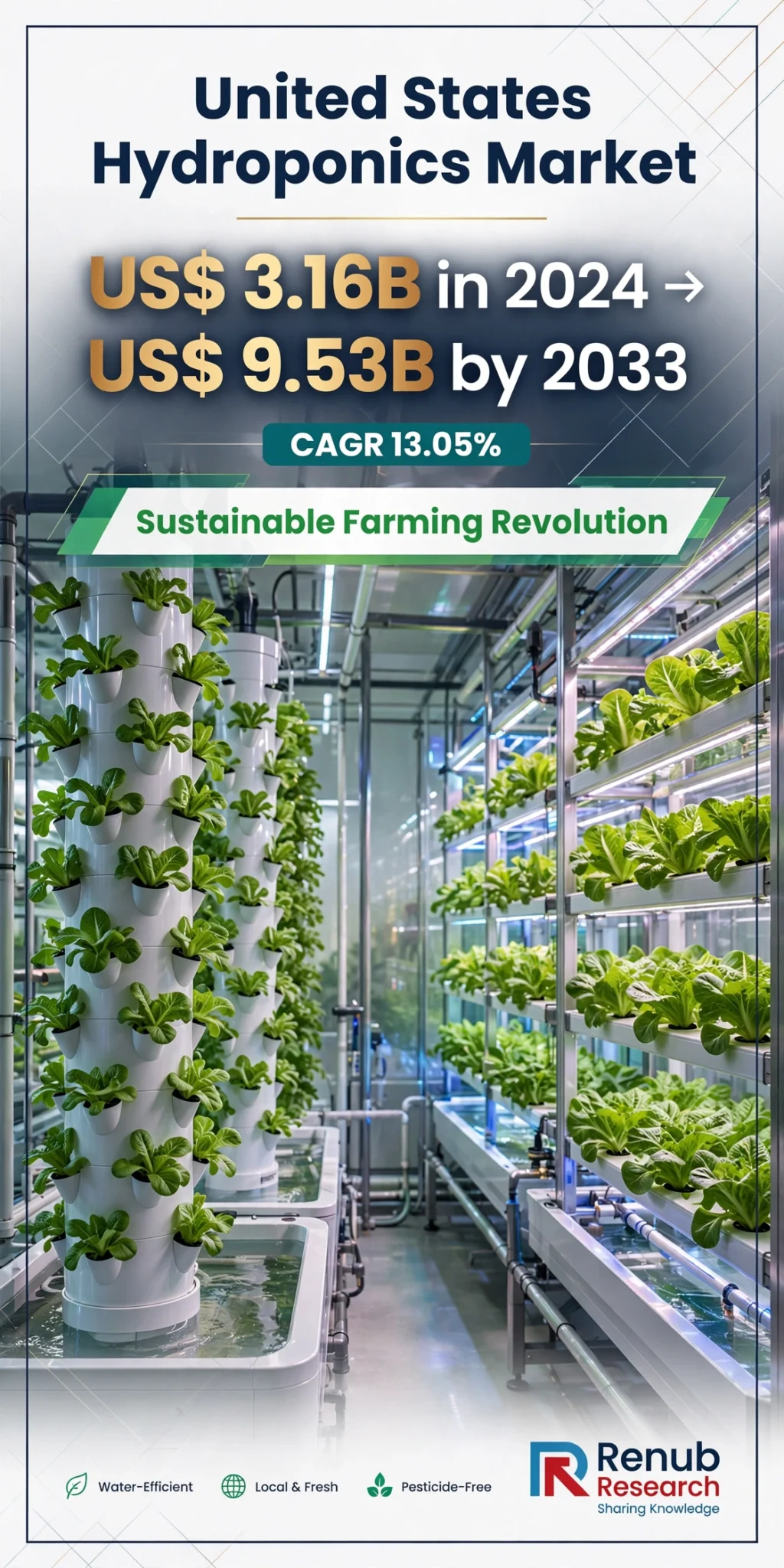
According to the latest industry analysis, the United States Hydroponics Market is projected to increase from US$ 3.16 Billion in 2025 to US$ 6.34 Billion by 2034. This represents a healthy Compound Annual Growth Rate (CAGR) of 8.05% during the 2026–2034 forecast period. This growth is underpinned by a national transition toward sustainable, localized food systems and the rapid integration of artificial intelligence in commercial farming.
What is Hydroponic Agriculture?
At its core, hydroponics is the science of growing plants in a nutrient-rich, water-based solution rather than soil. By utilizing inert growing media—such as coco coir, perlite, or rock wool—to support root structures, farmers can precisely control the delivery of oxygen, water, and essential minerals.
Because plants no longer need to expend energy searching for nutrients in the ground, they grow faster, larger, and with greater consistency. Whether deployed in massive vertical warehouses or residential “smart garden” kits, hydroponics allows for the cultivation of high-value crops like lettuce, tomatoes, and herbs in environments where traditional soil farming would be impossible or inefficient.
Download Free Sample Report: https://www.renub.com/request-sample-page.php?gturl=united-states-hydroponic-market-p.php
Primary Drivers of Market Growth
The rapid adoption of hydroponics in the U.S. is not a trend, but a calculated response to pressing environmental and economic challenges.
1. The Imperative for Resource Efficiency
Conventional agriculture consumes approximately 70% of global freshwater withdrawals. In contrast, hydroponic systems utilize recirculating water technology, consuming up to 75% less water than soil-based farming. As drought conditions intensify in states like California and Texas, federal and state-level investments—such as the billions allocated under the U.S. Department of Agriculture’s conservation programs—are funneling capital into technologies that maximize “crop-per-drop.”
2. Urbanization and the “Local Food” Movement
As the U.S. population continues to concentrate in urban centers, the logistical cost and carbon footprint of transporting produce thousands of miles have become significant concerns. Hydroponics bridges this “food mile” gap. By converting urban rooftops, abandoned warehouses, and vertical shipping containers into productive farms, cities can produce fresh greens within minutes of the consumer. This freshness increases shelf-life, reduces food waste, and meets the rising consumer demand for locally sourced, pesticide-free produce.
3. Technological Synergy: AI and Automation
The current “AgTech” boom has turned the hydroponic farm into a data-driven laboratory. Modern facilities now integrate:
-
Automated Sensors: Real-time monitoring of pH, EC (electrical conductivity), humidity, and temperature.
-
Precision LED Lighting: Spectrum-specific lighting that simulates ideal sunlight conditions, enabling 365-day harvesting regardless of external weather.
-
AI Analytics: Predictive software that optimizes nutrient dosing based on plant growth stages, significantly reducing manual labor costs and human error.
Key Market Challenges
Despite the sector’s promise, commercial scaling faces hurdles that require innovative solutions.
-
Capital Intensity: The barrier to entry for professional-grade hydroponics is high. Specialized HVAC systems, automated lighting, and nutrient delivery setups require significant upfront investment compared to traditional farmland.
-
Technical Skill Gaps: Hydroponics is an unforgiving science. A minor imbalance in nutrient solution or a localized failure in climate control can jeopardize an entire crop cycle within hours. There is a persistent need for specialized labor trained in biological system management and digital farm maintenance.
Regional Hotspots for Hydroponic Innovation
The U.S. market is not growing uniformly; it is clustering in regions that face specific environmental stressors or possess high urban demand.
-
California: As the nation’s largest producer, California leverages hydroponics to mitigate drought risks. Home to a dense concentration of Agri-Tech startups, the state leads in research and development for automated vertical farming.
-
Texas: Characterized by extreme heat and water volatility, Texas has embraced controlled-environment agriculture (CEA) to ensure a stable supply of leafy greens and tomatoes for its rapidly expanding metropolitan populations.
-
New York: Due to high land costs and a dense urban consumer base, New York is the epicenter for vertical farming. Rooftop and warehouse farms here are pioneers in shortening the supply chain from “farm-to-fork.”
-
Florida: Florida utilizes greenhouse-based hydroponics to protect crops from its unique climate challenges, including high humidity and hurricane-related crop damage, ensuring year-round supply for the hospitality and tourism sectors.
Segment Insights: What are We Growing?
The U.S. market is heavily skewed toward high-turnover crops that benefit most from controlled environments:
-
Tomatoes & Cucumbers: These staples represent the largest share of greenhouse-grown produce, favored by retailers for their consistent quality and year-round availability.
-
Leafy Greens & Herbs: Basil, mint, lettuce, and microgreens are the “bread and butter” of the vertical farming industry due to their rapid growth cycles and high profit margins in urban markets.
Competitive Landscape & Recent Innovations
The market is characterized by a mix of established industrial players and agile startups. Recent developments highlight a shift toward consumer accessibility and sustainability:
-
Plantaform (2025): Launched the first smart indoor garden using fog-based (aeroponic) technology, winning prestigious innovation awards and signaling a move toward “home-scale” professional farming.
-
Plenty Unlimited & Albertsons (2023): A major distribution partnership that brought indoor-grown, pesticide-free greens to over 2,000 grocery stores, demonstrating the shift from niche health-food status to mass-market retail.
-
Sustainability Pledges: Companies like BrightFarms are actively moving toward “Net Zero” greenhouse operations, using renewable energy and closed-loop water systems to satisfy the ESG (Environmental, Social, and Governance) requirements of major retailers.
The Future Outlook (2026–2034)
The next decade will see hydroponics move beyond simple cultivation into “predictive agriculture.” We anticipate the emergence of modular, plug-and-play farming units that allow restaurants, schools, and even apartment complexes to manage their own small-scale food production. As energy costs drop due to more efficient LED technology and localized solar integration, the economic viability of indoor farming will surpass traditional soil-based methods for an increasing variety of crops.
Frequently Asked Questions (FAQs)
1. Is hydroponic produce healthier than soil-grown produce? Nutritionally, they are comparable. However, hydroponic produce is often “cleaner” because it is grown in a controlled, sterile environment, significantly reducing the risk of soil-borne pathogens and the need for synthetic pesticides.
2. Why is hydroponics considered “sustainable” if it uses electricity? While indoor lighting requires electricity, the net water savings (up to 95% in some systems) and the elimination of long-haul transportation (food miles) significantly reduce the overall environmental footprint compared to traditional industrial agriculture.
3. What are the most common crops grown hydroponically in the U.S.? Leafy greens (lettuce, spinach, kale), herbs (basil, cilantro, mint), tomatoes, cucumbers, and peppers are the most common due to their high demand and suitability for controlled nutrient delivery.
4. Can I start a hydroponic farm at home? Yes. The market for “DIY Hydroponic Kits” is growing rapidly. Beginners often start with Deep Water Culture (DWC) or Kratky methods, which are low-cost and easy to manage for small-scale herb or lettuce production.
5. What is the biggest cost factor in operating a hydroponic farm? Energy consumption for climate control (HVAC) and lighting is typically the largest operational expense. Many commercial farms are now offsetting this by installing solar panels and using high-efficiency LED arrays.
6. Does hydroponics replace traditional farming? No, it complements it. Hydroponics is ideal for high-value, perishable crops near urban centers, while traditional soil farming remains more efficient for calorie-dense, long-storage crops like grains, corn, and soy.
7. How do hydroponic systems handle plant nutrients? Nutrients are dissolved into the irrigation water as a precise mineral solution. Automated sensors monitor these levels 24/7, ensuring plants receive exactly what they need at every stage of growth without chemical runoff into the environment.