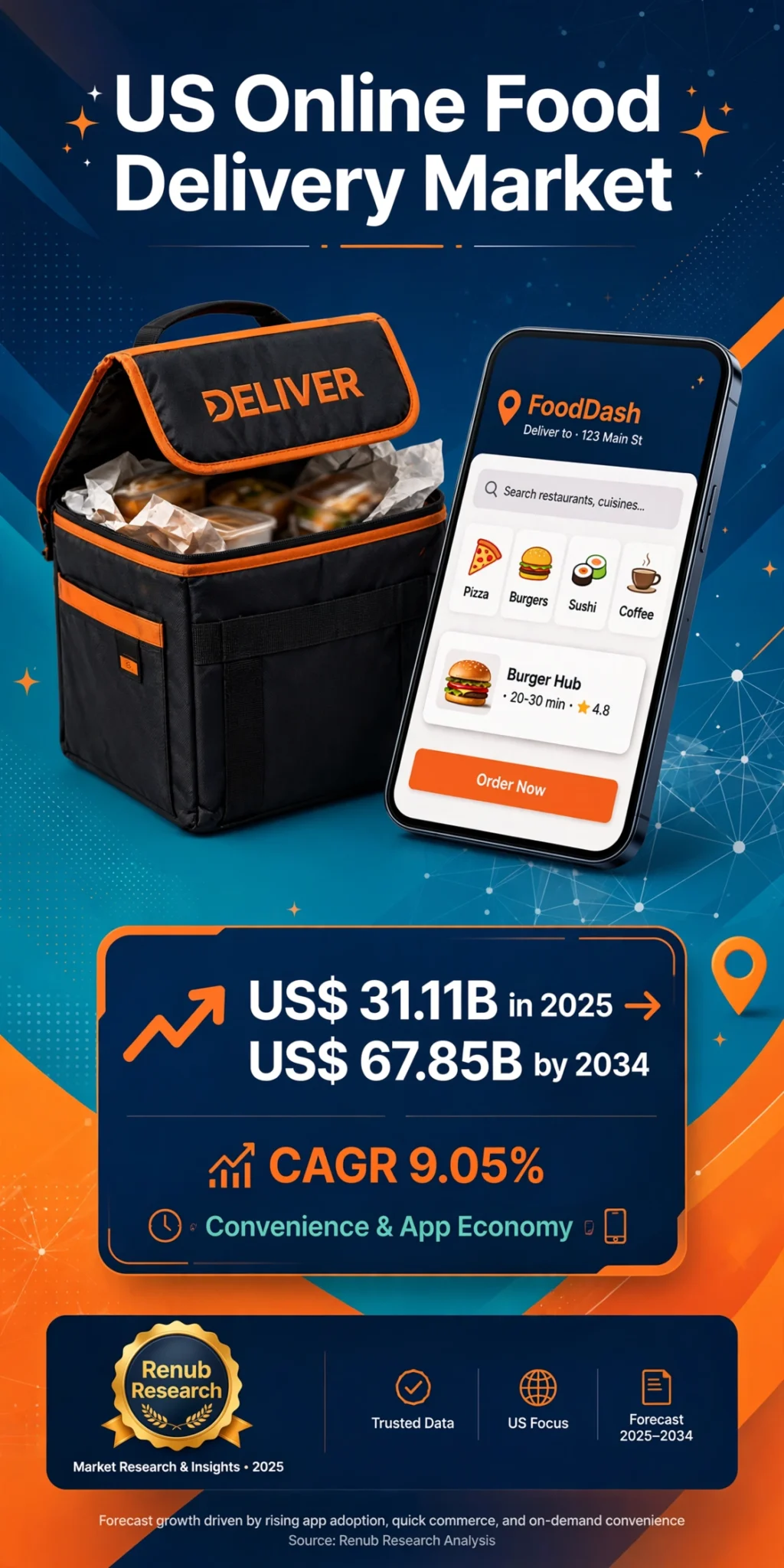
The landscape of American dining has undergone a permanent digital transformation. No longer just a luxury for busy weekends, ordering food via smartphone has become a cornerstone of the modern U.S. lifestyle. As technology integrates deeper into our daily routines, the industry is poised for massive expansion. According to recent data from Renub Research, the United States Online Food Delivery Market is projected to grow from US$ 31.11 Billion in 2025 to US$ 67.85 Billion by 2034, expanding at a robust compound annual growth rate (CAGR) of 9.05%.
This article explores the driving forces behind this growth, the technological innovations reshaping the sector, and the regional dynamics defining the future of food logistics in America.
Understanding the Online Food Delivery Ecosystem
Online food delivery is a sophisticated digital supply chain that connects consumers, third-party aggregators, and restaurant operators. By leveraging specialized mobile applications and web platforms, consumers can browse diverse menus, customize orders, execute secure cashless payments, and track their meals in real-time until they reach their doorstep.
The market has evolved from simple takeout services to a complex ecosystem involving Platform-to-Customer models (e.g., DoorDash, Uber Eats) and Restaurant-to-Customer models (e.g., Domino’s proprietary delivery). This shift is fueled by a societal move toward “on-demand” living, where time-pressed professionals and tech-savvy households prioritize convenience above traditional cooking methods.
Key Growth Drivers: Why is the Market Expanding?
1. The Primacy of Consumer Convenience
Convenience is the primary currency of the 21st-century economy. In August 2024, polling data revealed that 77% of U.S. consumers identified convenience—defined by speed, ease of access, and availability—as the most critical factor in their purchasing decisions. With the rise of dual-income households and the high cost of urban living, many Americans view food delivery as a necessary time-saving tool rather than a luxury. The ability to access international cuisines and local favorites from a single interface has effectively lowered the barrier to entry for diverse dining experiences.
2. Digital Infrastructure and AI Integration
Technology is the engine driving market efficiency. Modern delivery platforms now utilize Artificial Intelligence (AI) and Machine Learning (ML) to provide hyper-personalized experiences. These features include:
-
Predictive Ordering: Suggesting meals based on a user’s historical preferences and ordering patterns.
-
Logistics Optimization: AI-driven routing algorithms that minimize delivery times and fuel consumption by accounting for real-time traffic data.
-
Voice-Based Search: Enhancing accessibility for users who prefer hands-free ordering.
Strategic partnerships continue to solidify this digital bridge. For instance, the May 2024 partnership between Uber Eats and Instacart allows millions of users to order restaurant meals directly through the Instacart app, drastically expanding the geographic and demographic reach of food delivery services.
3. The Rise of Cloud Kitchens
The traditional restaurant model is being complemented—and sometimes replaced—by “Cloud Kitchens” (or Ghost Kitchens). These facilities operate exclusively for delivery, removing the overhead costs associated with front-of-house dining areas. By partnering with third-party delivery apps, cloud kitchens can focus entirely on volume and speed, allowing them to experiment with new menu concepts at a fraction of the risk associated with opening a physical storefront.
In April 2026, Block, Inc. and Uber Technologies announced a strategic alliance to integrate Uber Eats with Square and Cash App Pay. This move streamlines operations for thousands of small-to-medium restaurants, allowing them to process orders and payments with seamless efficiency.
Challenges Facing the Industry
Despite explosive growth, the industry faces significant hurdles that threaten profit margins and service reliability:
-
High Operational Costs: Logistics, customer acquisition, and marketing spend are massive capital sinks. Balancing aggressive discounts—meant to hook new users—with sustainable profitability remains a constant tug-of-war for major platforms.
-
Food Quality Control: Maintaining temperature and presentation during transit is difficult. Factors such as traffic congestion and extreme weather can lead to delays, directly impacting customer satisfaction.
-
Commission Structures: The fees charged by aggregators to local restaurants remain a point of contention. Finding a model that keeps platforms profitable while keeping restaurant partners happy is essential for long-term industry stability.
Market Segmentation: How Americans Order Food
Platform-to-Customer vs. Restaurant-to-Customer
The Platform-to-Customer segment dominates the market by offering variety and aggregation. Users prefer these platforms (like DoorDash or Grubhub) because they consolidate dozens of restaurant options into one interface. Conversely, the Restaurant-to-Customer model remains strong for large pizza and fast-food chains that maintain their own delivery fleets to control the end-to-end customer experience and avoid third-party commission fees.
Web vs. Mobile App Dominance
While websites serve as a reliable portal for desktop users and bulk orders, Mobile Applications have emerged as the undisputed leader of the sector. The intuitive nature of smartphone apps, combined with push notifications, loyalty rewards, and GPS tracking, keeps users highly engaged. The widespread availability of affordable smartphones and high-speed mobile internet has made apps the primary gateway for food delivery in the United States.
The Evolution of Payments
The transition to cashless transactions has been a major tailwind for the industry. Integration with digital wallets (Apple Pay, Google Pay), stored credit cards, and instant peer-to-peer payment systems ensures that checkout is friction-free. Security protocols and payment gateway integration have fostered high levels of consumer trust, leading to repeat purchase behavior.
Regional Hotspots: Key U.S. Markets
The U.S. market is not monolithic; specific urban centers are setting the pace for adoption:
-
New York City: Driven by a fast-paced lifestyle and extreme population density, NYC is the most competitive delivery market in the nation. The demand for everything from late-night street food to high-end international cuisine is constant.
-
Los Angeles: The sprawling nature of LA makes delivery a necessity for many. The market shows a high preference for health-conscious, organic options and diverse ethnic cuisines.
-
San Diego: With a large student and youth population, San Diego has seen a rapid uptake in app-based ordering, heavily influenced by the city’s culture of wellness and sustainable dining.
-
Jacksonville: Representing the steady growth of secondary metropolitan markets, Jacksonville is witnessing increased demand as families and professionals embrace the convenience of suburban food delivery.
Key Players Shaping the Future
The market is characterized by intense competition among several dominant entities, each employing unique ecosystem strategies to retain market share:
-
DoorDash: Leads in U.S. market share with a focus on extensive local partnerships.
-
Uber Eats: Leverages its massive ride-sharing network and global brand to provide seamless cross-platform utility.
-
Grubhub: A long-standing player known for its deep integration with local restaurant networks.
-
Domino’s Pizza: The gold standard for the “Restaurant-to-Customer” model, emphasizing technological innovation in their own delivery infrastructure.
-
HelloFresh & Blue Apron: Catering to the meal-kit niche, providing an alternative to traditional takeout by delivering pre-portioned ingredients.
Frequently Asked Questions (FAQs)
1. How fast is the U.S. online food delivery market growing? The market is expected to grow from US$ 31.11 Billion in 2025 to US$ 67.85 Billion by 2034, maintaining a healthy CAGR of 9.05% during the forecast period.
2. What is the primary driver of the online food delivery market? The primary driver is the rising consumer demand for convenience, supported by smartphone penetration, digital payment adoption, and the widespread availability of diverse restaurant options.
3. Are mobile apps more popular than websites for ordering food? Yes, mobile applications are the dominant platform due to features like real-time GPS tracking, push notifications, personalized AI recommendations, and seamless one-tap payment options.
4. What are “Cloud Kitchens,” and why are they important? Cloud kitchens (or ghost kitchens) are delivery-only cooking facilities that lack a physical storefront. They reduce overhead costs for operators and allow for faster, more efficient delivery of specialized food items.
5. Which U.S. cities are the most active in online food delivery? Major metropolitan hubs like New York City, Los Angeles, and San Diego lead in adoption, though growth is accelerating rapidly across all major U.S. states, including Texas, Florida, and Illinois.
6. How do delivery platforms ensure food quality? Platforms utilize specialized insulated packaging, optimized delivery algorithms to reduce travel time, and customer feedback systems (ratings and reviews) to hold restaurants and couriers accountable.
7. What is the impact of the “Block and Uber” alliance? The strategic alliance between Block (Square) and Uber Technologies simplifies operations by integrating payment and ordering systems, allowing restaurants to manage digital orders more effectively while providing users with better payment flexibility.