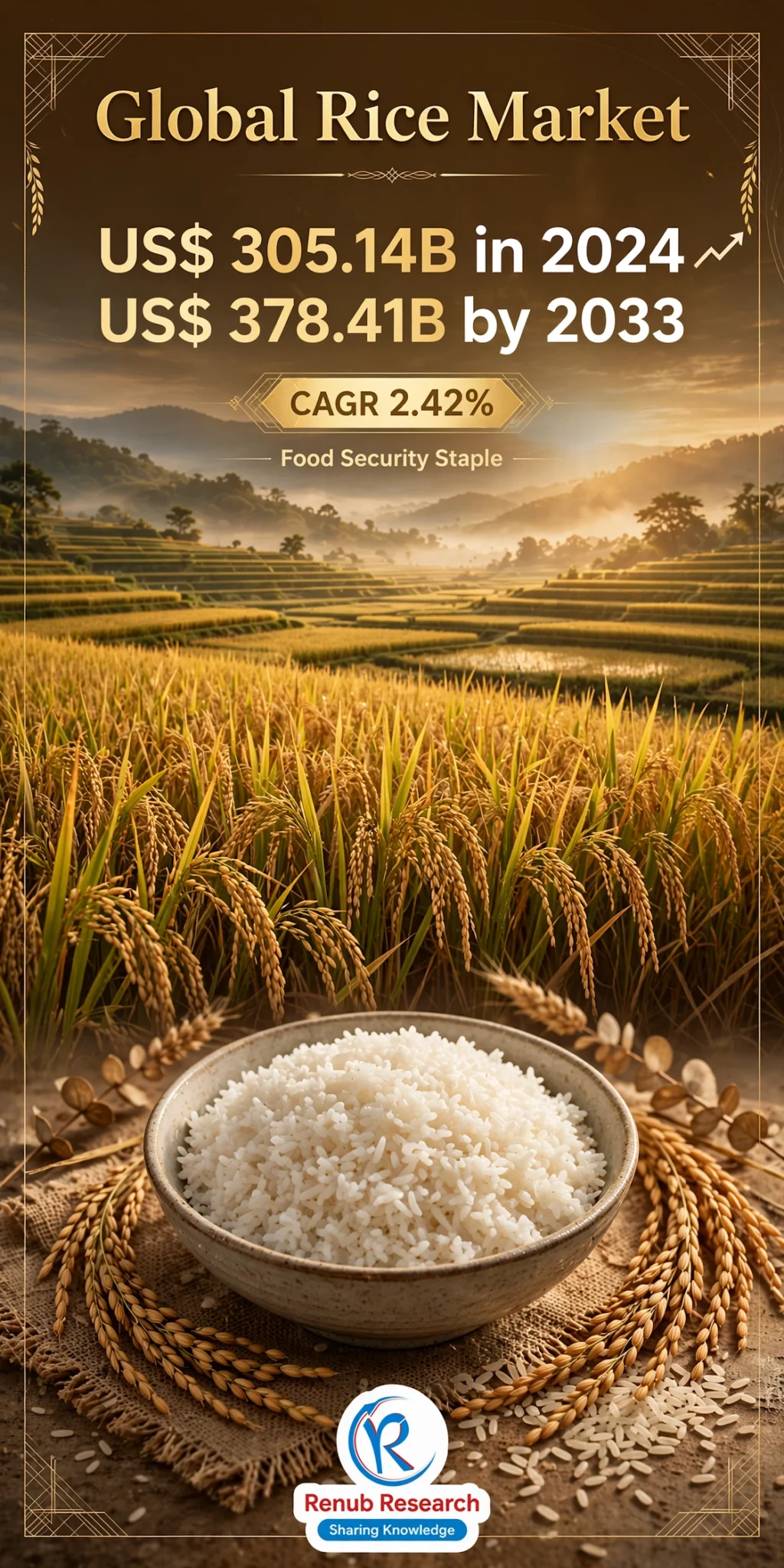
The global rice market stands at a critical juncture of transformation, driven by an ever-expanding population and rapid advancements in agricultural technology. As a primary caloric source for over half the world’s population, rice remains the bedrock of global food security. According to the latest data from Renub Research, the global rice market is projected to reach US$ 405.50 Billion by 2034, growing from US$ 305.14 Billion in 2025. This expansion represents a steady CAGR of 3.21% during the forecast period of 2026–2034.
This article explores the fundamental drivers, regional dynamics, and emerging challenges shaping the future of the world’s most essential grain.
Download Free Sample Report https://www.renub.com/request-sample-page.php?gturl=global-rice-market-p.php
Understanding the Global Rice Market Landscape
Rice—derived from the Oryza sativa and Oryza glaberrima species—is far more than a staple commodity; it is a versatile foundation for global culinary traditions. From the aromatic Basmati of South Asia to the creamy Arborio of Italy, rice varieties cater to diverse consumer needs, ranging from daily household meals to sophisticated food manufacturing.
Beyond direct consumption, the industrial utility of rice is expanding. Rice flour, starch, and plant-based rice milk are gaining traction in the nutraceutical and beverage sectors, catering to gluten-free and health-conscious consumer segments. Because it is relatively cost-effective and adaptable to various climates, rice remains the most reliable buffer against food insecurity in developing nations.
Primary Growth Drivers for the Worldwide Rice Market
The trajectory toward a US$ 405.50 billion valuation is supported by several macroeconomic and technological tailwinds.
Rising Global Population and Food Demand
The most significant pressure on the rice market is demographic. With the global population projected to reach 8.6 billion by 2030 and nearly 10 billion by 2050, the demand for affordable, high-energy calories is non-negotiable. Organizations like the FAO and IFPRI estimate that global food demand will rise by 70% by 2050. As urbanization accelerates in Asia, Africa, and Latin America, rice remains the most accessible energy source for expanding middle-class populations.
Advancements in Agricultural Technology
The “Green Revolution” continues through digital transformation. Modern farming now integrates:
-
Precision Agriculture: Using satellite imagery and IoT sensors to monitor crop health and water usage.
-
Climate-Resilient Breeding: Research institutions are successfully developing hybrid varieties capable of withstanding extreme drought, flooding, and salinity.
-
AI-Driven Innovation: In February 2025, the International Rice Research Institute (IRRI) introduced an AI-based digital platform to accelerate hybrid rice breeding, drastically shortening the time required to bring high-yield seeds to market.
Expansion of Export Markets and Global Trade
Globalization has facilitated a robust international trade network for specialty rice. While major producers like India, Thailand, Vietnam, and Pakistan lead in volume, there is an increasing niche demand for premium varieties in North America, Europe, and the Middle East. Strategic government policies that lower trade barriers and modernize logistics are ensuring that premium rice reaches global shelves with higher efficiency.
Critical Challenges Facing Rice Production
Despite the optimistic forecast, the rice industry must navigate significant structural hurdles that threaten supply chain stability.
Climate Change and Environmental Impact
Rice cultivation is inherently water-intensive and sensitive to temperature fluctuations. Irregular monsoon patterns and prolonged droughts jeopardize yields in primary producing regions. Furthermore, conventional paddy farming is a known source of methane emissions, placing pressure on the industry to adopt “regenerative agriculture” and “alternate wetting and drying” (AWD) techniques to reduce the environmental footprint.
Price Volatility and Supply Chain Inefficiency
Rice prices are susceptible to geopolitical shifts and export restrictions. When major producing nations impose bans or tariffs to protect domestic supply, global prices experience sharp volatility. Additionally, post-harvest losses remain a concern in developing nations due to inadequate storage infrastructure and cold-chain logistics, leading to significant waste before the product ever reaches the consumer.
Regional Market Analysis: A Global Snapshot
The global rice market is geographically fragmented, with distinct consumption and production patterns.
The United States: Shifts in Dietary Habits
The U.S. market is evolving beyond traditional consumption. An increasingly multiethnic population and a surging interest in “healthy grains” have driven demand for brown, wild, and jasmine rice. U.S. agricultural organizations are investing heavily in climate-resistant seeds, ensuring domestic production remains competitive.
India: The Global Powerhouse
As one of the world’s largest exporters, India plays a decisive role in global price stability. Domestic demand remains high, but the export sector is booming, driven by premium basmati and non-basmati varieties. Recent initiatives, such as the December 2024 launch of DAAWAT® Jasmine Thai Rice by LT Foods, highlight the industry’s focus on diversifying product portfolios to capture global tastes.
Germany & The European Union: Import-Dependent Dynamics
With limited local production due to climatic constraints, Germany relies on imports to satisfy demand. The market is defined by a shift toward high-quality, organic, and sustainably sourced grains. European consumers are increasingly driving the demand for transparent supply chains, favoring brands that adhere to EU environmental and fair-trade standards.
The United Arab Emirates (UAE): Strategic Reserves
The UAE represents a unique market driven by a massive expatriate population and a lack of local arable land. Consequently, the country functions as a major trade hub. In 2024, the UAE government prioritized the development of strategic food reserves to mitigate risks associated with global supply chain disruptions, ensuring consistent availability of staple grains like Basmati.
Market Segmentation and Strategic Outlook
The future of the rice market lies in value-added processing and segmentation. Market leaders such as Axiom Foods, Ebro Foods, and The Hain Celestial Group are pivoting toward specialized categories:
-
Organic vs. Conventional: The organic segment is growing faster than the conventional sector as health-conscious consumers prioritize chemical-free production.
-
End-Use Diversification: Beyond home cooking, the use of rice in the nutraceutical, personal care, and baby food sectors is creating new revenue streams.
-
Convenience Products: Ready-to-eat (RTE) and ready-to-cook (RTC) rice products are seeing double-digit growth in urban markets, catering to busy lifestyles.
Frequently Asked Questions (FAQs)
1. What is the projected value of the global rice market by 2034? The global rice market is anticipated to reach US$ 405.50 Billion by 2034, growing from US$ 305.14 Billion in 2025.
2. What is the expected CAGR of the rice market between 2026 and 2034? The market is expected to grow at a CAGR of 3.21% during the forecast period of 2026–2034.
3. Which factors are driving the growth of the global rice market? Key drivers include the rising global population, increasing urbanization, technological advancements in hybrid seed development, and growing demand for specialty rice varieties in Western markets.
4. How is climate change affecting the global rice industry? Climate change leads to erratic rainfall and droughts, which threaten crop yields. Additionally, traditional rice farming methods are being scrutinized for methane emissions, forcing a shift toward more sustainable, climate-resilient agricultural practices.
5. Why is the brown rice market gaining prominence? The brown rice market is expanding due to increased consumer awareness regarding nutrition. As a whole grain, it is richer in fiber, vitamins, and minerals compared to white rice, aligning with global trends toward healthier, plant-based diets.
6. Which countries are the leading producers and exporters of rice? India, Thailand, Vietnam, and Pakistan are among the leading producers and exporters, supplying the majority of the world’s rice demand.
7. How are technology and AI impacting rice production? AI and digital platforms are currently being used to speed up the breeding of hybrid rice varieties and optimize irrigation, allowing farmers to increase yields even under challenging environmental conditions.