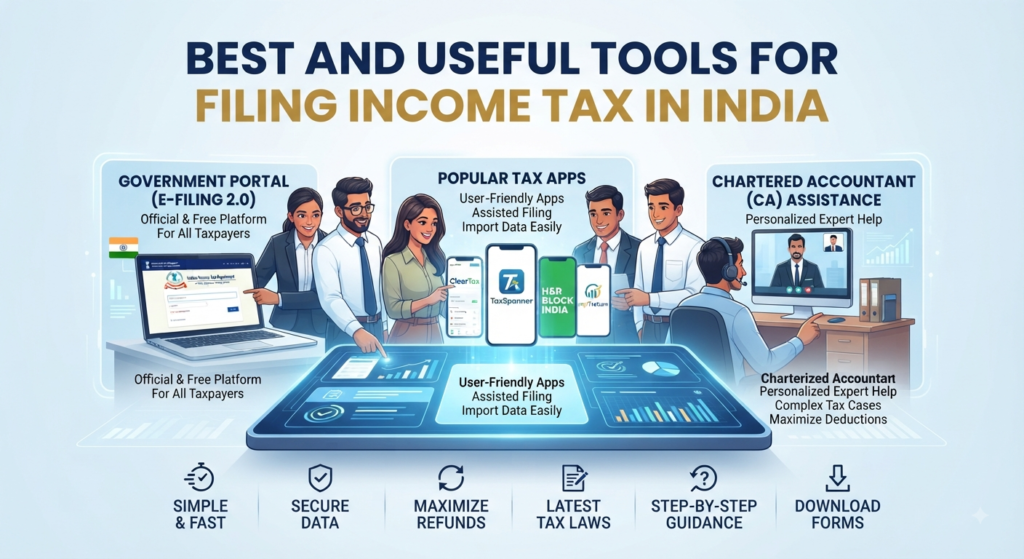
Filing an income tax return in India has become much easier with online tools. Instead of manually calculating tax, checking TDS records, or searching through multiple documents, taxpayers can now use calculators, tax statements, and online filing utilities to make the process faster and more accurate.
Whether you are a salaried employee, freelancer, investor, business owner, or NRI, the right tax tools can help you estimate your liability, identify discrepancies, and prepare your ITR with greater confidence.
Here are some of the most useful tools to consider while filing income tax in India.
1. Income Tax Calculator
An Income Tax Calculator is one of the most useful tools before starting your ITR filing.
It helps you estimate your tax liability based on your income, deductions, residential status, and applicable tax regime. The official Income Tax Department calculator can calculate tax under the applicable provisions and allows taxpayers to compare the old and new tax regimes.
A good calculator can help you understand:
- Estimated taxable income
- Tax liability
- Standard deduction
- Eligible deductions
- Tax under different regimes
- Cess and applicable surcharge
- Estimated refund or additional tax payable
Best for: Salaried taxpayers, freelancers, professionals, and NRIs who want to estimate their tax before filing.
2. AIS — Annual Information Statement
The Annual Information Statement (AIS) is one of the most important tools to check before submitting your ITR.
AIS provides a broader view of financial information reported against your PAN. It can include TDS/TCS, interest, dividends, securities transactions, certain high-value transactions, tax payments, and other information reported to the Income Tax Department. Taxpayers can also submit feedback if information appears incorrect.
Before filing your return, compare the information in AIS with your actual records.
For example, if your bank interest is ₹50,000 but AIS shows ₹70,000, you should investigate the difference before submitting your ITR.
Best for: Almost every taxpayer.
3. Form 26AS
Form 26AS is another important tax-checking tool. It primarily provides information relating to TDS and TCS, helping taxpayers verify whether taxes deducted or collected have been properly reflected.
You should compare Form 26AS with documents such as:
- Form 16
- Form 16A
- Bank statements
- TDS certificates
- Your AIS
AIS contains broader information, while Form 26AS focuses mainly on tax-related entries such as TDS/TCS.
Best for: Salaried individuals, investors, NRIs, and anyone who has tax deducted at source.
4. TDS Calculator
A TDS Calculator can help you understand how much tax may be deducted from particular payments.
This can be particularly useful when dealing with salary, interest, rent, professional income, commission, or certain payments involving NRIs.
For example, if you receive interest from a bank or payment for professional services, a TDS calculator can give you an estimate of the tax deduction.
However, the actual TDS rate depends on the nature of payment, taxpayer status, applicable provisions, PAN details, and other conditions.
5. Capital Gains Calculator
Investors who sell shares, mutual funds, property, or other capital assets may need to calculate capital gains separately.
A Capital Gains Calculator can help estimate the gain by considering the purchase price, sale price, holding period, expenses, and applicable tax rules.
For eligible transactions where indexation applies, an Indexation Calculator can also be useful. For example, Savetaxs provides a capital-gains indexation calculator that uses Cost Inflation Index values to estimate indexed cost and compare applicable capital-gains calculations.
Best for: Property sellers, investors, NRIs, and taxpayers with capital gains.
6. New Tax Regime Calculator
Choosing between the old and new tax regimes can affect your final tax liability.
A New Tax Regime Calculator helps taxpayers estimate their liability using the applicable slabs, standard deduction, eligible employer NPS contribution, rebate, cess, and other relevant factors.
Tools such as the Savetaxs New Tax Regime Calculator are designed to provide an initial estimate based on income and other details.
The official Income Tax Department calculator can also provide a comparison between the old and new regimes.
Tip: Don’t select a tax regime simply because it appears to have a lower rate. Compare your complete tax position, including deductions and exemptions for which you are eligible.
7. Income Tax e-Filing Portal
The official Income Tax e-Filing Portal is the primary platform for filing your ITR online.
It allows taxpayers to:
- File income tax returns
- Check ITR status
- View tax-related information
- Access AIS
- View Form 26AS
- Complete e-verification
- Download relevant forms and utilities
- Respond to certain tax-related communications
The portal currently supports online and offline filing utilities for several ITR forms, including ITR-1, ITR-2, ITR-3 and ITR-4 for AY 2026–27.
Best for: Every taxpayer filing an Indian income tax return.
8. e-Pay Tax
If your calculation shows that additional tax is payable, the e-Pay Tax facility on the Income Tax Department’s portal can be used to make direct tax payments.
The system allows taxpayers to generate a Challan Reference Number (CRN) and make payments through available payment methods.
This can be useful for:
- Advance tax
- Self-assessment tax
- Other direct tax payments
Always verify the assessment year/tax year, tax type, amount, and other details before completing payment.
9. NRI Tax Calculators
NRIs often have more complicated tax situations because their income may come from India and other countries.
An NRI may need to consider:
- Residential status
- NRE/NRO accounts
- Indian property income
- Capital gains
- Foreign income
- Foreign tax credit
- DTAA provisions
- TDS on Indian income
Dedicated NRI tax tools can simplify the initial calculations. Savetaxs, for example, provides tools for income tax calculation, residential-status assessment, Form 10F generation, and capital-gains calculations.
These tools are particularly useful for NRIs who want to understand their tax position before consulting a tax professional.
10. Tax Filing and Verification Tools
Calculating tax is only one part of filing an ITR. After preparing the return, taxpayers should also verify the return and check its status.
The Income Tax Department provides online resources for filing returns, e-verification, ITR status, and other filing-related services.
Using these official facilities helps ensure that your return is not only submitted but also properly verified.
How to Use These Tools Together
Instead of relying on just one calculator, use a simple sequence:
Step 1: Collect Form 16, Form 16A, bank statements, investment statements, and other income records.
Step 2: Check AIS and Form 26AS for reported income and TDS/TCS.
Step 3: Use an Income Tax Calculator to estimate your liability.
Step 4: Use specialized calculators for TDS, capital gains, or the new tax regime if applicable.
Step 5: Reconcile your calculations with AIS and your financial records.
Step 6: File your ITR through the Income Tax e-Filing Portal.
Step 7: Pay any remaining tax through Filing an income tax return in India has become much easier with online tools. Instead of manually calculating tax, checking TDS records, or searching through multiple documents, taxpayers can now use calculators, tax statements, and online filing utilities to make the process faster and more accurate.
Whether you are a salaried employee, freelancer, investor, business owner, or NRI, the right tax tools can help you estimate your liability, identify discrepancies, and prepare your ITR with greater confidence.
You may also like to read:- Income Tax Filing for NRIs
Final Thoughts
Tax calculators and online filing tools can save time and reduce common calculation mistakes, but they should be treated as decision-support tools rather than a substitute for professional advice.
For a straightforward salary-based return, these tools may be enough to prepare and verify your information. However, taxpayers with foreign income, business income, significant capital gains, multiple properties, complex investments, or NRI status may need professional assistance.
The most important rule is simple: calculate your tax, check your reported information, reconcile the numbers, and then file your ITR.
With the right combination of official Income Tax Department tools and specialized tax calculators, filing income tax in India can be much more organized and less stressful.