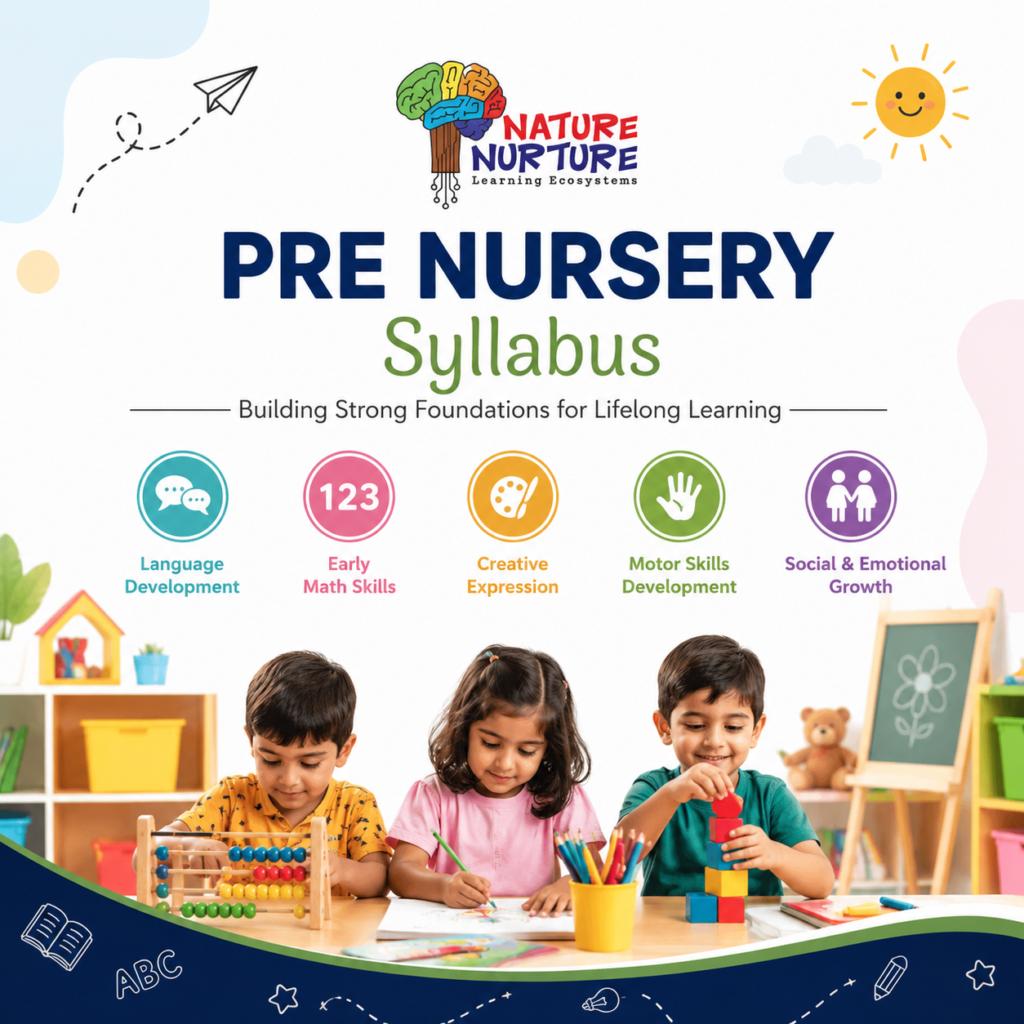
The first years of a child’s learning journey should be happy, simple, and full of discovery. Young children learn by touching, watching, listening, moving, and asking questions. A well-planned Pre Nursery Syllabus can give them opportunities to explore new ideas without making learning feel difficult or stressful.
At this age, children are still developing basic language, movement, social, and thinking skills. They need activities that match their age and interests. Stories, songs, colours, puzzles, drawing, outdoor play, and simple classroom tasks can make learning enjoyable while helping children become more confident.
Why Early Learning Activities Matter
Children learn something new from almost every activity they do. When they build with blocks, they learn about shapes and balance. When they sing a song, they practice sounds and language. When they play with friends, they learn how to share and communicate.
The Pre Nursery Syllabus should therefore focus on overall development instead of only academic work. Young children do not need long lessons or difficult worksheets. They need short, interesting activities that allow them to learn through experience.
Teachers can repeat useful activities in different ways so children have enough time to understand new ideas. Repetition can also help children remember words, colours, numbers, and simple instructions.
Learning Through Stories and Rhymes
Learning Through Stories and Rhymes
Stories are a wonderful way to introduce young children to language. Teachers can use short picture stories with simple characters and familiar situations. After reading, they can ask questions such as, “Who was in the story?” or “What happened next?” These activities make the Pre Nursery Syllabus more engaging while helping children develop listening and speaking skills.
Rhymes and songs can also make language learning fun. Children can clap, move their hands, or act out simple words while singing. These activities can improve listening, pronunciation, memory, and confidence.
Parents can continue this practice at home by reading a short story before bedtime. Nursery Books with colourful pictures and simple words can also encourage children to look at books and develop an early interest in reading.
Fun Number and Shape Activities
Young children can begin learning basic numbers through everyday objects. Teachers can ask children to count blocks, pencils, balls, or toys. Counting can become more interesting when children are allowed to touch and move the objects.
Shapes can be introduced through classroom objects. Children can find circles, squares, triangles, and rectangles around them. They can also create shapes using clay, paper, or building blocks.
These simple activities can make the Pre Nursery Syllabus more practical. Instead of only seeing numbers and shapes on a worksheet, children can understand them through real objects and play.
Drawing, Colouring, and Creative Work
Creative activities give children a chance to express their ideas. Drawing with crayons, colouring pictures, painting with safe materials, and making simple crafts can improve creativity and hand control. These activities can become a useful part of the Pre Nursery Syllabus by making learning more enjoyable and hands-on.
Teachers do not need to expect perfect drawings. At this age, the process is more important than the final picture. Children should be encouraged to choose colours, make marks, and explain what they have created.
Simple materials such as paper, crayons, clay, cardboard, leaves, and safe recycled items can provide many creative opportunities. A Nursery Books collection can also give children ideas for pictures, stories, and simple colouring activities.
Learning Through Movement
Young children need plenty of movement during the day. Sitting for long periods can make them tired and less interested in learning. Short movement activities can help them stay active and focused. Including these activities in the Pre Nursery Syllabus can make learning more enjoyable and support healthy physical development.
Teachers can include jumping, clapping, dancing, balancing, stretching, and simple action games. Outdoor activities can also include running, throwing soft balls, walking along simple paths, and playing group games.
These activities help develop balance, coordination, strength, and body awareness. They can also make the classroom routine more energetic and enjoyable.
Developing Social Skills
Children begin learning how to interact with others from an early age. Classroom activities can teach them to share toys, wait for their turn, listen to friends, and follow simple rules.
Teachers can use group games and partner activities to encourage cooperation. For example, two children can work together to build a block tower or complete a simple puzzle.
A good Pre Nursery Syllabus should give children opportunities to work both independently and with others. These experiences can help children understand kindness, patience, teamwork, and respect.
Exploring Nature and the Environment
Young children are naturally interested in animals, plants, weather, colours, and sounds. Teachers can use this curiosity to introduce simple environmental learning as part of the Pre Nursery Syllabus.
Children can observe leaves, flowers, birds, insects, or clouds during outdoor activities. They can collect fallen leaves, identify different colours, or talk about what plants need to grow.
Simple activities such as planting seeds can also teach patience and responsibility. Children can water a plant and watch how it changes over time. These experiences make learning more meaningful because children can see the results themselves.
Building Independence Through Simple Tasks
Young children can gradually learn to do small things on their own. Teachers can ask them to put toys away, arrange books, carry safe learning materials, or keep their belongings in the right place. These simple activities can be included in the Pre Nursery Syllabus to help children develop practical skills.
These simple tasks can build confidence and responsibility. Children begin to understand that they can help others and take care of their surroundings.
Nature Nurture supports learning environments where children are encouraged to participate, explore, and make simple choices. When children are trusted with age-appropriate responsibilities, they can become more independent and confident learners.
The Role of Parents
Parents can support classroom learning through simple activities at home. Reading stories, talking about pictures, counting objects, singing songs, drawing, and playing simple games can reinforce what children learn at school. These activities can also support the Pre Nursery Syllabus by giving children more opportunities to practice their skills in a relaxed environment.
Parents should also give children time to ask questions and express their thoughts. A short conversation about a picture or a daily activity can help develop vocabulary and confidence.
Nursery Books can be useful at home when parents read with children instead of expecting them to read alone. Looking at pictures and discussing the story can be just as valuable for young learners.
Creating a Happy Learning Experience
A good early learning environment should make children feel safe, welcomed, and comfortable. Teachers can use friendly words, simple instructions, colourful materials, and regular encouragement.
The Pre Nursery Syllabus works best when activities are flexible enough to suit different children’s interests and learning speeds. Some children may enjoy drawing, while others may prefer music, movement, blocks, or storytelling.
The goal is not to make every child learn in exactly the same way. It is to give them opportunities to explore, practice, communicate, and enjoy learning.
Conclusion
A strong Pre Nursery Syllabus should help children learn through play, creativity, movement, stories, communication, and everyday experiences. These activities can support language, thinking, physical skills, social development, and confidence.
When teachers and parents work together, young children receive consistent encouragement at school and home. With caring guidance and age-appropriate activities, children can build a positive attitude toward learning and develop strong foundations for the years ahead.
Nature Nurture believes that early learning becomes more meaningful when children are given the freedom to explore, ask questions, create, and learn at their own pace. A well-designed Pre Nursery Syllabus supports this approach by giving young children opportunities to learn through play, creativity, hands-on activities, and everyday experiences .