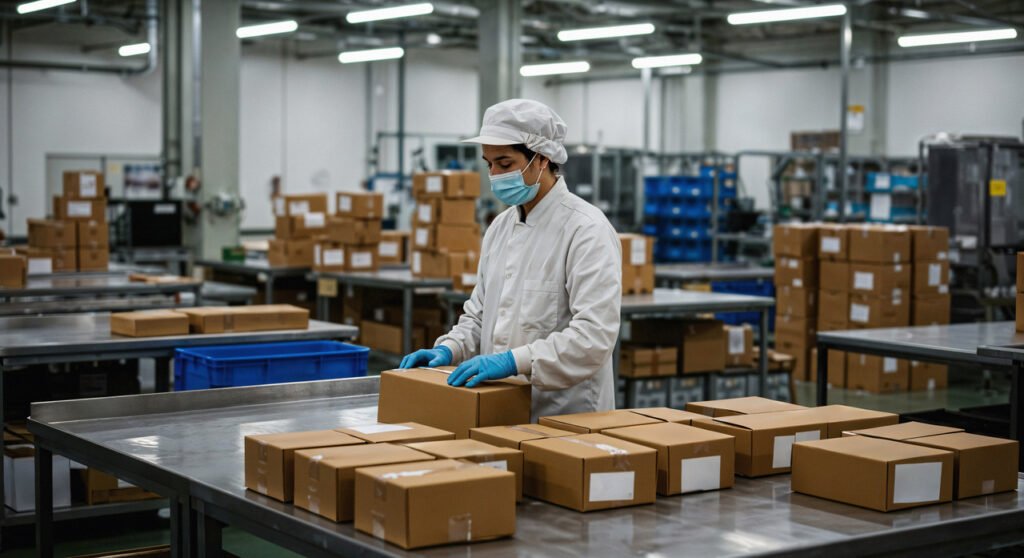
Food packaging is becoming increasingly important as manufacturers across the Middle East look for ways to improve efficiency, product protection and sustainability. Growing production volumes, expanding distribution networks and changing consumer expectations are encouraging businesses to rethink how products are packaged, labelled and prepared for the market.
Packaging is no longer simply the final step after manufacturing. It is becoming an integrated part of the production process, supported by automation, connected equipment and increasingly sophisticated packaging technologies.
For manufacturers operating in the Middle East, these developments are particularly relevant as the region continues to strengthen its food production capabilities and attract international manufacturing investment.
Dubai has an important role in this development. As a major international business and logistics hub, the city provides a meeting point for food manufacturers, technology providers, suppliers and buyers from across the region and international markets.
This is also where Gulfood Manufacturing becomes relevant. Organised by Dubai World Trade Centre, the event brings together the global F&B manufacturing ecosystem across processing, packaging, ingredients, automation and supply chain solutions. The 2026 edition is scheduled for 3 to 5 November 2026 at Dubai World Trade Centre in Dubai.
Packaging Is Becoming More Intelligent
Traditional packaging processes focused primarily on containing and protecting products. Modern packaging systems are expected to achieve much more.
Manufacturers increasingly need packaging that supports product shelf life, provides accurate information, improves production efficiency and responds to sustainability requirements.
This is driving investment in smart packaging solutions that can incorporate technologies such as sensors, digital identification, intelligent labels and connected systems.
For manufacturers, smart packaging can create opportunities to improve traceability and gain better visibility across the product lifecycle.
It can also support more informed inventory and distribution decisions when packaging information is connected with wider digital systems.
Automation Across Packaging Lines
The growth of automation is one of the most significant changes taking place within food manufacturing.
Modern packaging lines can integrate filling, sealing, labelling, inspection and handling into coordinated production systems. This reduces unnecessary manual intervention and can improve consistency across high-volume operations.
Packaging automation can also provide manufacturers with better control over production parameters. Sensors and software can monitor equipment performance and identify issues before they result in significant production losses.
As packaging lines become more connected, manufacturers can collect data about production speed, material consumption, downtime and quality.
This information can support continuous improvement and help businesses identify opportunities to make their operations more efficient.
The Sustainability Challenge
Sustainability is another major factor influencing packaging decisions.
Food manufacturers need packaging that protects products effectively while responding to growing expectations around material efficiency and environmental responsibility.
This creates a complex challenge. Reducing packaging material cannot come at the expense of product protection, because damaged or spoiled food can create even greater environmental and economic costs.
Manufacturers therefore need to consider the entire lifecycle of packaging.
Material selection, package design, production efficiency, transportation requirements and end-of-life considerations all need to be evaluated together.
Modern smart packaging solutions can contribute to this wider approach by providing greater information about products and helping manufacturers understand how packaging performs throughout the supply chain.
Improving Product Traceability
Traceability has become increasingly important as food supply chains become more complex.
Products may move between manufacturers, warehouses, distributors and retailers across multiple countries before reaching consumers.
Packaging can play an important role in maintaining visibility throughout this journey.
Digital identification technologies can connect individual products or batches with relevant production and supply chain information. This can help manufacturers and supply chain partners track products more effectively.
For businesses managing international distribution from or through the Middle East, stronger traceability can provide greater control over inventory and product movement.
Supporting Food Safety
Packaging also contributes directly to food safety.
The packaging process needs to protect products from contamination and maintain the required conditions throughout storage and transportation.
Automated inspection systems can be integrated into packaging lines to identify issues such as incorrect seals, damaged packages or other defects.
This is particularly important for high-speed production environments where manual inspection alone may not provide sufficient coverage.
Connected packaging systems can therefore support both production efficiency and quality assurance.
The Role of Dubai in Packaging Innovation
Dubai’s position as an international trade and business centre makes it an important location for manufacturers and technology providers looking to engage with the Middle East.
The city provides access to regional markets while also attracting international companies looking to establish commercial relationships across the wider region.
Gulfood Manufacturing reflects this international positioning. The event brings together manufacturers, equipment providers, ingredient specialists, packaging companies and technology leaders in one industry-focused environment.
For businesses evaluating packaging technologies, this provides an opportunity to compare solutions, understand emerging trends and meet potential suppliers.
From Packaging Machines to Complete Systems
The future of packaging will increasingly depend on integration.
Manufacturers are moving away from viewing individual machines as isolated investments. Instead, they are looking at how packaging equipment can work with processing systems, inspection technologies, warehouse operations and production software.
This integrated approach can improve visibility across the manufacturing process.
For example, production data generated by packaging equipment can potentially be connected with manufacturing software to provide information about throughput and efficiency.
This creates a foundation for more data-driven decision-making.
Finding the Right Technology Partners
Technology investment requires careful evaluation.
Manufacturers need to consider production volumes, product characteristics, packaging formats, available space, integration requirements and future expansion plans.
A solution that works effectively for one manufacturer may not necessarily be suitable for another.
This makes industry-focused events valuable. At gulfood manufacturing conference, manufacturers can engage directly with technology providers and explore solutions based on their specific production requirements.
The event’s business-focused approach also supports connections between exhibitors and buyers looking for practical manufacturing solutions.
Preparing for the Future
The future of food packaging will be shaped by several developments happening simultaneously.
Automation will continue to improve production efficiency. Digital technologies will provide greater visibility. Sustainability will influence material and design decisions. Traceability will become increasingly important across international supply chains.
For manufacturers, these trends mean packaging needs to be considered as part of the wider production strategy.
Investing in smart packaging solutions can help businesses explore new approaches to traceability, connectivity and product information, while advanced packaging technologies can improve production performance.
As the Middle East continues to develop its food manufacturing ecosystem, Dubai will remain an important meeting point for companies exploring these opportunities.
Gulfood Manufacturing provides a platform for this exchange, connecting the global food manufacturing community with technologies and solutions relevant to the region’s evolving production landscape.
For manufacturers planning their next packaging investment, understanding how automation, connectivity, sustainability and traceability work together will be essential. The future of food packaging is not simply about better packages. It is about creating smarter, more efficient and more connected manufacturing systems.