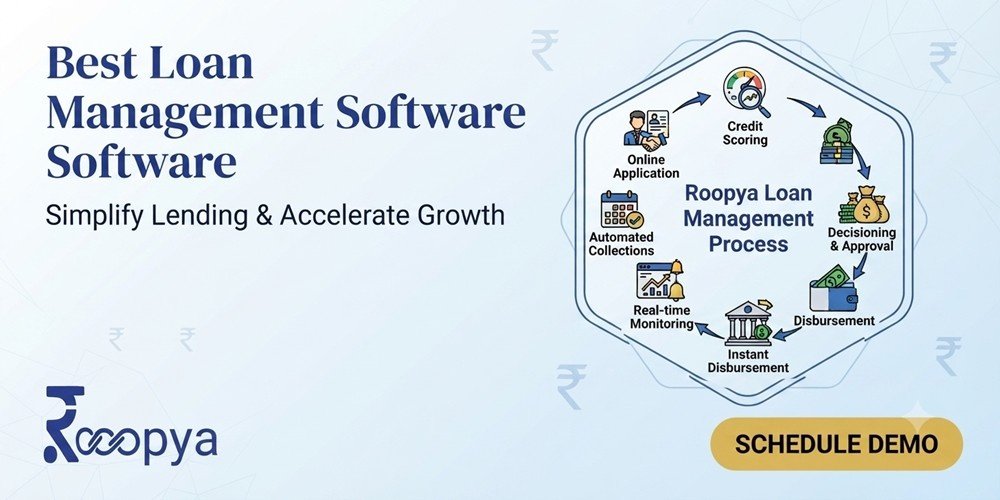
Compare the best loan management software for banks and NBFCs. See must-have features, evaluation criteria, and why Roopya.money is built for Indian lenders.
Once a loan is disbursed, the real operational work begins. Repayments have to be tracked accurately, interest has to be calculated correctly across dozens of possible structures, overdue accounts need to be flagged before they become losses, and every one of these actions needs to be documented for audit and regulatory review. This is the job of loan management software — and for banks and NBFCs, choosing the right platform is one of the most consequential technology decisions they’ll make. Get it right, and servicing becomes accurate, scalable, and largely automated. Get it wrong, and even a well-underwritten loan book can bleed money through miscalculated interest, missed follow-ups, and reporting errors.
This guide breaks down what loan management software actually does, the criteria that separate a genuinely strong platform from a mediocre one, and what to look for during evaluation — drawing on how we’ve built Roopya for the specific needs of Indian banks and NBFCs.
What Is Loan Management Software?
Loan management software (sometimes called a Loan Management System, or LMS) is the platform that manages a loan for its entire life after disbursement. Its core responsibilities include:
- Generating and maintaining repayment schedules based on the loan’s interest structure and tenure
- Calculating interest accurately — flat, reducing balance, or hybrid structures — and applying it consistently across the portfolio
- Processing repayments through multiple channels: NACH, UPI, cheque, or manual entry
- Tracking overdue accounts, ageing buckets, and NPA classification
- Supporting collections workflows, from automated reminders to field-agent assignment
- Handling restructuring, foreclosure, and part-payment scenarios
- Producing the reports lenders need for internal MIS, audits, and regulatory submissions
Where a Loan Origination System governs how a loan gets approved, loan management software governs how it gets serviced — and because that servicing period can run for years, even small inefficiencies compound significantly over the life of a portfolio.
Why the Right Loan Management Software Matters
1. Interest and Repayment Accuracy at Scale
A single miscalculated interest structure, applied across thousands of accounts, can create material financial and reputational damage. Purpose-built loan management software applies interest logic consistently and automatically, removing the manual calculation errors that spreadsheets or under-featured systems allow to creep in.
2. Faster, More Effective Collections
The earlier a lender identifies a slipping account, the better the chances of recovery. Good loan management software surfaces overdue accounts immediately, automates reminder communications, and gives collections teams a prioritized, data-backed worklist instead of a manual review of ledgers.
3. Reduced NPA Risk Through Early Visibility
Ageing and delinquency tracking that updates in real time — rather than at month-end — gives risk teams a genuine chance to intervene before an account crosses into non-performing territory.
4. Audit-Ready Compliance
Regulatory expectations around documentation, restructuring records, and NPA classification are detailed and strict. Software that maintains a complete, timestamped record of every transaction and status change turns audit preparation from a scramble into a report export.
5. Operational Scalability
As a loan book grows from thousands to hundreds of thousands of accounts, manual servicing processes break down. The right software lets a lender’s existing operations team manage a much larger portfolio without proportional headcount growth.
Key Features That Separate the Best Loan Management Software From the Rest
Flexible Interest and Repayment Configuration
Look for support for multiple interest methods (flat, reducing balance, hybrid), variable repayment frequencies (monthly, weekly, bullet), and the ability to configure new loan products without waiting on a vendor’s development team.
Multi-Channel Repayment Collection
The best platforms integrate directly with NACH, UPI, payment gateways, and allow manual entry for cash or cheque payments, reconciling all of it automatically against the right loan account.
Automated Delinquency and NPA Management
This should include configurable ageing buckets, auto-classification aligned with RBI norms, and dashboards that let risk and collections teams see exposure by product, branch, or portfolio segment at a glance.
Collections Workflow Tools
Strong software goes beyond flagging overdue accounts — it should support automated SMS/email/WhatsApp reminders, field-agent task assignment, and tracking of promise-to-pay commitments.
Restructuring, Foreclosure, and Part-Payment Support
Real portfolios aren’t static. Borrowers foreclose early, request restructuring, or make partial payments — the software needs to handle all of these cleanly, recalculating schedules and interest without manual workarounds.
Integration With Origination, Accounting, and Core Banking Systems
Loan management software rarely operates in isolation. It needs clean integration with the Loan Origination System that feeds it new accounts, and with accounting or core banking systems for books of account and reconciliation.
Comprehensive Reporting and MIS
Real-time dashboards and exportable reports covering portfolio health, collections efficiency, NPA trends, and product-wise performance are essential for both day-to-day operations and board-level reporting.
Security and Data Governance
Given the sensitivity of financial and personal borrower data, look for role-based access control, encryption, and detailed audit logs of who accessed or changed what.
How to Evaluate Loan Management Software: A Practical Checklist
- Does it support every loan product you currently offer, and can it be configured for products you plan to launch?
- Can your team configure new interest structures and repayment schedules without vendor development work?
- Does it integrate with your existing or planned Loan Origination System?
- What payment channels does it support out of the box?
- How does it handle NPA classification, and does that align with current RBI norms?
- What does the collections workflow actually look like day-to-day for an agent or officer?
- Can it generate the specific regulatory and audit reports your compliance team needs?
- Is it cloud-based, and what does the implementation timeline typically look like?
- What level of support is available post-implementation?
How Roopya Approaches Loan Management Software
Roopya.money was built specifically around the operational realities of Indian banks and NBFCs — not adapted from a global template. The platform supports configurable interest and repayment structures across multiple loan products, automated delinquency and NPA tracking aligned with regulatory expectations, and multi-channel repayment collection, all built to work as one continuous system with origination rather than as a bolted-on afterthought.
Because origination and servicing data flow together, information captured when a loan is approved — applicant details, sanctioned terms, documents — carries forward automatically into servicing, removing the re-entry and reconciliation work that fragmented systems create.
Loan Management Software vs. Loan Origination System
These are often discussed together, and for good reason — they cover adjacent halves of the same lifecycle. Understanding where one ends and the other begins matters when planning a lending technology stack.
| Aspect | Loan Management Software | Loan Origination System |
| Stage of loan lifecycle | Post-disbursement | Pre-disbursement |
| Primary function | Repayments, collections, servicing | Application intake, underwriting, approval |
| Key users | Collections and operations teams | Sales, credit, and risk teams |
| Typical outputs | Repayment schedules, statements, NPA reports | Sanction letter, loan agreement |
Common Mistakes When Choosing Loan Management Software
Choosing on Price Alone
The cheapest option often lacks the configurability or compliance depth a growing lender needs, leading to costly migration to a different platform within a few years.
Ignoring Integration Requirements
Software that services loans well but integrates poorly with origination or accounting systems creates manual reconciliation work that erodes the efficiency gains the software was supposed to deliver.
Underestimating Collections Workflow Needs
Some platforms treat collections as an afterthought — a simple overdue list — rather than a structured workflow with reminders, agent assignment, and promise-to-pay tracking. This gap shows up directly in recovery rates.
Not Planning for Product Growth
A system configured tightly around today’s loan products can become a bottleneck when the lender wants to launch a new one. Flexibility in product configuration should be evaluated up front, not discovered later.
The Bottom Line
The best loan management software isn’t necessarily the one with the longest feature list — it’s the one that matches how your institution actually lends, services accounts, and reports to regulators, while integrating cleanly with the rest of your lending stack. For Indian banks and NBFCs, that means software built around local regulatory requirements, common repayment channels, and the product diversity most lenders actually operate with.
Roopya was built with that fit in mind — combining origination and servicing into one connected platform designed for the way Indian lenders actually work, rather than a generic system adapted after the fact.
Frequently Asked Questions
What is loan management software?
Loan management software is a digital platform that handles a loan’s lifecycle after disbursement — repayment scheduling, interest calculation, collections, delinquency tracking, and reporting — so lenders can service loans accurately at scale.
What makes a loan management software the ‘best’ fit for a lender?
The best fit depends on the lender’s loan products, portfolio size, and regulatory environment. In general, the strongest options combine flexible repayment and interest configurations, strong compliance and audit support, real-time reporting, and easy integration with origination, accounting, and payment systems.
Is loan management software different from a Loan Origination System?
Yes. A Loan Origination System handles everything before disbursement — applications, underwriting, approvals. Loan management software takes over after disbursement, managing repayments, collections, and the loan’s ongoing servicing until closure.
Can loan management software handle multiple loan products?
A well-built platform should support multiple products — personal loans, business loans, gold loans, loans against property — each with its own interest structure, repayment frequency, and penalty rules, configured without custom development for every product.
Does loan management software help with NPA and delinquency tracking?
Yes. Core to any loan management platform is automated tracking of overdue accounts, ageing buckets, and NPA classification in line with regulatory norms, along with tools to support collections follow-up.
Is Roopya.money’s loan management software suitable for both banks and NBFCs?
Yes. Roopya.money is designed to serve both banks and NBFCs, with configurable workflows that adapt to different loan products, portfolio sizes, and compliance requirements across institution types.
How does loan management software support regulatory reporting?
It maintains structured records of repayments, restructurings, and account status, and can generate the reports lenders need for RBI and internal audit requirements, reducing the manual effort of compiling this data separately.