
Introduction
Bhang is an important plant from the perspective of the history of South Asia and is usually mentioned while talking about cannabis and traditional culture, botany, and practices. Throughout the years, the term has become widely known, but there are some misconceptions about the word since people tend to refer to cannabis plants as well as their traditional preparations with the same word. Nowadays, there is an increased interest in the matter since people search for information regarding the benefits, uses, and meaning of the bhang plant. There is also increased interest in the history and existence of the plant in Pakistan.
It should be noted that when trying to learn about the topic in question, one should take into consideration an objective approach to it. The matter is that there is a difference between traditional knowledge, historical information, botanical information, and scientific evidence. One should not confuse the traditional claims about the plant with medical facts. The following article is an attempt to present comprehensive information regarding the bhang plant, including its meaning, history, common claims about its benefits and uses, and cultural significance in Pakistan.
What Is the Bhang Plant?
The bhang plant is associated with cannabis. Cannabis is a genus whose plants have existed and been used by man for thousands of years. Different varieties of the plants have served different purposes, such as the production of fiber and seeds, and use in traditional culture and science.
It should be noted that bhang does not constitute a totally separate botanical species. It is a traditional South Asian word related to cannabis and preparations made of cannabis. Leaves of cannabis are distinguished by their division into several narrow leaflets. Physical properties of cannabis may be very different depending on a variety, growing conditions, and genetics. Different varieties can have different amounts of cannabinoids.
THC, or tetrahydrocannabinol, and CBD, or cannabidiol, are two cannabinoids that are frequently discussed and have different effects on biological systems. This is one of the reasons why cannabis is now a very popular research object. Thus, it is wrong to think that every plant or preparation associated with bhang has the same chemical composition and effects. Therefore, the term “bhang plant” should be understood in its cultural and botanical context but not as the name of a separate plant species. Bhang Plant Meaning
The meaning of the bhang plant has a great connection to the history and culture of cannabis in South Asia. The word “bhang” has been used historically in the language and culture of South Asians in regard to cannabis. Depending on the context in which it is used, it could mean plant materials, a preparation, or a cultural practice involving cannabis.
From the botanical aspect, the name of the plant is cannabis. From the cultural aspect, bhang is the traditional name for cannabis-related practices. This distinction is crucial since online resources use these terms interchangeably. An article that talks about botany will discuss cannabis, while an article dealing with culture will discuss bhang.
The meaning of the bhang plant is therefore slightly different based on the context of the use of the word. Overall, it is a term from the South Asian culture that is very closely associated with cannabis. Knowing the meaning of the term makes it easy to interpret the information surrounding the topic.
Historical Background of the Bhang Plant
The cannabis plant has a long history of human usage, especially within some areas of Asia. The historical sources show that different peoples used the plants for several purposes, such as fiber, seeds, traditional practices, and cultural events.
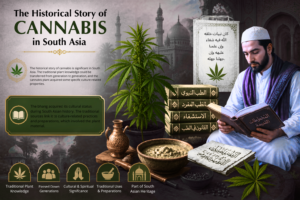
The historical story of cannabis is significant in South Asia. The traditional plant knowledge could be transferred from generation to generation, and the cannabis plant acquired some specific culture-related properties. The bhang acquired its cultural status during South Asian history. The traditional sources link it to culture-related practices and preparations, which involved the plant material.
Nevertheless, it does not mean that the historical information could be taken as scientific evidence of the medical efficiency of cannabis. An
cient people did not have laboratories, clinics, or detailed cannabinoid knowledge. Science has made significant progress in cannabis research; today scientists know the structure of the plant and its influence on the human organism. They can determine the chemical substances individually and investigate their interactions.
The historical significance of the bhang plant is invaluable since it gives some insights into agriculture, traditional knowledge, culture, and human-plant interactions.
Bhang Plant Benefits and Uses
Internet searches for bhang plant benefits are quite popular. The cannabis plant has biologically active ingredients, which have been studied extensively by scientists.
It should be noted that there is a distinction between historical beliefs about the plant and its proven benefits based on scientific research. Below are several points highlighting major areas related to the plant historically, botanically, and scientificant.
1. Cultural and Historical Importance
Another aspect that makes the bhang plant significant is its historical and cultural significance. Cannabis has been a traditional part of the knowledge of different South Asian societies for many generations already. Investigating the history of this plant will enable people to get more data about how people used to interact with the plant culturally.
The historical significance of a certain plant does not equal any medical use of this plant. Nonetheless, studying the history of a certain plant will enable people to learn more about traditional agriculture and culture. Thus, it can be concluded that bhang is one of the best examples of how different plants are perceived in different eras and cultures.
2. Scientific Interest in Cannabinoids
Cannabis has received much scientific interest due to its cannabinoids. Some of the most famous cannabinoids are THC and CBD, although there are many other chemical compounds found in cannabis too. They are studied in order to investigate their biological impact and potential uses.
Science has also helped to learn more about the endocannabinoid system, which participates in numerous physiological processes. The increasing number of studies doesn’t mean that all claims concerning the benefits of the bhang plant have been scientifically proven. Rather, this fact means that cannabis includes some compounds worth studying.
3. Research Related to Pain
Cannabinoids have been researched in regard to their potential association with pain and symptom management. There is some research suggesting that specific cannabinoid-based interventions could be of use to specific patients suffering from certain health problems. Yet, the evidence differs depending on the condition, the medication used, the dosage, and other factors.
It is important to keep in mind the difference between the two because not all standardized medications equal traditional preparations. Any individual intending to use cannabis for pain relief should consult a medical practitioner.
4. Medical Research Applications
There are some cannabis extracts or cannabinoid drugs that have been studied in connection with certain diseases. In some countries, certain cannabinoid drugs may even be prescribed or utilized for medical purposes. Such medications may vary greatly from the conventional ones due to their precise composition and content.
Thus, any scientific studies related to a certain drug cannot serve as a basis for drawing conclusions about the overall effectiveness of the bhang plant. Any medical data should always be analyzed in connection with a particular drug, disease, and patient.
5. Agricultural and Industrial Value
Cannabis also has a rich agricultural and industrial past. There are varieties that will yield tough plant fibers, which have traditionally been utilized for making rope, fabrics, paper, and other types of products. The seeds of cannabis have also been consumed as food and oil in regions where it is legally allowed.
The industrial hemp variety is very significant in this case because it is grown for reasons such as fiber and seed production and has traditionally contained much lower amounts of THC compared to cannabis that is cultivated for its intoxicating qualities. It is clear that cannabis is not only something that has traditional uses. It also has other agricultural and industrial asp
6. Botanical Research
Also, the bhang plant has significant value from the point of view of botanical research.
Scientific researchers can examine the genetics, morphology, physiology, adaptation, and chemical properties of the cannabis plant. Different cannabis strains may have different physiological properties and cannabinoids.
The purpose of botanical research is to enable scientists to learn about the responses of plants to the environment and the impact of genetics on their physiological properties. This kind of research is distinct from any claims regarding consumption of cannabis.
7. Educational and Cultural Value
Another advantage that comes with researching bhang is the educational aspect of it.
The plant gives us an opportunity to study the link between traditional and scientific knowledge. We have an opportunity to learn about botany, agriculture, history, chemistry, culture, and public health, among other fields.
When studying plants from an educational standpoint, one gets to understand the reasons behind the separate evaluation of both traditional claims and scientific proof.
Bhang Plant Uses
Use of the bhang plant described in both historical and current literature can be classified into a few general types, such as traditional use, industrial use, scientific use, and medical use.
All of these have their own history and should not be mistaken for one another.
Traditional Uses
The use of bhang has a rich history in the culture of South Asia. Cultural and historical evidence connects it to specific methods.
Different communities have had differing traditions concerning it. No universal tradition exists that defines the relationship between all communities and cannabis. Its use is a matter of history and culture. It should not necessarily be seen as a modern medical practice.
Industrial Uses
There are certain strains of cannabis that have industrially beneficial qualities. The fiber from such strains has traditionally been used to manufacture rope, cloth, paper, and similar substances. The seeds may be utilized in the production of foodstuffs and oil, where applicable, according to local regulations.
This type of use is usually characteristic of industrial hemp and differs significantly from cannabis strains grown for cannabinoids.
Scientific Uses of bhang plant
Modern research has given rise to yet another class of uses of the bhang plant. Studies of cannabis are carried out to gain an understanding of its genetics, chemistry, cannabinoids, pharmacology, and possible applications.
These studies may include laboratory experimentation, animal studies, human studies, and other scientific research techniques. The objective behind such research is that of generating scientifically proven evidence.
Medical Applications of bhang plant
Some cannabis preparations and cannabinoid therapies have been investigated for particular diseases. When these medications are legally available, they can be employed under the watchful eye of doctors. Their preparation, dosing, quality assurance, and cannabinoid content can all be tightly controlled.
This is totally opposite to what happens when people assume that all traditional cannabis medicines have identical medical effort.
: Bhang Plant Meaning in Pakistan
Bhang plant in Pakistan is related to the cultural history of cannabis in South Asia. Cannabis has been used in the region for decades; the traditions concerning this plant have developed in various communities.
However, cultural history and current legislation are not one and the same thing. The legal status of various cannabis-related activities depends on applicable laws, regulations, location, and types of activities. It may change over time. Thus, when studying the history of the bhang plant in Pakistan, it is essential to separate historical data from the modern legal requirements.
An activity having cultural or historical value does not mean that this activity is legal now.
For more reliable data regarding current legal requirements, the official sources of information provided by the government or legislation of Pakistan should be used, and not the outdated content on the Internet.
Traditional Knowledge and Scientific Evidence
There are instances when the debate regarding bhang plant advantages tends to be confusing due to the combination of traditional information and scientific data.
Traditional data could actually be helpful since it indicates how certain people used various plants in the past. Modern medical science has another standard for the evaluation of the efficacy of a particular remedy. Scientific data may be gathered via lab tests, observational studies, clinical trials, systematic reviews, and many other ways.
A traditional statement may be a good topic for research, but it does not automatically mean that a specific herbal preparation will help to treat a medical problem. In the same way, the data related to a purified or standardized cannabinoid does not automatically apply to all traditional preparations used for bhang. It is important for health information.
Safety Considerations
Professional discussion about the bhang plant must also consider safety issues.
The use of cannabis can affect the nervous system. Depending on the product and its cannabinoids, the effects could be alterations in attention, memory, coordination, perception, and mood.bhang plant Some individuals might experience unwanted effects such as dizziness, anxiety, confusion, or impaired judgment. Effects could vary based on many factors. These include age, state of health, drug or medication intake, product type, and others.

Impaired driving is another concern. The use of cannabis products causing intoxication affects coordination, attention, and response times. Using cannabis products and driving could be hazardous not only to oneself but to others on the road too.
Youth is another group requiring extra caution due to their continued brain development. Individuals who are pregnant, lactating, taking prescription drugs, or having certain medical conditions must get professional healthcare guidance before using cannabis products.
Modern Research on the Bhang Plant
The scientific knowledge about cannabis has increased substantially in recent years.
Currently, scientists conduct research about cannabinoids, receptors, genetics, metabolism, plant compounds, and potential medicinal applications. The endocannabinoid system is among the important topics for research since it is involved in multiple biological mechanisms. Both THC and CBD have been extensively studied by scientists; however, they are not the only chemical compounds in cannabis.
Scientists examine potential medical applications of cannabis, as well as its possible disadvantages and limitations.
It is crucial to conduct such research since scientific research should not be limited to studying the potential benefits of any substances. Scientific research considers negative consequences, interactions, and other issues.
Importance of Reliable Information
There is much information available online on bhang, but the credibility of that information may differ greatly.
While some websites might simply state traditional beliefs without backing them up, others could embellish the possible effects. It is important to critically assess the information found.
Credible health information must refer to credible sources of its claims. Such sources include scientific research, established medical institutions, universities, and governments, rather than unsubstantiated posts from social media.
Any statements involving words like “cures everything,” “totally safe,” or “sure treatment” must be taken with reservation. The natural properties of any product could have biological effects, and natural does not mean safe.
Bhang Plant and Traditional Culture
The connection between the bhang plant and traditional culture shows how plants can be incorporated into the history of social life.
In traditional societies, knowledge about native plants was accumulated through careful observations of them. The cannabis plant became a part of the cultural tradition in South Asia. An analysis of this tradition gives us important information from the past.
On the other hand, contemporary science offers ways to analyze the chemical and biological characteristics of the plant. Thus, both types of information can be seen as complementary as long as we understand their specific standards and purposes.
Botanical Characteristics of Cannabis
Botanically, cannabis is an annual plant that blooms and possesses certain characteristics. Cannabis’ physical features may differ based on genetics and the environment.
Scholars have conducted studies on the differences between various strains to learn about their growth characteristics, height, fiber quality, seed production, and cannabinoid content.
Chemical composition is especially significant since the amounts of cannabinoids present may differ from one strain to another. Such botanical differences make it clear that it is erroneous to consider all cannabis plants as alike.
Understanding the Difference Between Hemp and Cannabis Products
Another area of misconception is the relationship between industrial hemp and other types of cannabis. Industrial hemp is usually grown for industrial purposes, including cultivation of fibers and seeds, and usually contains very small amounts of THC in accordance with the applicable legal definition.
There are other types of cannabis that could be grown for different chemical properties.
The legal definition might differ from one country to another, and this needs to be taken into account in any discussion of terminology. It is especially important when talking about the bhang plant in Pakistan.
Responsible Approach to Bhang Plant Information
It requires a responsible attitude towards the topic in question in order not to go to extremes and not to confuse cultural information and medical information.
One can interpret the bhang plant meaning by taking into consideration its relation to the cannabis plant and the culture of South Asia. Uses of the bhang plant can be examined historically, industrially, scientifically, and medically.
In the same way, one can analyze the benefits of bhang plants, paying special attention to their health aspects.
People should not use the information provided in the online articles as an alternative to medical consultations.
Frequently Asked Questions
What is the bhang plant?
Bhang plant is a term often linked to cannabis in South Asian culture. The bhang plant is usually linked to the use of cannabis and not as a unique botanical plants.
What is the bhang plant meaning?
The meaning of the bhang plant refers to its connection to cannabis and the nomenclature used in traditional South Asia. The precise meaning depends upon context.
What are the main bhang plant benefits?
Bhang plant advantages are explored both traditionally and scientifically. Some compounds from cannabis have been scientifically researched and applied to some purposes, but traditional assertions about their medical value are not necessarily medically confirmed.
What are the bhang plant uses?
Uses of the bhang plant can be studied in terms of tradition, culture, industry, botany, science, and medicine. Different types of cannabis have different uses.
What is the bhang plant in Pakistan?
The bhang plant in Pakistan is cannabis in the cultural, historical, and legal context of the country. The current laws and regulations must be reviewed from credible and official sources.
Is bhang a separate plant species?
Bhang is not usually regarded as a distinct plant genus in its own right. The name is traditionally connected with cannabis and certain cannabis products.
Are all cannabis plants the same?
Not necessarily. Varieties of cannabis can vary genetically, physically, chemically, and in their intended uses.
Does traditional use prove medical effectiveness?
No. Traditional use gives information about the past, but the effectiveness of medicine is dependent on science.
Conclusion
There is an extensive history of the bhang plant, which relates to botany, agriculture, traditional knowledge, culture, and scientific research. Despite being widely known in South Asia, the definition of bhang might depend on the context.
The bhang plant definition is associated with cannabis and South Asian terminology. There are numerous traditional and cultural bhang plant uses along with modern scientific studies in botany, chemistry, agriculture, and medicine.
People show increasing interest in the bhang plant benefits; however, one must know how to differentiate between claims that are proven by science and traditional beliefs. One cannot simply rely on all the information found online since not all the claims have been scientifically proven yet.
In addition, the history of bhang plants in Pakistan is a part of the history of cannabis in South Asia in general. However, it is vital not to confuse the history of the use of bhang with legality nowadays. Laws and regulations may change, and thus it is important to check current information from reliable sources.
To conclude, the best way to learn about the bhang plant is to combine botanical knowledge, historical background, scientifically proven information, safety, and laws.