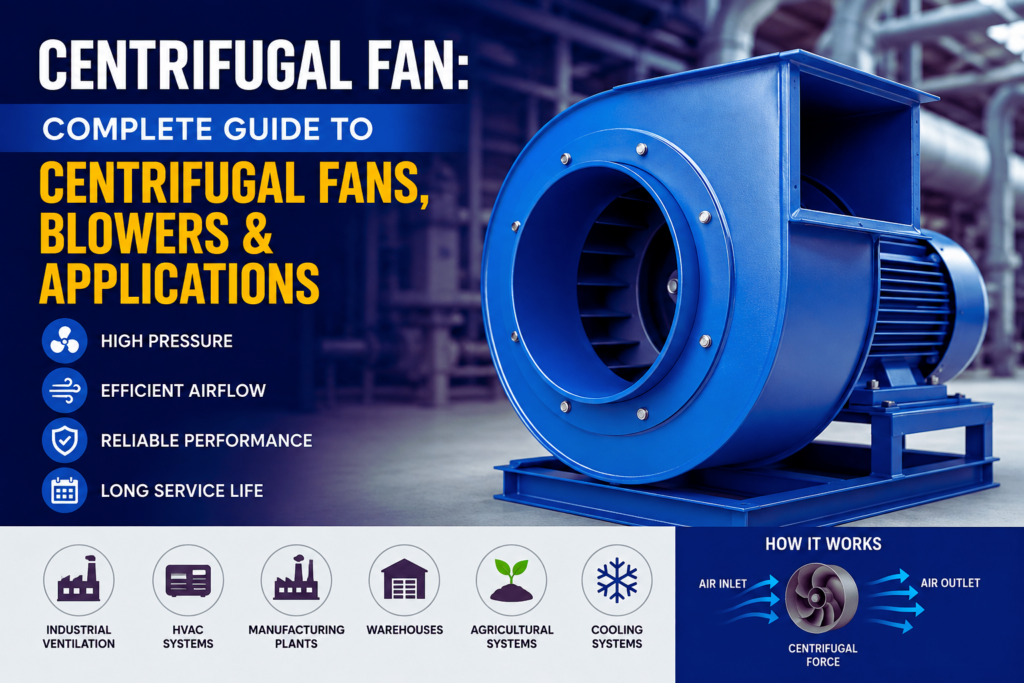
A modern industrial centrifugal fan used for high-pressure airflow, ventilation, HVAC systems, manufacturing facilities, warehouses, agricultural applications, and industrial cooling systems.
Centrifugal Fan: Complete Guide to Centrifugal Fans, Blowers & Applications
Introduction to Centrifugal Fan
A centrifugal fan is a crucial mechanical equipment for conveying air, gases or other air-borne materials. It is widely used in industrial ventilation, HVAC system, manufacturing plants, warehouses, agricultural system, cooling system etc. A centrifugal fan is different from an axial fan in that the direction of the wind changes as the air moves through a rotating impeller.
The modern centrifugal fans are designed for providing the same air flow and air pressure under various ventilation needs. They can also manage high system resistance which is beneficial for heavy-duty industrial uses. Depending on the design, a centrifugal fan can provide high pressure, efficient airflow, reliable operation, and long service life.
Basic design consists of an impeller, housing, shaft, motor, inlet and outlet openings. As the motor turns the impeller, air is drawn in to the inlet, and is carried outwards due to centrifugal force. The air is then directed into the housing to the discharge outlet.
The working principle of centrifugal fan can give a better idea to the business people to choose the appropriate centrifugal fan for ventilation system of the business. It can also help users to understand the differences between different types of fan designs and working pressures and airflow capacities.
What Is a Centrifugal Fan?
Centrifugal Fan: A centrifugal fan is a type of rotating air moving machine that draws air in the middle of the impeller and sends it out at an angle. The rotating impeller increases the air’s velocity and pressure. This energy is then transformed and directed to the fan casing, which then becomes useful for air circulation.
Unlike an axial fan. Air flow of an axial fan is primarily parallel to the axis of rotation. A centrifugal fan, on the other hand, sucks air into the center and expels it to the edge of the wheel.
The design enables the centrifugal fans to operate effectively in the presence of higher resistance. These are, therefore, frequently used in ductwork, filters, dust collectors, exhaust and industrial ventilation.
There are a few factors that determine the performance of a centrifugal fan. These include impeller design, speed of rotation, motor power, system resistance, air density and housing configuration. The proper selection of these factors is key to obtaining the desired airflow and pressure.
How a centrifugal fan works to move air?
Air first enters the fan through the inlet (1). Air is drawn into the rotating impeller and is pushed outwards. Air is pumped outwards from the hub to the rim of the wheel by centrifugal force.
The air exits the impeller and goes into the fan housing. The housing is configured to provide a collection and directional function of the moving air towards the discharge outlet. This generates a controlled airflow that can be used for ventilation, cooling, exhaust or other industrial processes.There are several main components of a centrifugal fan.The centrifugal fan has a number of main components.
There are several components of a typical centrifugal fan. The impeller is the part that rotates and which is responsible for increasing the speed of the air. The blade shape and configuration greatly affect the performance of the fan.
The housing encloses the impeller and regulates the air flow. It also assists to change a portion of the velocity of the air into pressure. Mechanical power for rotating the impeller is provided by a motor.
The shaft conveys rotational force of the motor to the impeller. Bearings are used to hold the rotating shaft in place and enable it to move smoothly. A fan may also contain belts, pulleys, dampers, vibration isolators and protective guards, depending on the application.
How a Centrifugal Fan Functions?
The principle of a centrifugal fan is quite simple. The rotating speed of the motor is fixed, causing the impeller to rotate at a certain speed. Air is sucked in the middle of the impeller and is pushed to the outer edge of the impeller.
The rotating blades increase the velocity of the air. This high-speed air is then captured in the housing and channeled back to the outlet. In the process, some of the velocity energy is transformed into pressure.
Final airflow is dependent on the fan and the system it is connected to. Long ducts, filters, bends, dampers, or other restrictions in a system will require extra pressure to be pumped by the fan.
Air Intake Process
Air is drawn through the inlet into the centrifugal fan. There are different types of inlets which are designed to control the air flow to the impeller. If the inlet is properly designed, the turbulence and overall efficiency of the fan can be decreased.
The air is picked up by the impeller blades as it moves toward the middle of the rotating wheel. While the wheel is rotating, the air then expands outwards.
Impeller Rotation
The impeller is one of the vital parts of centrifugal fans. Its size, shape of blades, the number of blades and its rate of rotation all affect its airflow and pressure.
Mechanical energy from the motor is transferred to the air when the impeller rotates. The air becomes faster and moves out towards the outer rim of the wheel.
The performance characteristics of different impeller designs vary. For instance, forward curved, backward curved, and radial blade design are chosen based on the airflow and pressure specifications.
Generates air pressure through the physical movement of the blades
A centrifugal fan produces air flow by imparting more energy to the moving air. The impeller generates velocity and the housing assists in converting velocity to useful pressure.
The dimensions that are used to measure airflow are generally cubic feet per minute (cfm) or cubic meters per hour (m3/h). The other major performance factor is static pressure, which is the amount of resistance the fan has to overcome.
Airflow is not the only criterion for choosing a fan. The required pressure must be taken into account also. If one uses a fan which does not have enough pressure, the air will not flow well when the fan is connected to the ductwork or the ventilation system.
Air Discharge Mechanism
The air flows through the impeller and then goes to the outlet in the housing. The housing shape that is used for controlling airflow and pressure prior to entering the connected ductwork or equipment.
Good design of the discharge can boost the performance of the ventilation system. If installed incorrectly, excessive bends, or the wrong duct size can create resistance, which means less air will flow.
Energy Efficiency
One of the considerations to take into account when choosing centrifugal fans is energy efficiency. The proper size fan will deliver the necessary air movement without the wasted motor-use.
The working point, fan design, motor efficiency, system resistance, and control method are key factors for achieving efficiency. Flow rates can also be variable, and variable speed drives can help save energy.
Types of Centrifugal Fans
There are a number of different centrifugal fan designs and each has differing performance qualities. The best choice will depend on the airflow, pressure, operating environment, noise level and application.
Forward-Curved Centrifugal Fans
The centrifugal fan blades are curved in the direction of the rotation in forward curved centrifugal fan. Such fans can generate large amounts of airflow at relatively low operating speeds, and are widely used in HVAC and air-handling systems.
They are compact and may be beneficial in situations where space is limited. They might not be the best choice, however, in applications where the system resistance is high and dust load is high.
Backward-Curved Centrifugal Fans
The blades of a backward-curved fan curve the opposite way of the rotation. They are well known to run efficiently and are commonly employed in areas with a high energy efficiency requirement.
These centrifugal fans can provide good pressure performance while maintaining relatively high efficiency. These are usually employed in industrial ventilation, air handling systems and process use.
Radial-Blade Centrifugal Fans
Radial-blade centrifugal fans have blades that are closer to the impeller radius. They are well built and can be used in heavy-duty industrial applications.
They are frequently used for dust, particles, fumes and airborne materials. Their sturdy construction means they are likely to work well in tough situations.
High-Pressure Centrifugal Fans
For systems that need a lot of pressure, high speed centrifugal fans are used. They can be applied for restrictive duct systems, filtration systems, combustion systems, industrial process equipment etc.
To select a high pressure centrifugal fan, it is necessary to determine the total system resistance. The fan’s pressure should be sufficient to keep the necessary airflow in the entire system.
Industrial Centrifugal Fans
The continuous and heavy duty uses of industrial centrifugal fans. They are generally used in factories, production facilities, warehouses, power plants, processing plants and other industrial facilities.
The fans can be modified in airflow, pressure, temperature and material requirements based on the condition of the installation. Depending on the operating environment, construction materials could be of different steel grades or other materials.
Centrifugal Fans vs. Centrifugal Fan Blower
Often the centrifugal fan blower is called the centrifugal fan. But their use can differ based upon the model, application and pressure needed.
They are both air moving systems with rotating impellers. This is typically a function of how much pressure and flow the equipment operates on.
A centrifugal fan is the one that is most frequently used for general ventilation, exhaust, cooling and air movement. For applications where greater pressure is needed to overcome the system resistance, a centrifugal fan blower can be used.
Ventilation or pressure difference.
A centrifugal fan can be used to obtain high flow with a substantial static pressure. A blower is normally used when higher pressure is needed than normal ventilation fans.
There is no set limit between a fan and a blower though. These terms could be used variously by the manufacturers to describe their products.
This means that the best choice should be determined by the actual use of the product and not just by the name of the product. All of the above should be taken into account when determining required airflow, static pressure, temperature, system resistance, and operating conditions.
Industrial Applications
A wide variety of industrial systems use centrifugal fans or blowers. Typical uses range from dust collection, fume extraction, industrial exhaust, combustion air, cooling, drying and process ventilation.
In cases where air needs to be filtered, long duct runs, heat exchangers, or other restriction are in the way, a centrifugal fan blower can be a beneficial solution.
Which is the better option?
One solution is not right for all applications. This choice will rely on the airflow and pressure needed.A centrifugal fan can be a good choice for general ventilation with moderate resistance. If high pressure is needed, a centrifugal blower-style design might be better suited for the application.
When ordering equipment, ensure that a proper system calculation has been performed. This will avoid issues with inadequate ventilation, air conditioning, motor loading, or equipment costs.
Centrifugal fans are utilized by a number of industries since they can be used to successfully manage airflow and pressure demands. They are used in all kinds of building ventilations up to complex industrial applications.
Industrial Ventilation
Industrial facilities may need to have air moving continuously to provide the desired working conditions. A centrifugal fan is able to circulate contaminated air and bring in fresh air to the production area.
HVAC Systems
Centrifugal fan is a commonly used fan in HVL systems. They can transport conditioned air via ducts and generate the pressure to overcome system resistance.They can be matched to the size and ventilation needs of buildings.
Agricultural Ventilation
Good air circulation is needed in agricultural buildings like poultry houses, animals buildings and storage areas. Ventilation can be provided with the help of centrifugal fan and it can maintain appropriate environmental conditions.
The correct size of the fan depends on the size of the building, the amount of air circulation needed, ventilation design, temperature and humidity.
Manufacturing Facilities
Centrifugal fans are commonly employed in manufacturing plants to provide process ventilation, cooling, exhaust and air movement. Depending on environmental conditions, some systems may need special fans for high temperatures, corrosive atmosphere, or polluted air.
Dust and Fume Extraction
Dust and fume extraction systems must be fitted with fans with sufficient capacity to overcome resistance generated by the duct work, filters and fume collection systems. These systems can be provided with the necessary pressure using a centrifugal fan blower installed properly.
Cooling Systems
For equipment and process cooling, centrifugal fans are capable of handling large volumes of air. They are also used in industrial machinery, electrical equipment, air-handling systems and other applications which require controlled airflow.
Warehouses and Commercial Buildings
Centrifugal fan can be used for air circulation, exhaust, temperature control and ventilation in warehouse and commercial buildings. Selecting the proper fan allows for good air flow in large areas.There are several advantages to centrifugal fans.There are several advantages to centrifugal fans.
Popularity of centrifugal fans is due to their ability to deliver reliable air flows under many operating conditions. Their design has a number of advantages for industrial and commercial users.
High-Pressure Airflow
One of the biggest merits of centrifugal fan is its ability to create beneficial pressure. This is appropriate for systems with ducts, filters, dampers and other resistance elements.
Efficient Ventilation
If the fan is properly chosen, it can move air effectively and efficiently. If the fan is the correct size for the system, it will not need to be operated as hard as a smaller one, which will save energy.
Reliable Performance
Industrial centrifugal fans are meant to be used for a long time. They can offer reliable operation for extended operating life when properly installed and maintained.
Energy-Saving Operation
Choosing an efficient fan and using it at its optimum operating point can help decrease energy usage. Savings are also available in variable speed control if there is demand variation.
Durability
Strong material and robust component are employed in many industrial centrifugal fans. This enables them to function in harsh conditions where breakdowns can be costly.
Low Maintenance Requirements
Regular cleaning, lubrication, inspection of bearings, belts and vibration monitoring can all help keep the performance of the fan. In addition, preventive maintenance can help detect potential issues before they become a problem and result in unexpected downtime.
Centrifugal Fan: Complete Guide to Selection, Manufacturers, Maintenance & Performance
How to Choose the Right Centrifugal Fan
To ensure efficient operation, reliable airflow and correct pressure, it is essential to select the right centrifugal fan. If the fan is too small, it may not deliver sufficient air circulation and if it’s too large, it will use excess energy and raise operating costs.
Prior to buying equipment, review the entire ventilation system. Take into account duct length, filters, dampers, bends, outlets, temperature and other factors that may influence system resistance.
Required Airflow
One of the key factors to consider when choosing centrifugal fans is airflow. Calculate the amount of air that is required to flow in the system during normal operation.
The need for airflow varies from application to application. The capacity needed for industrial ventilation can be different from that of cooling, exhaust, dust collection and HVAC applications.
The amount of required airflow is dependent upon the size and use of the space or process. An incorrect fan selection can lead to sub-optimal results.
Static Pressure
The resistance the centrifugal fan has to overcome is dependent on static pressure. Pressure losses can be caused by ductwork, filters, dampers, grilles and other equipment.
The fan must be able to deliver the appropriate pressure to ensure adequate air flow through the system. If the rating is too low, there will be a substantial decrease in airflow after installation.
Fan Size
The size of the fan influences the air movement, pressure, speed and energy usage. A bigger impeller will pump more air but size is not the sole criterion for performance.
The appropriate size should be chosen for the desired operating point. Fan performance curves can help manufacturers select the proper equipment to fit system needs.
Motor Power
The motor power should match the operating conditions of the fan. If the motor size is too small, it will overheat or burn out due to heavy use.
An oversized motor may increase initial and operating costs. With proper engineering, the motor should be adequate for the required power and not redundant.
Operating Environment
The choice of a fan can be influenced by the surrounding environment. Special equipment may be needed for temperature, humidity, dust, corrosive gases and explosive atmospheres.
However, the use of construction materials and motor specifications should be carefully evaluated for high temperature or corrosive applications.
Material and Construction
The material of centrifugal fan must correspond with the application. The fan may be constructed from strong steel or stainless steel or corrosion resistant materials may be used for special applications.Components such as the impeller, housing, shaft and the like should be optimized for operating conditions.
Noise Level and Efficiency
Noise may be a significant factor in commercial buildings, workshops, offices and other filled spaces. Noise can be affected by fan speed, fan design, fan housing configuration, and installation.
There should be a focus on energy efficiency as well. A properly-functioning fan can help to lower electricity usage during extended periods of operation.
How to Choose the Right Centrifugal Fan Manufacturers
Choosing a good centrifugal fan manufacturer is as crucial as selecting a fan model. A good manufacturer will offer reliable products, performance specifications, technical advice and assistance.
Prior to ordering, research the manufacturer’s engineering, product quality, customization, testing, and after-sales service.

Manufacturing Quality
Fan reliability and service life is closely related to manufacturing quality. Seek out manufacturers that employ appropriate materials, precise manufacturing methods, well balanced impellers and quality components.When operating a fan, it should move air freely and withstanding the design parameters.
Product Range
Experienced centrifugal fan manufacturers usually offer different models for various airflow and pressure requirements.
Depending on the application, it can range from ordinary ventilation fans to high pressure fans, industrial exhaust fans, dust handling fans and process fans.
Customization Options
Customized fan designs are required for some applications. These might include unusual dimensions, materials, motor features, operating temperatures, or mounting options.Basic equipment can be adjusted as needed to the project by manufacturers who offer high engineering skills.
Energy Efficiency
When operating a fan, energy-efficient equipment can cut operating costs to a considerable extent over the life of the fan. When comparing manufacturers, it is important that they have products that will work effectively at the duty point that is required.The price of a fan is not the only criterion by which to evaluate it. The total cost of ownership includes energy use also.
Quality Control
Quality control is used to guarantee that each centrifugal fan has the performance and construction required. Some of the key inspections can be dimensional, impeller balancing, motor testing, vibration testing and performance testing.
Technical Support
Technical support makes it easier to choose and install fans. The professional manufacturers should be able to supply data regarding airflow, static pressure, motor power, installation, maintenance and operating conditions. After installation, users can also gain help from good technical support to fix issues related to performance. The warranty and After-Sales Service provisions.The warranty and After-Sales Service.
When purchasing industrial equipment, there is an added level of confidence when the device comes with warranty coverage. An effective centrifugal fan manufacturer should make it clear the conditions of the warranty and maintenance. It can also play a major part in long term running in terms of replacement parts and maintenance support.
Why to Opt for the Professional Centrifugal Fan Manufacturers?
Collaborating with expert centrifugal fan manufacturers can yield a number of benefits. Veteran manufacturers are aware of the factors that influence airflow, pressure, impeller design, motor power and resistance.
They can assist customers in determining which equipment will meet the needs of those in their customer base rather than just selling a standard product. This is particularly important for industrial systems as wrong fan selection can lead to inadequate air flow, noise and vibration and increased energy use.
Customized solutions are available from professional manufacturers, too. They can create equipment based on the operating temperatures, air conditions, pressure needs, material needs and installation constraints. Good engineering support can enhance overall system performance and service life of the ventilation system.
Here are some tips to keep centrifugal fans running like top-notch machines. To ensure the efficient working of a centrifugal fan, regular maintenance is essential. Even good equipment can go bad when dust, wear, balance or mechanical issues are neglected.
An annual preventive maintenance program can help minimize the risk of unexpected equipment failures and can help to increase the life of equipment.
Regular Cleaning
Debris or dust can collect on the impeller or housing. If there is too much buildup, it can impact the fan’s balance and hinder air flow.
Clean the fan as per the operating environment and manufacturer’s recommendations. Care should be taken for application with dust, fibre and other airborne products.
Bearing Inspection
The rotating shaft is supported by bearings which need to be checked periodically. If there is an unusual noise, or excessive temperature or vibration it indicates a bearing problem. Lubrication shall be done in accordance with the manufacturers’ instructions.
Motor Maintenance
The motor should be checked for overheating, abnormal noise, loose connections and other indications of trouble. Maintain cleanliness and ventilation of the motor to ensure reliable operation. Premium service for belts and shafts.High quality belt / shaft inspection.
Centrifugal fan motors that are belt driven need to be maintained and inspected with regularity for condition of belts and pulleys. Belts that are worn, broken or misaligned will cause loss of performance and wasted energy. The alignment and wear on the shaft should also be examined.
Vibration Monitoring
If there is a lot of vibration, this may be caused from an unbalanced impeller, damaged bearing, loose mounting, misalignment or another mechanical issue.
The vibration system can be used as a tool to detect developing problems before they cause significant equipment failure if it is used regularly.
Preventive Maintenance Schedule
Develop maintenance plan based on hours and conditions. It is particularly important for continuous running fans in industrial applications to undergo regular inspection. By adhering to the manufacturers’ maintenance schedule, reliability and less unplanned downtime are assured.
Unless centrifugal fans are selected correctly, there is a possibility of issues with operation even when they are selected properly. When identified in time, the problem can be prevented to cause damage and restore normal performance.
Low Airflow
Clogged filters, blocked ducts, improper fan rotation, closed dampers, damaged belts or high system resistance cause low airflow. Inspect the entire system and don’t assume that the fan is the problem.
Excessive Vibration
These issues include an unbalanced impeller, worn bearings, loose components, shaft misalignment or improper installation, can all lead to excessive vibration. If the vibration is excessive, the fan should be inspected and turned off.
Unusual Noise
Some sounds that are unusual can be signs of bearings, loose parts, belt issues, foreign objects or turbulence. Early identification of the source will help to avoid greater mechanical damage.
Motor Overheating
Overheating can happen due to overloading, inadequate air circulation, incorrect voltage, mechanical friction, or the wrong motor. Before operating the motor and the fan for a prolonged period, inspect the operating conditions.
Reduced Fan Efficiency
This inefficiency can be caused by dirt on parts, wrong fan type, too much system resistance, worn belts, or not operating at the recommended performance point. Proper system design and maintenance can help to keep the systems efficient. Airflow and performance factors for centrifugal fans.
There are several factors that are related to the performance of a centrifugal fan. The knowledge of such factors helps in the selection and troubleshooting of equipment.
Airflow Capacity
Airflow refers to the amount of air that the fan can move in a given time. Capacity is dependent on the application and objectives of the ventilation.
Static Pressure
The resistance encountered by the fan is termed static pressure. More resistance in the system will need a fan with a higher pressure rating.
Fan Speed
Airflow and pressure are greatly affected by fan speed. The faster the speed, the more enhanced the performance, but also at the same time there is more power consumption, noise, and mechanical stress. The speed of the fan should thus be kept within the manufacturer’s operating range.
Motor Efficiency
The overall energy consumption of the whole ventilation system depends on motor efficiency. With a right choice of an efficient motor, electricity expenses could be minimised during sustained operations.
System Resistance
Resistance is caused by ductwork, filters, bends, dampers, grilles, etc. The centrifugal fan should be specified to run properly with the entire system’s resistance.
Conclusion
Centrifugal fans are a true all-purpose fan for industrial, commercial, HVAC, agricultural or ventilation purposes. Can produce useful air flow and useful air pressure and therefore is suitable for systems that have different resistance.
The choice of an appropriate fan should take into account the airflow, static pressure, motor power, operating environment, efficiency and system design. The regular maintenance is equally crucial to ensure reliability and durability of the equipment.
In addition to the advantages of high efficiency, reliability, and innovation, experienced centrifugal fan manufacturers can offer customers further benefits when purchasing industrial equipment, including quality manufacturing, technical assistance, customization, and after-sales service.
When the need is for general ventilation, cooling, exhaust, dust collection, or a variety of high-pressure movements of air, the proper centrifugal fan can increase system efficiency and operational reliability.
Frequently Ask Question
A centrifugal fan is used for what?
It is used to move air or gases in processes like industrial ventilation, HVAC, cooling, exhaust, dust collection, fume extraction and production.
What is the working principle of centrifugal fan?
A centrifugal fan is a fan that sucks the air towards the center of a rotating impeller. The impeller is used to increase the velocity of the air as it moves outwards and the housing is used to direct the air towards the outlet of the air.
What is the difference between a centrifugal fan and blower?
The centrifugal fan blower is usually a piece of equipment that is used to move air at higher pressure, although the terms fan and blower might be used interchangeably. Flow and pressure requirements should be used to achieve the actual performance.
What centrifugal fan should I buy?
Take into account air flow, static pressure, fan size, motor power, operating temperature, air quality, material requirements, efficiency and noise. Comprehensive system calculation will give the best selection.
What are the trustworthy centrifugal fan manufacturers?
Analyze centrifugal fan manufacturers according to product quality, engineering experience, customization, testing process, technical support, warranty and after sales service. Please always check if the manufacturer can provide the airflow and pressure you need.