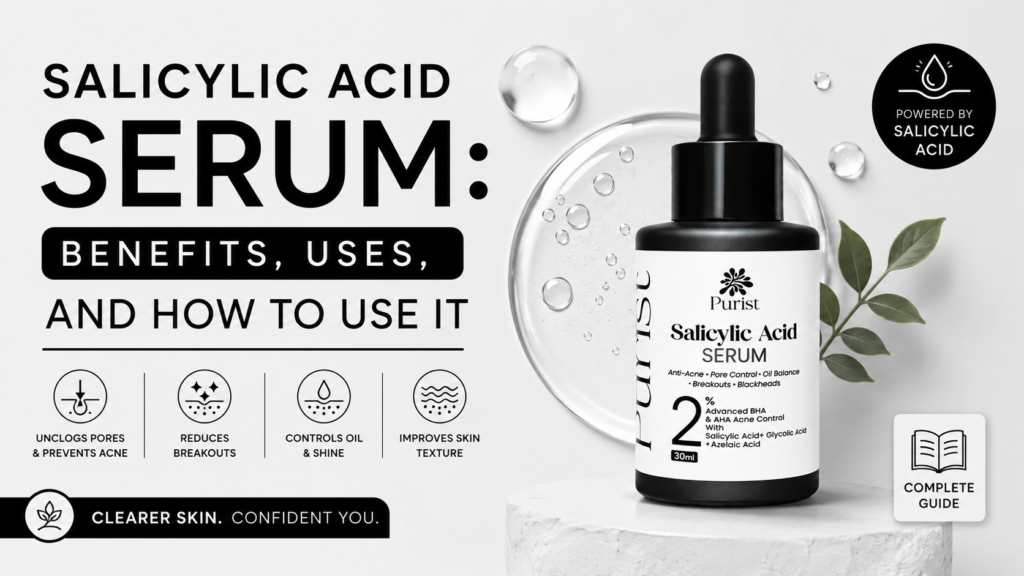
Salicylic acid serum is one of the most useful skincare ingredients for people dealing with clogged pores, blackheads, excess oil, and recurring breakouts. Unlike many surface-level exfoliants, salicylic acid is oil-soluble, which allows it to work inside pores where a mixture of sebum, dead skin cells, and debris can accumulate.
But using salicylic acid effectively is not simply about applying more product. The concentration, frequency, skin type, supporting products, and overall skincare routine all matter.
If you are considering adding a salicylic acid serum to your routine, this guide explains what it does, who can benefit from it, how to introduce it safely, what ingredients to avoid combining unnecessarily, and what kind of results you can realistically expect.
What Is Salicylic Acid Serum?
Salicylic acid is a beta-hydroxy acid (BHA) commonly used in skincare products designed for acne-prone, oily, and congested skin. It is a keratolytic ingredient, meaning it helps loosen and remove dead skin cells.
Its oil-soluble nature is one of its biggest advantages. Because it can interact with oil and sebum, salicylic acid can reach into the pore rather than working only on the outermost surface of the skin.
A Salicylic Acid Serum combines this exfoliating ingredient with a leave-on formulation. Unlike a cleanser that is quickly rinsed away, a serum remains on the skin, allowing the active ingredient to stay in contact with the skin for longer.
This makes it particularly useful when your main concerns include clogged pores, blackheads, oily skin, uneven texture, and blemishes.
However, salicylic acid is still an active ingredient. More frequent application does not necessarily mean faster results. A balanced routine that supports the skin barrier is usually a better approach than aggressive exfoliation.
How Does Salicylic Acid Work on the Skin?
To understand why salicylic acid is popular for congested skin, it helps to understand what happens inside a clogged pore.
Your skin naturally produces sebum, an oily substance that helps maintain the skin’s protective barrier. Dead skin cells can also accumulate around the opening of a hair follicle. When sebum and dead cells build up together, the pore can become congested.
Salicylic acid helps loosen the connections between dead skin cells and encourages their removal. Because it is lipophilic, meaning it has an affinity for oil, it is particularly suited to oily and congested areas.
This exfoliating action can help:
- Remove accumulated dead skin cells
- Keep pores from becoming heavily congested
- Reduce the appearance of blackheads
- Improve rough or uneven texture
- Make oily skin feel less congested
- Support a clearer-looking complexion
The important point is that salicylic acid does not provide an overnight solution. Consistent use gives the ingredient time to work while your skin gradually adjusts.
Salicylic Acid Serum Benefits
A well-formulated salicylic acid serum can be useful for several common skincare concerns. Its benefits are especially relevant to people whose skin becomes oily, congested, or prone to blemishes.
Helps Clear Congested Pores
Pores can become congested when oil, dead skin cells, and environmental debris accumulate. Salicylic acid helps exfoliate these unwanted buildups and can make pores appear clearer over time.
This is one reason BHA products are commonly recommended for people who notice congestion around the nose, forehead, chin, and other oily areas.
Helps Reduce the Appearance of Blackheads
Blackheads are open comedones that form when material inside a pore becomes exposed to air and oxidizes.
Because salicylic acid is oil-soluble, it is particularly useful for skincare routines focused on blackheads and clogged pores. Regular, appropriate exfoliation may help reduce existing congestion and discourage excessive buildup.
Supports Acne-Prone Skin
Salicylic acid is widely used in acne-focused skincare because it helps exfoliate inside pores and has anti-inflammatory properties.
It may be particularly helpful for mild acne, blackheads, whiteheads, and occasional breakouts. However, persistent, severe, painful, or cystic acne may require professional evaluation rather than relying exclusively on cosmetic skincare products.
Helps Improve Uneven Skin Texture
When dead skin cells accumulate unevenly, skin can feel rough or bumpy.
By encouraging the removal of excess dead skin cells, salicylic acid can help create a smoother-feeling surface. With consistent use, the skin may look more refined and feel softer.
Helps Manage the Appearance of Excess Oil
Salicylic acid does not permanently switch off your sebaceous glands, but it can help keep oily areas from becoming heavily congested.
This can make the complexion appear cleaner and less weighed down by accumulated oil and dead skin.
Can Improve the Look of Post-Blemish Marks
Regular exfoliation may gradually improve the appearance of uneven tone left behind after blemishes. However, pigmentation can have many causes, and salicylic acid should not be treated as a dedicated pigmentation treatment.
If dark marks are a major concern, ingredients such as sunscreen, vitamin C, niacinamide, azelaic acid, or professionally recommended treatments may also have a role depending on the individual.
Who Is Salicylic Acid Serum Best For?
Salicylic acid is generally most relevant to people with oily, combination, acne-prone, or congested skin.
You may want to consider it if you frequently notice:
- Blackheads around your nose
- Whiteheads or clogged pores
- Excess shine throughout the day
- Rough skin texture
- Recurring minor breakouts
- Congestion around the forehead or chin
- Enlarged-looking pores caused by buildup
However, having oily skin does not mean you need to exfoliate every day.
If your skin is dry, highly sensitive, irritated, or has a compromised barrier, introducing an exfoliating serum too aggressively may make your skin feel worse.
The goal is not to remove every trace of oil from your face. Healthy skin needs its natural barrier. Effective skincare is about managing excess buildup without unnecessarily stripping the skin.
Salicylic Acid Serum for Different Skin Types
Oily Skin
Oily skin is often the most obvious candidate for salicylic acid because excess sebum can contribute to congestion.
A salicylic acid serum may help improve the appearance of clogged pores and reduce the heavy, congested feeling associated with excess oil.
Combination Skin
Combination skin often has an oily T-zone with relatively normal or dry cheeks. In this case, you may not need to apply salicylic acid equally across your entire face.
Targeting areas that are more prone to congestion can be a practical approach.
Acne-Prone Skin
For people who regularly experience blackheads, whiteheads, and mild blemishes, salicylic acid can be a useful addition to a broader acne-friendly routine.
Avoid the temptation to combine several powerful acne treatments immediately. Introducing one active at a time makes it easier to understand how your skin responds.
Dry or Sensitive Skin
Dry and sensitive skin requires more caution.
Start with a lower frequency, use a gentle cleanser, and follow with a moisturizer designed to support the skin barrier. If burning, persistent redness, severe dryness, or peeling occurs, reduce use or stop the product.
How to Use Salicylic Acid Serum Correctly
Adding an active ingredient to your routine is relatively simple, but technique matters.
Step 1: Cleanse Your Face
Begin with a gentle cleanser to remove sunscreen, excess oil, makeup, and daily buildup.
Avoid using a harsh cleanser simply because you are applying salicylic acid afterward. Combining aggressive cleansing with exfoliation can unnecessarily stress the skin barrier.
Step 2: Apply Salicylic Acid Serum
Apply a small amount to clean, dry skin according to the product’s directions.
If you are new to salicylic acid, begin slowly rather than immediately using it every day.
Step 3: Moisturize
Follow with a suitable moisturizer.
Hydration is important even when you have oily or acne-prone skin. A lightweight, non-comedogenic moisturizer can help keep the routine comfortable without making the skin feel excessively heavy.
Step 4: Use Sunscreen During the Day
A broad-spectrum sunscreen should remain a consistent part of your daytime skincare routine.
This becomes particularly important when your routine includes exfoliating ingredients because protecting your skin from UV exposure helps maintain an even-looking complexion.
How Often Should You Use Salicylic Acid Serum?
There is no universal frequency that works for everyone.
If you have never used salicylic acid before, starting two or three times per week is a reasonable way to assess tolerance. If your skin responds well, you can gradually adjust according to the product’s instructions.
Signs that you may be using too much include:
- Persistent dryness
- Burning
- Excessive peeling
- Increased sensitivity
- Tight or uncomfortable skin
- Persistent redness
These signs should not be interpreted as proof that the product is “working better.” They can indicate that your skin needs less exfoliation and more recovery.
What Percentage of Salicylic Acid Should You Choose?
The ideal concentration depends on the formulation, your skin type, and how frequently the product is intended to be used.
Many over-the-counter salicylic acid products fall within the 0.5% to 2% range.
A lower concentration may be a sensible starting point for beginners or people concerned about sensitivity, while products closer to 2% are commonly formulated for more intensive exfoliation.
But concentration is not the only factor.
The entire formulation matters, including:
- Product pH
- Supporting ingredients
- Delivery system
- Frequency of application
- Your skin’s tolerance
A higher percentage is not automatically a better product.
Salicylic Acid Serum vs Salicylic Acid Cleanser
Both products can be useful, but they serve different purposes.
A salicylic acid cleanser is applied and then washed off. It provides a shorter period of contact with the skin and can be convenient for people who want a simpler routine.
A salicylic acid serum is a leave-on product. Because it remains on the skin, it offers longer contact time with the active ingredient.
If your skin is sensitive or you are completely new to chemical exfoliation, a cleanser may feel easier to introduce. If your primary concern is persistent congestion and your skin tolerates leave-on actives, a serum may fit better into your routine.
The best option ultimately depends on your skin and the rest of your skincare regimen.
Can You Use Salicylic Acid With Other Skincare Ingredients?
This is where many skincare routines become unnecessarily complicated.
Salicylic acid can coexist with many ingredients, but using several strong actives together can increase irritation.
Salicylic Acid and Niacinamide
These ingredients can generally complement each other. Niacinamide is commonly used in routines designed for oily or blemish-prone skin and can be included alongside salicylic acid when the overall formulation is well tolerated.
Salicylic Acid and Hyaluronic Acid
Hyaluronic acid is primarily a hydrating ingredient and can fit comfortably into a routine containing salicylic acid.
Using a hydrating serum or moisturizer after exfoliation can help maintain skin comfort.
Salicylic Acid and Vitamin C
Both ingredients can have a place in the same overall skincare routine, but sensitive skin may benefit from separating them rather than layering multiple actives at once.
For example, one can be used in the morning and the other in the evening, depending on the individual products.
Salicylic Acid and Retinoids
Both salicylic acid and retinoids are active ingredients that can cause irritation, particularly when someone is new to them.
Rather than immediately applying both together, alternating them on different nights may be a more comfortable approach.
Always follow the directions for the specific products you are using.
Common Mistakes to Avoid
Using salicylic acid correctly is often less about doing more and more about avoiding common mistakes.
Using It Too Frequently
Daily application is not automatically better. If your skin becomes irritated, reduce frequency.
Applying Too Much Product
A larger amount does not necessarily produce better results. Follow the manufacturer’s recommended amount.
Combining Too Many Actives
Using salicylic acid, retinoids, multiple exfoliating acids, strong acne treatments, and harsh scrubs simultaneously can overwhelm your routine.
Skipping Moisturizer
Oily skin still needs hydration. Removing all moisture from the routine can leave skin feeling uncomfortable and may encourage an unnecessarily aggressive skincare cycle.
Picking at Blackheads and Breakouts
Exfoliation works gradually. Constantly squeezing or picking congested areas can cause inflammation and increase the chance of post-blemish marks.
Expecting Overnight Results
Skincare is a process, not a magic trick. Consistent use over time is generally more realistic than expecting dramatic changes after one or two applications.
How Long Does Salicylic Acid Serum Take to Work?
Results vary according to the person, product, frequency, and severity of the concern.
Some people may notice that their skin feels smoother relatively quickly, while concerns such as blackheads and recurring congestion can take longer to improve.
A useful approach is to assess your skin over several weeks rather than judging the product after a few days.
If your skin is becoming progressively more irritated rather than improving, however, continuing to increase usage is not the answer. Reassess your routine and consider professional advice if necessary.
Is Salicylic Acid Suitable for Daily Use?
Some people can eventually tolerate daily salicylic acid use, but that does not mean everyone should use it every day.
Your skin’s response should determine how frequently you apply it.
For beginners, starting a few times per week provides an opportunity to evaluate tolerance. People with sensitive or dry skin may prefer even less frequent use, while those with resilient oily skin may tolerate more frequent application.
Always prioritize the instructions provided for your particular product.
When Should You Stop Using Salicylic Acid?
Stop or reduce use if you develop significant irritation, persistent redness, severe dryness, intense burning, or other concerning reactions.
If you have a diagnosed skin condition, are using prescription acne medication, or are unsure whether an active ingredient is appropriate for your skin, speaking with a dermatologist or healthcare professional is the safest option.
Skincare should improve your routine—not turn your bathroom mirror into a chemistry lab.
Frequently Asked Questions About Salicylic Acid Serum
Is salicylic acid serum good for oily skin?
Yes. Salicylic acid is particularly useful for oily and congested skin because it is oil-soluble and can help exfoliate within pores. It may reduce the appearance of blackheads, congestion, and rough texture when used appropriately.
Can salicylic acid remove blackheads?
Salicylic acid can help loosen dead skin cells and buildup associated with clogged pores, making it useful for managing the appearance of blackheads. Consistent use is more realistic than expecting immediate removal after one application.
Can I use salicylic acid every day?
Some people tolerate daily use, while others experience dryness or irritation. If you are a beginner, start less frequently and increase only if your skin remains comfortable.
Should I moisturize after salicylic acid serum?
Yes. Moisturizing helps support skin comfort and the skin barrier, particularly when your routine contains exfoliating ingredients.
Can salicylic acid help with acne?
It can help manage acne-prone skin by exfoliating dead skin cells and reducing pore congestion. However, persistent or severe acne may require treatment from a dermatologist.
Can I use salicylic acid on sensitive skin?
Sensitive skin can sometimes tolerate salicylic acid, but it should be introduced cautiously. Lower frequency and appropriate hydration may help reduce irritation.
What should I avoid after using salicylic acid?
Avoid unnecessarily combining multiple strong exfoliants or active treatments in the same routine, particularly if your skin is sensitive. Follow the instructions for each product and introduce new actives gradually.
Final Thoughts
Salicylic acid serum has remained popular for a simple reason: it addresses several of the problems that make skin look congested, including excess buildup, blackheads, clogged pores, and uneven texture.
Its oil-soluble nature makes it particularly valuable for oily and acne-prone skin, while its exfoliating action can help create a smoother-looking complexion over time.
But effective skincare is about balance. Starting with an appropriate concentration, introducing the serum gradually, moisturizing consistently, and protecting your skin during the day can make the experience much more comfortable.
If your goal is clearer-looking, smoother, less congested skin, salicylic acid can be a valuable part of a well-planned routine—but consistency and skin tolerance matter far more than simply choosing the strongest product available.
For best results, choose a salicylic acid serum that fits your skin type and use it consistently as part of a simple, balanced skincare routine.