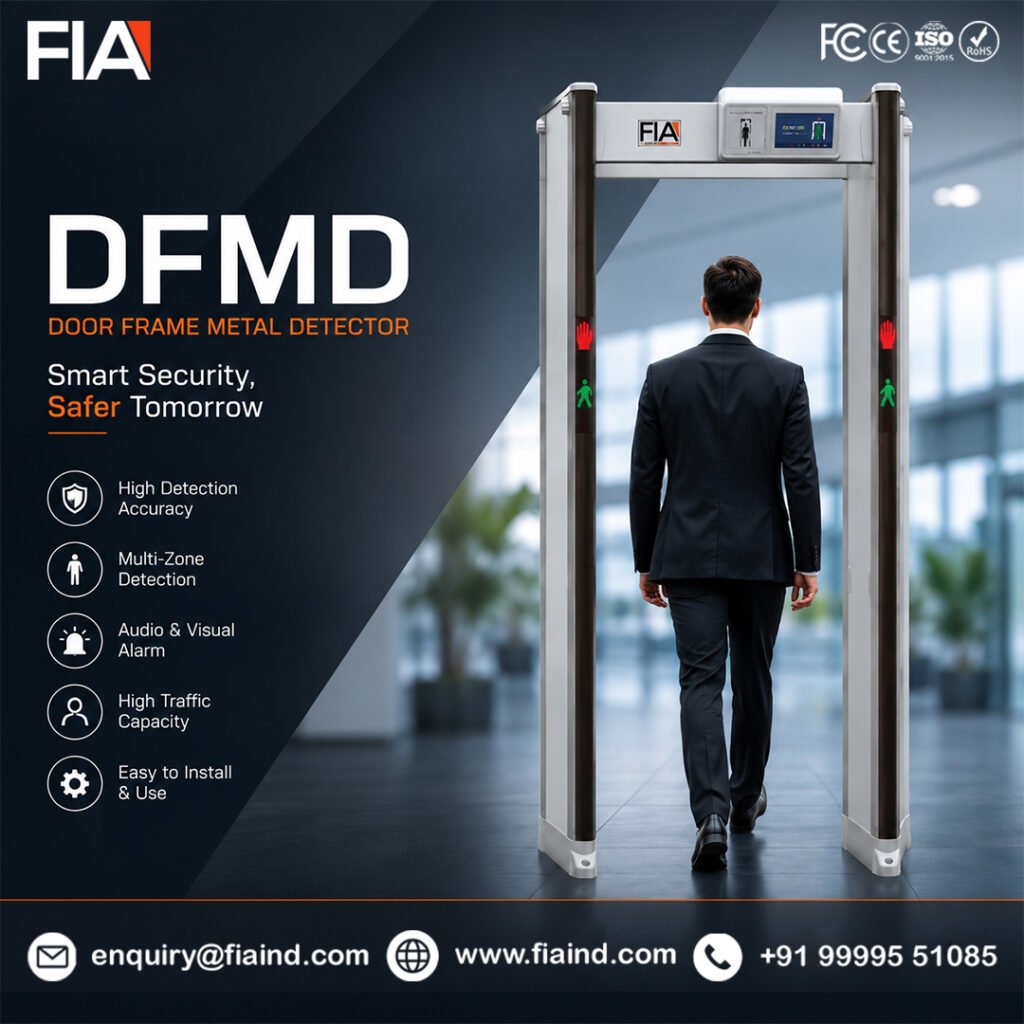
Security screening has moved from a “nice-to-have” to a baseline requirement for almost every high-footfall facility — airports, corporate parks, hotels, schools, courts, stadiums, and government buildings. At the center of this shift sits one piece of equipment that most visitors walk through without a second thought: the Door Frame Metal Detector (DFMD).
This guide explains what a DFMD is, how it works, the types available, key buying considerations, and why choosing a reliable manufacturer like FIA (First Idea Automation) matters when you’re investing in long-term security infrastructure.
What Is a Door Frame Metal Detector (DFMD)?
A Door Frame Metal Detector, also known as a walk-through metal detector, is a fixed, full-height security gate installed at entry points to automatically screen every person passing through it. Unlike handheld metal detectors (HHMDs), which require manual scanning by security staff, a DFMD screens people continuously and passively as they walk through, making it far more efficient for high-traffic locations.
The core purpose of a DFMD is simple: detect concealed metallic objects — weapons, blades, tools, or other prohibited items — before someone enters a secured premises. It does this without physical contact, without slowing down foot traffic significantly, and without requiring constant manual intervention.
How Does a DFMD Work?
The working principle of a DFMD is based on electromagnetic induction. The unit generates a controlled electromagnetic field within the frame. When a person carrying a metallic object passes through this field, the metal disrupts it and generates a secondary electromagnetic signal. The detector’s internal circuitry senses this disruption and triggers an audible and visual alarm, often pinpointing the approximate location of the object on the person’s body.
Modern DFMDs go well beyond this basic function. Depending on the model, they can:
- Distinguish between ferrous (iron-based) and non-ferrous metals
- Filter out harmless everyday items like belt buckles, coins, or spectacle frames to reduce false alarms
- Log footfall and alarm data for later audit and compliance reporting
- Integrate with access control and CCTV systems for a unified security setup
Types of Door Frame Metal Detectors
Not all DFMDs are built the same. Choosing the right type depends heavily on your facility’s risk profile and traffic volume.
1. Single-Zone DFMD Detects metal anywhere within the frame but cannot pinpoint its exact location on the body. Best suited for low-risk environments like small offices or retail stores where basic screening is sufficient.
2. Multi-Zone DFMD Divides the frame into multiple vertical detection zones (commonly 6, 12, 18, or more), allowing security personnel to know approximately where on the body — head, chest, waist, or ankle — the metallic object is located. This is the standard choice for airports, government buildings, and large public events where precision matters.
3. Advanced Digital DFMD Built with microprocessor-based circuitry, these units offer adjustable sensitivity per zone, better discrimination between harmless and threat items, weatherproofing for outdoor installations, and remote/software-based configuration. Increasingly, newer digital DFMDs also support IoT connectivity, sending real-time alerts and diagnostic data to a centralized security dashboard, which is especially useful for organizations managing screening across multiple sites.
Key Factors to Consider Before Buying a DFMD
Purchasing a DFMD is a long-term security and compliance decision, not a one-time equipment purchase. Here’s what facility managers, procurement teams, and security consultants should evaluate:
Zone configuration: More zones generally mean more precise threat location, but also a higher price point. Match the zone count to your actual security requirement rather than over- or under-specifying.
Sensitivity and discrimination: A good DFMD should reliably detect small metallic threats (in the range of a few grams) while minimizing false alarms from everyday carried items. Ask suppliers for the adjustable sensitivity range and independent test data.
Build and environmental durability: For outdoor installations — event entrances, stadium gates, temple complexes — look for weatherproof (IP-rated) enclosures that can withstand dust, rain, and temperature variation.
Compliance and certification: Always confirm that the unit conforms to recognized national or international security screening standards. Reputable manufacturers will readily share test certifications; vagueness on this point is a red flag.
Throughput requirements: High-footfall venues need DFMDs designed for continuous operation and fast, non-intrusive screening without creating bottlenecks at the entrance.
After-sales support and warranty: Since a DFMD is a long-term security asset, ongoing calibration, maintenance, and spare-parts availability matter as much as the initial purchase price.
Total cost of ownership: Rather than chasing the lowest quoted price, request an itemized quote separating unit cost, installation, warranty terms, and any annual maintenance contract — this gives a clearer long-term cost picture than comparing sticker prices alone.
DFMD vs. HHMD: Do You Need Both?
A common question among facility managers is whether a DFMD alone is sufficient. In most professional security setups, the answer is no — DFMDs and Hand-Held Metal Detectors (HHMDs) serve complementary roles. A DFMD handles primary, high-volume screening at the entrance, while an HHMD is used for secondary checks when the DFMD alarms, or for supplementary bag and body checks in lower-traffic zones. Using both together is widely considered the best-practice approach for comprehensive access control.
Why Manufacturer Choice Matters: FIA’s Approach to DFMD Systems
The reliability of a DFMD depends heavily on the manufacturer’s engineering standards and after-sales infrastructure. FIA (First Idea Automation) designs and manufactures door frame metal detector systems built for high accuracy and stable performance across commercial, industrial, and government installations.
FIA’s DFMD range is engineered specifically for Indian operating conditions — accounting for variables like power fluctuations, dust, humidity, and continuous high-traffic use — which makes the units dependable in real-world, high-risk environments rather than just controlled test conditions. The company’s product line spans from basic single-zone models suited to standard screening needs, to advanced multi-zone units designed for critical security environments where precise threat localization is essential.
Beyond the hardware itself, FIA emphasizes customizable sensitivity settings, accurate electromagnetic detection technology, and dedicated after-sales support — factors that directly affect how well a DFMD performs over years of continuous use, not just at the point of installation.
Visit for more information: https://www.fiaind.com/products/door-frame-metal-detector/
Final Thoughts
A Door Frame Metal Detector is no longer optional infrastructure for serious facility security — it’s a foundational layer of access control. But not every DFMD on the market is engineered to the same standard. Before purchasing, evaluate zone configuration, sensitivity, build quality, compliance certification, and vendor support carefully, and request documentation rather than relying on marketing claims alone.
For organizations evaluating dependable, India-ready DFMD systems, FIA’s door frame metal detector range is worth including in your comparison shortlist, backed by engineering focused on real-world durability and long-term reliability.
Learn more about FIA’s Door Frame Metal Detector systems at fiaind.com.