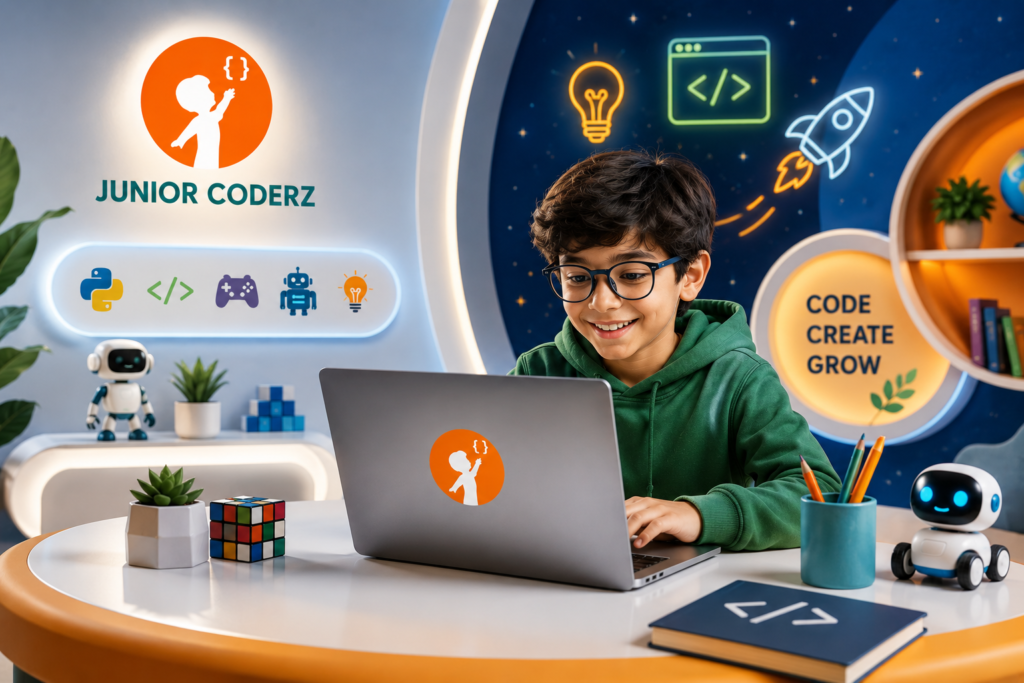
Coding skills for kids are becoming increasingly valuable as technology continues to influence education, communication, entertainment, and everyday life. Learning to code at a young age is not only about understanding programming languages. It can also give children opportunities to practice logical thinking, creativity, problem-solving, and project planning.
With the right learning environment, children can explore technology by creating games, animations, websites, apps, 3D designs, robotics projects, and AI-based ideas. Junior Coderz provides age-appropriate technology learning paths that introduce children to different areas of coding and digital creation.
Why Are Coding Skills Important for Kids?
Children naturally enjoy experimenting, creating, and discovering how things work. Coding can turn that curiosity into practical projects.
When children learn programming concepts, they can practice:
- Logical thinking
- Problem-solving
- Creativity
- Computational thinking
- Planning and organization
- Digital literacy
- Persistence and experimentation
- Project-building skills
Instead of simply consuming digital content, children can learn how technology is created and begin developing their own digital projects.
What Are Coding Skills for Kids?
Coding skills include the ability to understand programming logic and use technology to create something meaningful. For younger learners, coding may begin with visual block-based programming. As students gain experience, they can progress toward languages and technologies such as Python, HTML, CSS, JavaScript, artificial intelligence, and other advanced concepts.
A strong coding education can include several areas:
- Scratch and block-based coding
- Game development
- App development
- Web development
- Python programming
- Robotics and electronics
- 3D modeling
- Artificial intelligence and machine learning
Junior Coderz currently teaches these areas through different age- and skill-appropriate programs.
Scratch Coding: A Beginner-Friendly Starting Point
For young children who are completely new to programming, Scratch can provide an accessible introduction to coding.
Scratch uses visual blocks rather than requiring children to type complex programming syntax. Students can use these blocks to create:
- Games
- Animations
- Interactive stories
- Simple characters
- Creative digital projects
This approach allows children to understand concepts such as sequences, events, loops, and conditions while focusing on creativity.
Junior Coderz incorporates Scratch into programs such as Tiny Techies, Junior Inventors, and Code Champions.
How Scratch Helps Develop Coding Skills
Scratch projects encourage children to think about:
- What should happen first?
- What should happen next?
- How should a character respond?
- What happens when a player clicks something?
- How can a problem be fixed?
These questions introduce important programming concepts in a way that can feel more like creating than studying.
Game Development Skills for Kids
Games can be an exciting way to introduce children to programming because they combine technology, storytelling, design, and logic.
When children build a game, they may need to think about:
- Characters
- Movement
- Rules
- Scores
- Levels
- Challenges
- User interaction
- Game objectives
This makes game development a useful learning activity for developing both technical and creative skills.
Junior Coderz includes game development in several learning pathways, where it can be combined with technologies such as Python and 3D modeling.
App Development for Young Learners
App development gives children another opportunity to turn an idea into a digital product.
Students can learn how an application works from the idea and design stage through development. They can think about:
- What problem does the app solve?
- Who will use it?
- What features should it include?
- How should users interact with it?
- How can the app be improved?
Junior Coderz offers app development as part of selected programs for students, including Junior Inventors, Code Champions, and Python Hybrid.
Web Development Skills for Kids and Teens
Web development introduces students to the technology behind websites.
As learners progress, they can explore technologies such as:
- HTML
- CSS
- JavaScript
Learning web development can help children understand how websites are structured, designed, and made interactive.
It can also encourage students to combine technical knowledge with creativity. They can think about page layouts, colors, content organization, buttons, navigation, and interactive features.
Junior Coderz includes web development in selected programs, including Junior Inventors, Code Champions, and Algorithm Avengers.
Python Programming for Developing Stronger Coding Skills
As students become more comfortable with programming, Python can provide a path toward more advanced coding.
Python allows students to work with concepts such as:
- Variables
- Loops
- Functions
- Algorithms
- Debugging
- Object-oriented programming
Junior Coderz offers Python through programs including Python Hybrid and Python Pioneers, while Python is also part of other advanced learning paths.
Learning Python can help students move from visual programming toward text-based programming and more complex projects.
Robotics and Electronics Encourage Practical Thinking
Coding becomes even more interesting when students can connect programming concepts with robotics and automation.
Robotics activities can introduce children to ideas such as:
- Commands
- Sensors
- Movement
- Sequences
- Automation
- Logical decision-making
Virtual robotics can also give students an opportunity to explore engineering concepts while practicing programming logic.
Junior Coderz incorporates electronics and virtual robotics into selected programs, including Junior Inventors and Code Champions.
3D Modeling Combines Technology and Creativity
Coding education does not have to focus only on writing code.
3D modeling can introduce children to digital design and spatial thinking. Students can create digital models while learning to think about:
- Shapes
- Dimensions
- Structure
- Design
- Space
- Visual creativity
Junior Coderz includes 3D modeling in programs such as Junior Inventors, Code Champions, and Algorithm Avengers.
This combination of technical and creative learning can help students explore different areas of technology.
Artificial Intelligence and Machine Learning for Young Learners
Artificial intelligence is another area that older children and teens can explore as they develop their coding abilities.
AI and machine learning education can introduce concepts related to:
- Data
- Models
- Automation
- Image recognition
- Intelligent systems
- Problem-solving
Junior Coderz incorporates AI and machine learning into selected programs for different age groups, allowing students to explore modern technology alongside programming and other technical skills.
Coding Skills Can Develop Problem-Solving Abilities
One of the most useful aspects of coding is that programming problems rarely have to be solved all at once.
A student can break a larger challenge into smaller steps.
For example:
Big Goal: Create a simple game.
Smaller Tasks:
- Design the character.
- Create movement.
- Add obstacles.
- Add scoring.
- Add rules.
- Test the game.
- Find errors.
- Improve the project.
This process encourages children to approach challenges systematically.
Project-Based Learning Makes Coding More Engaging
Children often learn better when they can see the result of what they are creating.
Project-based coding can allow students to move through a simple learning cycle:
Learn → Build → Test → Fix → Improve
For example, a child learning Scratch may build an animation. A more advanced student might create a Python project, website, app, game, or AI-based project.
Junior Coderz emphasizes hands-on and interactive technology learning across its programs.
Coding Skills Can Grow With a Child
Children do not all learn programming at the same speed. A good coding pathway should therefore allow students to progress gradually.
Junior Coderz offers programs for different age and experience levels, ranging from beginner-focused learning for ages 6–7 through more advanced pathways for teens aged 14+.
This type of progression allows students to build a foundation before moving toward more advanced technologies.
Example Learning Progression
Beginner
- Computer basics
- Block-based coding
- Simple games
- Animations
- Logical thinking
Intermediate
- Python
- Game development
- Web development
- App development
- Robotics
- 3D modeling
Advanced
- Advanced Python
- AI
- Machine learning
- Advanced web development
- Complex programming projects
The exact learning path can depend on the student’s age, experience, and interests.
How Parents Can Encourage Coding at Home
Parents do not need to be professional programmers to encourage children to explore coding.
Simple strategies can include:
Encourage Curiosity
Ask children what they would like to build instead of only asking what they learned.
Celebrate Projects
A small game or animation can represent an important learning milestone.
Let Kids Experiment
Mistakes are a normal part of programming. Encourage children to test different ideas and learn from errors.
Focus on Creation
Encourage children to build something rather than only watching coding tutorials.
Give Them Time
Programming skills develop gradually. Consistent practice can be more useful than trying to learn everything at once.
What Makes a Good Coding Program for Kids?
When choosing coding skills for kids, parents can look for a program that offers:
- Age-appropriate lessons
- Experienced instructors
- Interactive classes
- Practical projects
- Different technology pathways
- Opportunities to solve problems
- Progressive learning levels
- Supportive instruction
The goal should be to help children understand technology while keeping the learning experience interesting and accessible.
Why Choose Junior Coderz for Coding Skills for Kids?
Junior Coderz offers a broad selection of technology-focused learning areas rather than limiting students to one programming topic.
Children can explore Scratch coding, game development, app development, web development, robotics, 3D modeling, Python, and AI/ML through different programs.
The available learning paths also cover different age groups and experience levels, helping students move from introductory concepts toward more advanced technology skills.
For parents looking for a structured way to introduce children to technology, this variety can make it easier to find a suitable starting point.
Final Thoughts
Learning coding skills for kids is about much more than memorizing programming commands. Coding can give children an opportunity to create, experiment, solve problems, and understand how digital technology works.
From Scratch and game development to Python, robotics, web development, 3D modeling, and artificial intelligence, children can explore a wide range of technology skills as they grow.
With age-appropriate learning paths and hands-on technology projects, Junior Coderz provides children and teens with opportunities to develop practical coding and digital creation skills.
For families interested in introducing children to programming, starting with the right level and allowing skills to develop gradually can make the learning journey more enjoyable and productive.