A power bank is more than a portable battery. It is something you carry in your pocket, backpack, office bag, or luggage while relying on it to keep your devices running when you need them most. That makes battery chemistry an important part of choosing the right power bank.
A semi solid state power bank is gaining attention because it uses a different battery approach from conventional lithium-ion designs. Instead of relying entirely on a conventional liquid electrolyte, semi-solid technology uses a gel-like or semi-solid electrolyte structure designed to improve thermal stability and reduce some of the risks associated with traditional battery chemistry. Semi-solid-state batteries are increasingly appearing in consumer products as the technology develops.
For people who regularly travel, work remotely, or simply want additional confidence from their everyday charging equipment, this technology offers an interesting alternative.
What Is a Semi Solid State Power Bank?
A semi solid state power bank is a portable charger that uses semi-solid battery cell technology rather than relying on the conventional liquid-electrolyte construction found in many traditional lithium-ion batteries.
In a conventional lithium-ion battery, the electrolyte helps lithium ions move between the electrodes. Because conventional electrolytes can be flammable, battery manufacturers use multiple protection systems to manage heat, charging, discharging, and electrical faults.
Semi-solid technology changes part of this structure by incorporating a semi-solid or gel-like electrolyte. The objective is to improve thermal stability and reduce the likelihood of certain failure conditions associated with liquid electrolytes. Current industry reporting describes semi-solid batteries as a practical development between conventional lithium-ion and fully solid-state battery technology.
This distinction is important because a power bank spends much of its life in real-world environments: inside bags, on desks, in cars, and during travel.
Why Does Battery Chemistry Matter in a Power Bank?
Most buyers start by looking at capacity. A 10,000mAh power bank may appear better than a smaller model, while a higher-wattage charger may look more attractive than a lower-output alternative.
However, capacity and charging speed are only part of the product.
The battery chemistry determines how energy is stored and how the cells respond to heat, charging, physical stress, and repeated use. This is why battery technology deserves attention when selecting a portable charger.
A semi solid state power bank focuses on this underlying part of the product rather than simply increasing the capacity number.
For everyday users, that can mean choosing a power bank based on how it is engineered instead of comparing only mAh figures.
Semi-Solid vs Conventional Lithium-Ion Batteries
The easiest way to understand the difference is to look at the electrolyte.
Traditional lithium-ion batteries generally use a liquid electrolyte. Semi-solid batteries use a partially solid or gel-like electrolyte structure. This difference can contribute to better thermal stability and lower flammability risk under certain conditions.
That does not mean a semi-solid battery is completely risk-free. No rechargeable battery should be treated as indestructible. Proper charging, storage, handling, and protection circuitry remain important.
Instead, the advantage is that the battery chemistry itself is designed with safety and stability in mind.
This is particularly relevant in a portable product because power banks are frequently transported and used in changing temperatures and environments.
Why Semi-Solid Technology Can Be Useful in India
India presents several practical challenges for portable electronics.
Hot weather, extended outdoor use, commuting, long journeys, and frequent travel can expose electronics to elevated temperatures. While every battery has operating limits, thermal management becomes especially important when a device is regularly carried around.
A semi solid state power bank can be an appealing choice for users who want battery technology designed around improved thermal stability.
This is one reason advanced battery technologies are receiving greater attention across consumer electronics, mobility, and energy-storage applications. Semi-solid batteries offer a transition toward safer battery designs while remaining closer to established lithium-based manufacturing processes than fully solid-state systems.
GRAVL Core 30: A Semi-Solid Power Bank Built for Everyday Carry
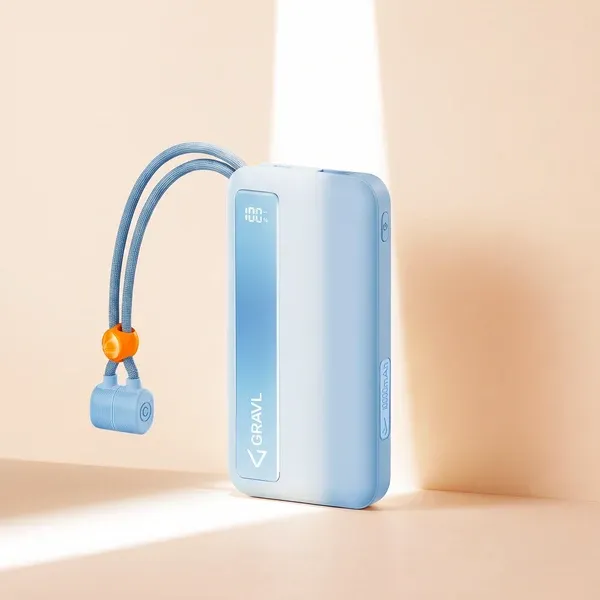
GRAVL’s semi-solid range currently features the Core 30, a 10,000mAh power bank designed around semi-solid battery chemistry. The collection page currently lists the Core 30 in Blue and Pink.
The Core 30 combines its battery technology with practical features for daily charging:
- 10,000mAh capacity
- Up to 30W maximum output
- Built-in Type-C and Lightning cables
- Smart LCD battery display
- Semi-solid battery chemistry
- Compact design for everyday carrying
- Blue and Pink colour options
The built-in cables are particularly useful for people who do not want to carry an additional charging cable everywhere. The LCD display also provides a quick indication of remaining battery level, making it easier to know when the power bank needs to be recharged.
Most importantly, the Core 30 puts the battery chemistry at the centre of its design rather than treating it as an afterthought.
Is a Semi Solid State Power Bank Safer?
Safety is one of the biggest reasons people are interested in semi-solid battery technology.
A semi solid state power bank can offer an important safety advantage because its semi-solid electrolyte structure is intended to provide greater thermal stability and reduce the risks associated with highly flammable liquid electrolytes. Industry coverage also identifies improved safety and thermal behaviour as major advantages driving interest in semi-solid battery technology.
However, it is important to use accurate language.
Semi-solid does not mean fireproof. It does not mean the product can be damaged without consequences. It also does not eliminate the need for charging protection.
The better way to understand it is simple: battery chemistry is one part of a broader safety system.
Cell design, battery management, electrical protection, thermal management, physical construction, and responsible use all matter.
Is It Good for Travel?
Travel is one of the situations where battery safety becomes particularly important.
Airlines regulate portable batteries based on their energy capacity, measured in watt-hours, rather than simply using the mAh number printed on the product. GRAVL states that its power banks are designed within commonly applicable carry-on limits, while the Core 30’s 10,000mAh capacity is approximately 37Wh based on a nominal 3.7V cell voltage.
But airline compliance and battery chemistry are two separate considerations.
A battery being permitted in carry-on luggage does not automatically make it safer than another permitted battery. Airline rules establish what you can carry; the battery’s design and chemistry influence how it behaves during use.
For travellers looking for a semi solid state power bank, this combination of portable capacity and semi-solid battery technology can make the Core 30 a practical option.
Always check the latest requirements of your specific airline before flying, as airline policies can change.
What Should You Look for When Buying One?
Buying a semi solid state power bank should not be based on the words “semi-solid” alone.
Consider these factors:
1. Battery Capacity
For phones and everyday devices, 10,000mAh is a practical middle ground between portability and backup capacity.
2. Charging Output
Look at maximum output wattage as well as capacity. A higher capacity does not automatically mean faster charging.
3. Built-In Cables
Integrated cables can reduce the number of accessories you need to carry, particularly during commuting and travel.
4. Battery Display
A digital display can make battery management easier because you can see the remaining charge instead of relying on a few indicator lights.
5. Build and Protection
Battery chemistry is important, but physical construction and electronic protection also matter. A well-designed power bank should be engineered as a complete system.
6. Warranty and Support
A clear warranty can provide additional confidence when investing in a rechargeable product that you expect to use regularly.
Why GRAVL Focuses on Battery Chemistry
At GRAVL, we believe a power bank should be designed around more than capacity and charging speed.
Our approach is focused on safety, reliability, and transparency. The Core 30 represents that philosophy by using semi-solid battery technology as a fundamental part of the product rather than simply adding another specification to the box.
Which stands for peace of mind, safety, reliability, and transparency.
The goal is straightforward: create charging products that people can carry confidently through everyday routines, workdays, commutes, and travel.
Who Should Consider a Semi-Solid Power Bank?
A semi solid state power bank can make sense for several types of users.
Frequent travellers: If you regularly carry a power bank on flights or long journeys, battery chemistry and airline compliance are both worth considering.
Daily commuters: People who carry a power bank in a backpack or office bag every day may appreciate a design focused on thermal stability and practical portability.
Remote workers: A reliable backup battery can be useful when working away from a wall outlet.
Safety-conscious buyers: If battery chemistry is an important part of your purchase decision, semi-solid technology provides an alternative to conventional battery construction.
Everyday smartphone users: You do not need to be a technology enthusiast to benefit from choosing a power bank designed with modern battery technology.
Final Thoughts
The power bank market has traditionally focused heavily on capacity, charging speed, and size. Those specifications remain important, but battery chemistry deserves equal attention.
A semi solid state power bank brings a different approach to portable energy storage by using a semi-solid electrolyte structure designed to improve thermal stability and reduce certain risks associated with conventional liquid electrolytes. It is not a replacement for responsible battery use, but it represents a meaningful development in rechargeable battery technology.
GRAVL’s Core 30 brings this technology into an everyday 10,000mAh power bank with up to 30W output, built-in Type-C and Lightning cables, and an LCD battery display.
If your priority is not simply carrying more power but carrying it with greater attention to battery technology, a semi-solid design is worth considering.
Explore the GRAVL Semi-Solid Power Bank Collection and discover a different approach to everyday portable charging.