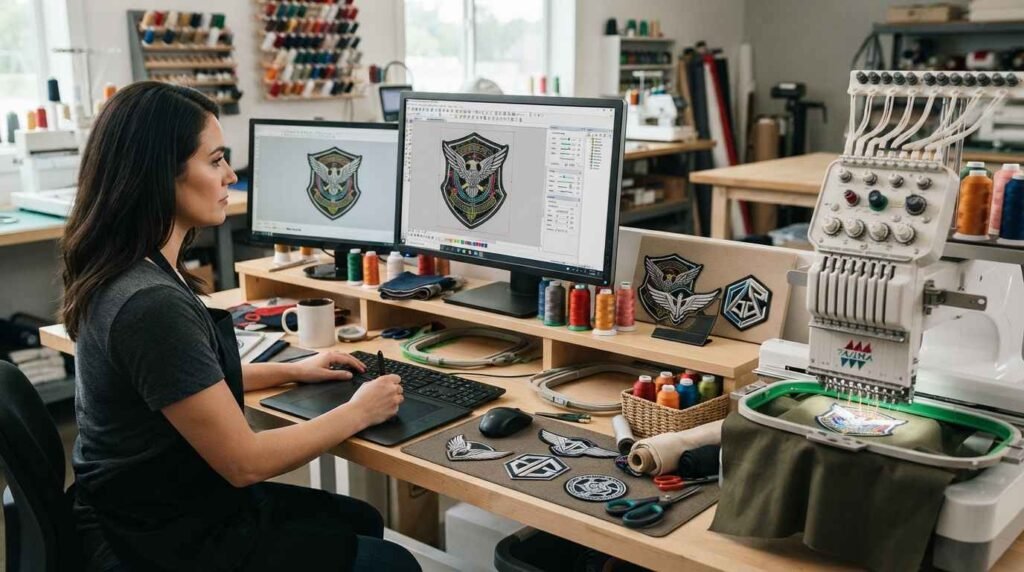
What to Expect From a Professional Patch Digitizing Provider
Custom embroidered patches require more than attractive artwork. Before a logo, emblem, text, or graphic can be stitched onto a patch, the design must be converted into a machine-readable embroidery file. Working with a professional patch digitizing provider can help ensure that the artwork is prepared according to the patch size, material, border style, and production requirements.
A professional provider should do more than convert an image into stitches. The process involves reviewing artwork, planning stitch types, managing small details, selecting appropriate density, organizing stitch sequences, and preparing the required machine format. Clear communication and quality control are also important, especially when the design will be produced in large quantities.
Knowing what to expect can help businesses, apparel companies, organizations, and individual customers choose a suitable provider for their patch projects.
Understanding the Role of a Patch Digitizing Provider
A patch digitizing provider prepares artwork for embroidery production.
The customer may provide a logo, drawing, text, photograph, or another type of artwork. The provider evaluates the design and converts its visual elements into stitches.
An embroidery machine cannot directly stitch a JPG or PNG image. It needs a specialized embroidery file containing instructions for stitch placement, direction, sequence, color changes, and other technical details.
For patch production, the provider must also consider the patch’s final dimensions and construction.
This makes the digitizing process a technical part of custom patch production.
1. Expect a Review of Your Artwork
A reliable provider should review the artwork before creating the final embroidery file.
The artwork review helps identify potential production issues.
The provider may examine:
- Design complexity
- Text size
- Fine lines
- Colors
- Patch dimensions
- Overall shape
A high-resolution image or vector file can make the review easier.
If the artwork contains extremely small details or unclear sections, the provider may explain which parts could require modification.
This early review can prevent problems later in the production process.
2. Expect Recommendations for Patch Size
The final patch dimensions can affect how the artwork should be prepared.
A detailed logo may work well on a large patch but become difficult to reproduce at a smaller size.
Small lettering is particularly sensitive to size limitations.
A professional provider should consider the intended dimensions before finalizing the embroidery file.
If the requested size is too small for certain elements, you may receive recommendations about simplifying the artwork or adjusting specific details.
This does not necessarily mean changing the identity of the design.
The objective is to adapt the artwork to the physical limitations of embroidery.
3. Expect Appropriate Stitch Planning
Different design elements require different stitching approaches.
Large areas may use fill stitches, while lettering and narrow sections may use satin stitches.
Fine outlines may require running stitches or another suitable technique.
The provider should select stitch types based on the design rather than applying identical settings to every project.
Stitch direction also matters.
Different directions can affect the appearance and texture of embroidered areas.
Careful stitch planning can help create a cleaner and more organized patch.
4. Expect Proper Stitch Density
Stitch density refers to how closely stitches are placed.
It needs to be balanced according to the design and material.
Excessive density can create unnecessary bulk and may contribute to distortion.
Insufficient density can leave gaps or allow the underlying material to become visible.
A Professional Patch Digitizing Provider should consider these factors when preparing the file.
Different parts of the same patch may require different density settings.
Large filled areas, small lettering, and narrow borders do not always need identical treatment.
5. Expect Suitable Underlay Stitches
Underlay provides a foundation beneath the visible embroidery.
It can help support top stitches and improve the stability of the design.
The appropriate underlay depends on the material, design, and stitch structure.
For example, a large filled section may require different support from a small lettering element.
A provider with practical embroidery knowledge should account for these differences when preparing the file.
Proper underlay can contribute to better coverage and a more stable finished design.
6. Expect Attention to Small Text
Text is often one of the most challenging parts of a custom patch.
Names, slogans, locations, team information, and company details may need to fit into a limited area.
Very small lettering can become difficult to read because thread has physical thickness.
A professional provider should evaluate the lettering at its actual production size.
If the text is too small, the provider may recommend increasing the letter size, modifying the font, or simplifying the wording.
The goal is to preserve readability while maintaining the intended design.
7. Expect Accurate Patch Borders
A patch border helps define its final shape.
Common border styles include merrowed borders, satin stitch borders, and cut-edge finishes.
The embroidery file should account for the selected border method.
Custom-shaped patches may require additional planning because the outer edge follows an unusual outline.
The provider should understand how the border relates to the artwork.
Adequate spacing between the design and outer edge may be necessary depending on the production method.
Discussing the border style before file preparation can help avoid unnecessary revisions.
8. Expect Proper Stitch Sequencing
The order in which different parts of a design are stitched affects production.
A patch may contain several colors and overlapping elements.
The embroidery file should organize these sections logically.
Good sequencing can reduce unnecessary machine movements, trims, and thread changes.
It can also help prevent certain design elements from being covered incorrectly by later stitches.
The exact sequence depends on the artwork and production method.
A professional provider should plan the order with the complete design in mind.
9. Expect the Correct Embroidery File Format
Different embroidery machines use different file formats.
Common formats include DST, PES, EXP, JEF, and VP3.
The required format depends on the machine being used.
Before the file is prepared, provide the machine information or required format.
A suitable provider should confirm the format rather than assuming one will work for every machine.
Receiving the correct file format can prevent compatibility problems when production begins.
10. Expect Clear Communication
Communication is an important part of custom embroidery work.
A provider should understand the design requirements and clarify important information before starting.
You may need to provide:
- Original artwork
- Final patch dimensions
- Patch shape
- Border style
- Thread color requirements
- Embroidery machine format
If any important information is missing, the provider should ask for clarification.
Good communication can reduce misunderstandings and unnecessary revisions.
It is also helpful when the provider explains technical limitations in simple terms.
11. Expect a Clear Revision Process
Custom designs may require adjustments.
A test sew-out may reveal that lettering needs modification or that a particular detail does not reproduce as expected.
A customer may also request changes to the original artwork.
Before ordering, understand how revisions are handled.
Ask what types of adjustments are included and whether major design changes have additional charges.
A clear revision policy makes the process easier to manage.
It also helps both sides understand what is included in the service.
12. Expect Quality Control Before Delivery
The embroidery file should be reviewed before being delivered for production.
Quality control can involve checking the design dimensions, stitch sequence, color changes, lettering, and file format.
The provider may also use embroidery software to inspect the design before delivery.
This review can help identify obvious problems.
However, software inspection does not replace actual embroidery testing.
A design that looks correct on a computer may behave differently when stitched onto the actual patch material.
For important projects, a sew-out remains useful.
13. Expect Test Sew-Out Guidance
A test sew-out is a sample embroidery produced before full-scale manufacturing.
It provides an opportunity to examine how the file performs on the actual material.
A sew-out can reveal problems involving:
- Letter readability
- Stitch coverage
- Border alignment
- Design proportions
- Fabric movement
For a large patch order, testing can help reduce the risk of repeating an issue across many pieces.
The test should ideally use materials and settings similar to the final production process.
Machine tension, needles, thread, stabilizer, and operator setup can also affect the result.
14. Expect Professional Handling of Complex Artwork
Some patch designs contain multiple colors, detailed logos, thin outlines, and small text.
These designs require more planning than simple shapes.
A professional provider should evaluate the artwork element by element.
Some details may need to be simplified to work at the selected size.
This is particularly important when the patch is small.
The provider should explain any necessary modifications rather than making major changes without communication.
The aim is to maintain the important visual characteristics while making the design practical for embroidery.
15. Expect Advice About Fabric and Materials
The patch material can affect embroidery results.
Different materials behave differently during stitching.
Some fabrics are more stable, while others may stretch or shift.
The provider may ask what type of material will be used for the patch.
This information can help with stitch settings and design preparation.
Common patch materials include twill, felt, canvas, and other embroidery-friendly fabrics.
The final choice should be based on the intended application and production method.
16. Expect Help With Different Patch Styles
A professional provider should be familiar with different patch styles.
Traditional embroidered patches, custom-shaped patches, logo patches, and raised designs can have different requirements.
For example, a custom-shaped patch may require careful planning around its outer edge.
A raised design may require additional considerations related to stitch structure and available space.
When requesting a service, explain the type of patch you want to produce.
This allows the provider to prepare the file according to the intended production method.
17. Expect Practical Advice Rather Than Automatic Conversion
Automatic image conversion can create basic embroidery files, but it may not account for every production requirement.
An automated process may generate excessive stitches, unsuitable stitch directions, or poor sequencing.
Professional preparation involves reviewing and adjusting the design.
This is particularly important for logos, small lettering, and detailed patch artwork.
A provider should focus on how the file will actually perform during embroidery.
The objective is a production-ready design rather than simply changing the file type.
18. Expect Realistic Turnaround Information
Turnaround time can vary according to design complexity and workload.
A simple logo may require less preparation than a detailed custom patch.
If you have a deadline, communicate it before placing the order.
A reliable provider should give realistic information about when the file can be completed.
Urgent work may have different conditions from standard orders.
Rather than focusing only on speed, consider whether the provider allows enough time for design review and quality checks.
How to Prepare Before Contacting a Provider
Customers can make the process easier by preparing project information in advance.
Provide the highest-quality artwork available.
If possible, include a vector version of the logo.
Confirm the final patch dimensions.
Specify the patch shape and border style.
Tell the provider which embroidery machine or file format will be used.
If specific thread colors are required, provide the relevant information.
Clear instructions help the provider understand the project before beginning the file.
Questions to Ask Before Choosing a Provider
Before placing an order, ask about experience with custom patches.
You can also ask how the provider handles small lettering and complex artwork.
Find out which embroidery formats are available.
Ask about revisions and whether test sew-outs are recommended.
It can also be useful to review previous patch designs.
The answers can help you determine whether the service understands your production requirements.
How to Evaluate Previous Patch Work
A portfolio can provide useful information about a provider’s capabilities.
Look closely at the details instead of only judging the overall design.
Check whether lettering appears readable.
Look at curved borders and small shapes.
Review whether the stitch coverage appears balanced.
If actual sew-out photographs are available, compare them with digital previews.
Examples that are similar to your project can provide more useful information than unrelated designs.
What a Professional Workflow Looks Like
A typical workflow starts with artwork submission.
The provider reviews the design and confirms important requirements.
The artwork is then converted into an embroidery file with appropriate stitch types, density, underlay, and sequencing.
The file is reviewed and delivered in the required machine format.
For important projects, a sew-out can then be produced.
If adjustments are required, the file can be revised before full production.
This structured process helps reduce avoidable errors.
Common Warning Signs to Watch For
There are several signs that a provider may not be suitable for a complex patch project.
One warning sign is a provider that promises to convert every design without reviewing the artwork.
Another is a lack of information about file formats.
Unclear revision policies can also create problems.
If a provider cannot explain how small text or detailed artwork will be handled, ask for clarification before ordering.
A very low price is not necessarily evidence of poor quality, but price should be evaluated alongside experience, communication, and production support.
Conclusion
Knowing what to expect from a Professional Patch Digitizing Provider can make the custom patch process easier and more predictable. A suitable provider should review your artwork, consider the final patch size and shape, plan appropriate stitches, handle lettering carefully, prepare accurate borders, and deliver the file in the format required by your embroidery machine.
Quality control and communication are equally important. For detailed designs or large production orders, a test sew-out can help identify potential issues before manufacturing begins. It is also important to remember that final embroidery quality depends on the file as well as the machine, thread, stabilizer, fabric, needles, and production setup.
By choosing a provider that combines technical knowledge with clear communication and practical production guidance, you can prepare custom patch designs more effectively. For professionally prepared embroidery files for custom patches, idigitize can assist with designs suited to different patch applications.
Frequently Asked Questions
Q1. What should I expect from a Professional Patch Digitizing Provider?
You should expect artwork review, appropriate stitch planning, attention to patch size and borders, correct file formatting, clear communication, quality control, and support with revisions when needed.
Q2. What artwork should I send to a patch digitizing provider?
Send the highest-quality artwork available. Vector files such as AI, EPS, SVG, or PDF can be useful, although high-resolution JPG and PNG files may also work as references.
Q3. Does patch size affect the digitizing process?
Yes. Smaller patches have less room for fine details and small lettering. The final dimensions should be provided before the embroidery file is prepared.
Q4. Should I request a test sew-out?
For important designs or large production orders, a test sew-out is recommended because it shows how the embroidery file performs on the actual material.
Q5. Which embroidery file format should I request?
The format depends on your embroidery machine. DST, PES, EXP, JEF, and VP3 are among the commonly used formats.