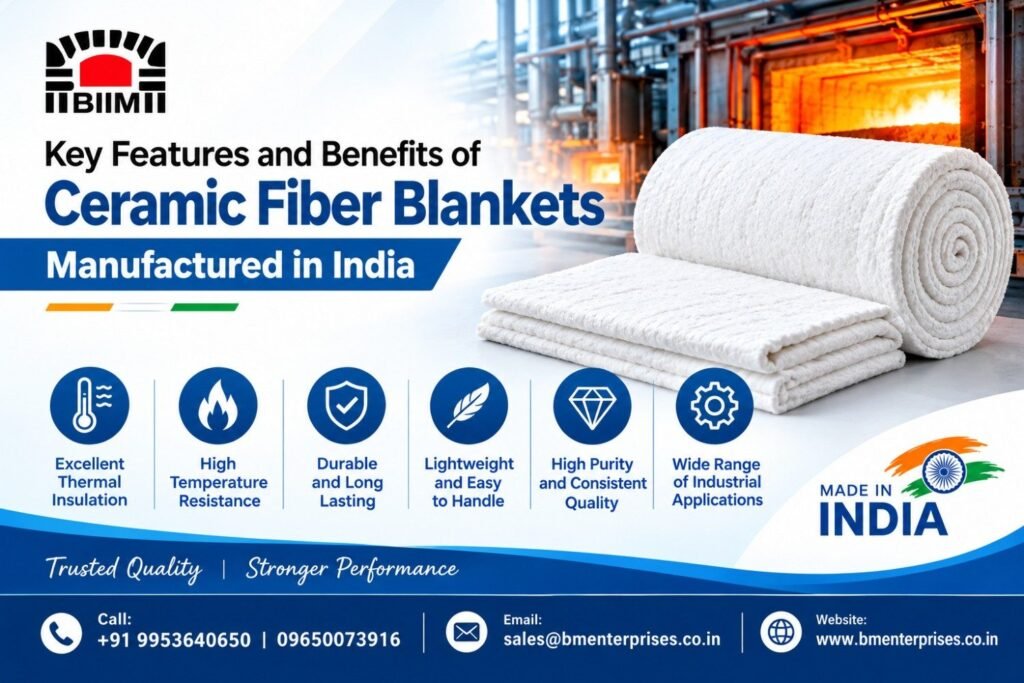
For industrial furnaces, boilers, kilns, and heat treatment, insulating materials must withstand high temperatures while controlling heat loss. One such material is ceramic fiber blankets that have found wide usage due to their high-temperature resistance, low heat conductivity, lightness, and flexibility. Because they are flexible, ceramic fiber blankets are easy to handle and install around surfaces, as they do not require heavy refractory materials. They make a good option for thermal insulation for those who wish to save on energy.
BM Enterprises manufactures refractory and insulation materials and offers ceramic blankets for furnaces, boilers, kilns, ovens, and other high-temperature equipment. Different densities and thicknesses of insulation materials ensure a buyer finds the best insulation material that fits their needs.
What Are Ceramic Fiber Blankets?
Ceramic fiber blankets are flexible refractory insulating materials, which consist of ceramic fibers with high thermal resistance. Ceramic fibers give a porous and light construction that reduces the transmission of heat with good flexibility. Ceramic fiber blankets may be provided in roll form and cut into required sizes, thus being easy to install in comparison with other refractory materials.
Among the most popular types of ceramic fiber blankets is the one with a density of 128 kg/m3 and mechanical stability. Depending on the type of ceramic fiber blanket, there are various grades of density, thickness, and temperature classification. It is necessary to select the appropriate grade according to temperature and conditions of use.
Key Features of Ceramic Fiber Blankets
Resistance to High Temperatures: These ceramics can withstand high temperatures, thus making them appropriate for use in furnaces, kilns, boilers, ovens, among other high-temperature industrial applications.
Low Thermal Conductivity: Low thermal conductivity reduces the amount of heat transfer and losses, ensuring increased thermal efficiency and temperature regulation.
Lightweight Structure: These ceramic blankets are much lighter compared to most heavy refractories, thus making them convenient in handling and installation.
Flexibility: The ceramic fiber blankets are flexible; hence, easy to shape, cut, and fit into places like curved surfaces, furnace doors, ducts, and expansion joints.
Thermal Shock Resistance: The blankets can withstand rapid temperature variations through heating and cooling cycles and, thus, are good for use in high-temperature industrial equipment.
Different Densities: There exist ceramic fiber blankets of different densities, such as 64 kg/m³, 96 kg/m³, 128 kg/m³, and 160 kg/m³. Thus, users can choose an appropriate product depending on their insulation needs.
Different Thickness Options: Based on the grade of the material, the ceramic blankets can be obtained in different thicknesses such as 6, 12, 20, 25, and 50 mm.
Use in Industries: The materials are popularly used for furnace linings, kilns, boilers, heat treatment furnaces, ductwork, piping, furnace doors, and backup insulation systems.
Use in Repairs and Modifications: Ceramic fiber blankets can be easily cut into different dimensions for insulation purposes and repairs and modifications in insulation systems.
Ceramic Fiber Blanket Specifications
Specifications vary according to manufacturer and grade, but a typical industrial 128 kg/m³ ceramic fiber blanket may have the following characteristics:
Specification
Typical Value
Product
Ceramic Fiber Blanket
Density
128 kg/m³
Temperature Classification
Up to 1260°C for selected grades
Thickness
6, 12, 20, 25 and 50 mm
Width
Around 610 mm in common products
Thermal Conductivity
Around 0.15 W/m·K for selected products
Form
Flexible blanket/roll
Colour
Generally white
Applications
Furnaces, kilns, boilers, ovens and ducts
Exact specifications can vary between products, so industrial buyers should confirm the technical datasheet before placing an order.
Applications of Ceramic Fiber Blankets
Industrial Furnaces: Used as backup insulation, lining material, and furnace-door insulation to reduce heat loss and maintain high operating temperatures.
Kilns and Ceramic Industries: Can be applied to kiln walls, roofs, doors, and kiln cars to ensure thermal insulation throughout heating-cooling cycles.
Boilers: To ensure thermal insulation by applying it to various components, doors, and surfaces that undergo heat exchange.
Steel and Foundry Industries: To apply to the surfaces of reheating furnaces, melting units, furnace doors, and other areas heated intensely.
Industrial Ovens: Lightweight insulating material for industrial ovens where drying and curing are carried out.
Pipelines and Hot Ducts: Can be used to insulate high-temperature pipelines and hot ducts, thereby limiting heat loss from their surface.
Expansion Joints: Flexible insulating material that can be used as insulation for the expansion joints, since there is a requirement for movement due to thermal expansion.
Furnace Doors and Covers: The flexibility of the ceramic fiber blanket allows it to adapt to an irregular surface for insulation around the door and cover areas.
Backup Insulation: Installed behind the refractory bricks/castables/boards as backup insulation.
Benefits for Industrial Insulation
The main advantage of ceramic fiber insulation is its ability to better manage heat flow. The lightness of this product can be beneficial if fast heating and cooling cycles are needed due to its low thermal mass. As this type of insulation is lightweight, it allows reducing the total insulation weight in comparison with the refractory one.
Moreover, installation advantages can be highlighted. The maintenance team can trim the blanket into pieces and replace them if necessary, according to the particular design of the lining.
Choosing the Right Ceramic Fiber Blanket
The choice of blanket goes beyond just looking at the temperature rating of the product. Factors such as density, thickness, thermal conductivity, operating temperature, dimensions, and installation are all things that need to be looked into when choosing the right type of ceramic fiber blanket.
In addition, chemical resistance, mechanical interaction, vibration, and thermal cycling can affect the choice of products and service life. For instance, a 128 kg/m³ blanket may work for a specific furnace insulation requirement, but the right thickness will depend on thermal requirements and available installation space.
BM Enterprises – Ceramic Fiber Blankets Supplier in India
BM Enterprises is a renowned manufacturer and supplier of refractory and insulation materials for various industrial uses. BM Enterprises offers refractory fire bricks, ceramic fiber blankets, high alumina bricks, insulation bricks, refractory castables, mortars, calcium silicate boards, and various thermal insulations.
As one of the ceramic fiber blanket manufacturers in India, BM Enterprises aims to offer its clients industrial use products that have high-temperature capacity. Before placing orders, clients are given an opportunity to talk about density, thickness, temperature resistance level, quantity, and application of the products. This will make it easy to order other refractory materials from a professional refractory supplier.
Conclusion
The ceramic fiber blanket products manufactured and delivered in India have proved to be a good choice for thermal insulation in industrial applications due to their properties like high resistance to temperatures, low thermal conductivity, light weight, flexibility, and high resistance to thermal shocks.
If any customer is looking for a ceramic fiber blankets manufacturer, ceramic blankets, or a ceramic fiber blankets supplier in India, the selection of the product as per the real situation is highly necessary. The ceramic fiber insulation and a wide range of refractory products can be provided by BM Enterprises.
FAQs
1. Where are ceramic fiber blankets applied?
These are used for thermal insulation of furnaces, kilns, boilers, ovens, ducts, furnace doors, and heat treatment equipment.
2. What is 128 kg/m³?
This is the nominal density of the ceramic fiber blanket. 128 kg/m3 ceramic blankets are widely applied for industrial insulation.
3. At which temperature can ceramic fiber blankets be applied?
Their temperature capability varies with the grade. Some selected standard grades of ceramic fiber blankets are rated up to about 1260°C.
4. Are there ceramic fiber blankets available in different thicknesses?
Yes, there are various thicknesses, such as 6, 12, 20, 25, and 50 mm, among others.
5. Where can I purchase ceramic fiber blankets in India?
BM Enterprises offers ceramic fiber blankets and other types of refractory insulation material for industrial purposes in India.