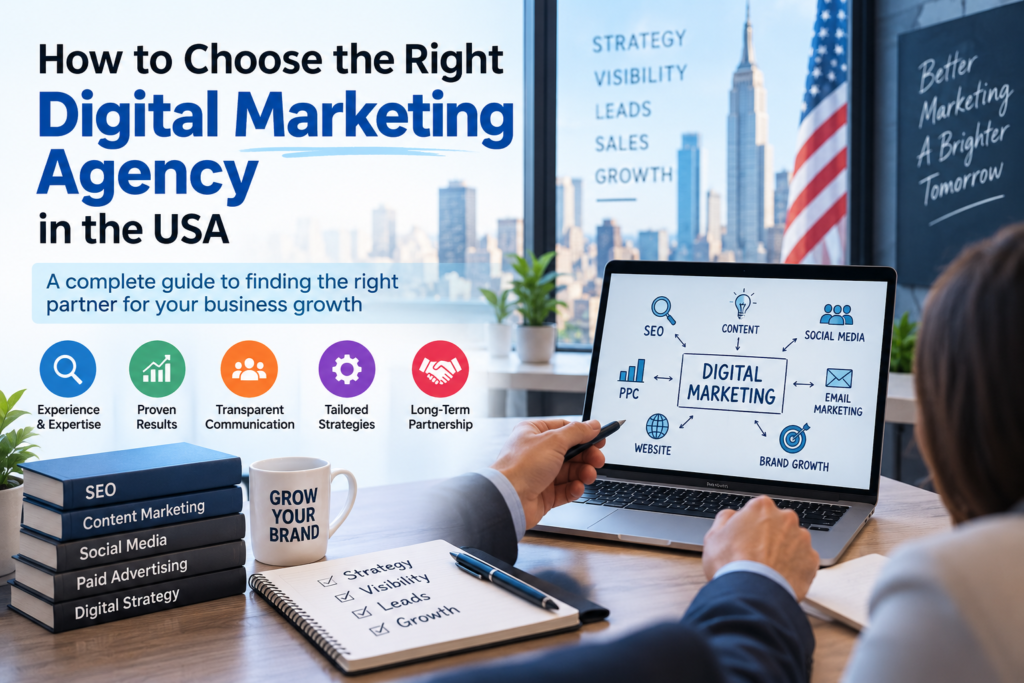
Choosing a digital marketing partner is an important decision for any business operating in the United States. Whether a company is a small local business, a growing startup, an e-commerce brand, or an established organization, its online presence can have a major impact on visibility, customer engagement, and long-term growth.
The challenge is that there are thousands of agencies offering services such as search engine optimization, paid advertising, content marketing, social media management, website development, and digital public relations. Comparing these agencies can be difficult when many websites make similar promises.
A better approach is to evaluate an agency based on its experience, processes, communication, transparency, and ability to understand your specific business objectives.
Understand What Your Business Actually Needs
Before contacting an agency, identify the areas where your business needs the most support.
For example, a company with a well-designed website but very little organic traffic may need an SEO-focused strategy. An e-commerce business may benefit from a combination of search optimization, paid advertising, email marketing, and conversion optimization.
A startup launching a new product may have different priorities, such as brand awareness, content development, digital PR, and audience research.
Creating a list of your current challenges can make the selection process much easier. Instead of asking an agency to “do digital marketing,” you can discuss specific objectives.
Common objectives include:
- Increasing organic search visibility
- Generating qualified website traffic
- Improving lead generation
- Increasing online sales
- Building brand awareness
- Improving website conversions
- Reaching a specific geographic market
- Developing a consistent content strategy
Clear objectives also make it easier to measure whether an agency is producing meaningful results.
Look at the Agency’s Experience
Experience should be evaluated carefully rather than simply counting the number of years an agency has been operating.
Ask whether the agency has experience working with businesses similar to yours. Industry knowledge can be valuable because different sectors have different customers, regulations, buying cycles, and competitive environments.
For example, a local service business may need a strong local SEO strategy, while a software company may focus more heavily on technical content, organic search, product education, and lead generation.
Review the agency’s case studies, portfolio, published content, and examples of previous work when available. Look for evidence that demonstrates how the agency approaches problems and measures outcomes.
A credible agency should be able to explain its work without relying entirely on vague claims such as “guaranteed rankings” or “instant traffic.”
Evaluate the Services Offered
Not every business needs every digital marketing service.
A good agency should be able to explain which services are relevant to your goals rather than simply presenting a large list of offerings.
Digital marketing services can include:
Search Engine Optimization
SEO focuses on improving a website’s visibility in organic search results. It can involve technical optimization, keyword research, content development, internal linking, digital authority, and user experience.
Content Marketing
Content marketing helps businesses educate and engage their target audiences through useful articles, guides, research, videos, and other resources.
Paid Advertising
Pay-per-click advertising can provide faster visibility through platforms such as Google Ads and social advertising networks. However, paid campaigns require ongoing testing, budget management, and performance analysis.
Social Media Marketing
Social media can help businesses communicate with customers, distribute content, and build brand recognition. The right platforms depend on where the target audience spends time.
Website Development and Conversion Optimization
A business may generate significant traffic but still struggle to produce leads or sales if its website is difficult to use. Website performance, navigation, mobile usability, page speed, and calls to action can all affect conversions.
Digital PR
Digital PR can help organizations increase brand visibility through news coverage, expert commentary, publications, and other online media opportunities.
The best service mix depends on the company’s goals, resources, industry, and stage of growth.
Check How the Agency Measures Results
One of the most important questions to ask a digital marketing agency is how it defines success.
Traffic alone does not always represent business growth. A website could receive thousands of visitors without generating meaningful leads or sales.
Depending on the business model, useful performance indicators may include:
- Qualified organic traffic
- Leads generated
- Conversion rate
- Cost per acquisition
- Revenue attributed to marketing
- Search visibility
- Engagement with key content
- Return on advertising spend
- Customer acquisition cost
The agency should explain which metrics matter and why.
For example, an SEO campaign should not be evaluated solely by the number of keywords ranking on Google. Rankings are useful indicators, but their business value depends on whether they attract relevant users and contribute to meaningful outcomes.
Ask About Reporting and Communication
Communication can make a significant difference in a long-term agency relationship.
Before signing an agreement, find out how often the agency provides reports and what those reports contain.
A useful report should explain what was done, what changed, what performed well, what did not perform as expected, and what actions are planned next.
Businesses should also understand who they will communicate with. Some agencies assign a dedicated account manager, while others use larger teams.
Ask questions such as:
- How frequently will we receive reports?
- Who will be our main point of contact?
- How are strategy changes communicated?
- What happens if performance declines?
- How quickly are important questions answered?
Good communication does not mean constant meetings. It means having a clear process for sharing information and making decisions.
Review the Agency’s Approach to SEO
If SEO is an important part of your marketing strategy, pay particular attention to the agency’s methods.
Avoid agencies that promise guaranteed first-page rankings or immediate organic growth. Search engines use complex systems, and legitimate SEO requires testing, quality content, technical improvements, and time.
Ask the agency whether it performs technical audits, evaluates search intent, analyzes competitors, improves existing content, and monitors performance.
It is also useful to understand how the agency approaches links and digital authority.
Quality should generally matter more than quantity. An agency that promises hundreds of links every month without explaining their relevance or quality may create unnecessary risks.
Consider Transparency and Ethics
Trust is particularly important when an outside company has access to your website, advertising accounts, analytics platforms, and other digital assets.
Make sure you understand who owns your website, domain, content, advertising accounts, analytics data, and other important assets.
You should also ask whether the agency follows search engine guidelines and industry best practices.
Ethical marketing generally focuses on creating genuine value for users rather than attempting to manipulate platforms through deceptive techniques.
Transparency around pricing is equally important. A professional agency should clearly explain what is included in its agreement and identify additional costs before work begins.
Compare Pricing Carefully
The cheapest agency is not necessarily the best choice, and the most expensive agency is not automatically the most effective.
Pricing can vary based on the agency’s expertise, team size, services, campaign complexity, target market, and expected workload.
Instead of comparing monthly fees alone, compare the scope of work.
For example, one agency might charge less but provide only basic reporting and limited content, while another may provide detailed research, technical SEO, content development, analytics, and ongoing strategy.
Ask for a clear breakdown of:
- Services included
- Expected deliverables
- Reporting frequency
- Contract duration
- Additional charges
- Cancellation terms
- Campaign responsibilities
This makes it easier to compare agencies based on value rather than price alone.
Check Reviews and Independent Evidence
Testimonials on an agency’s own website can be useful, but they should not be your only source of information.
Look for independent reviews, professional profiles, industry publications, client references, and other credible evidence.
When reading reviews, pay attention to recurring themes. Several clients mentioning strong communication or detailed reporting can provide useful insight into the agency’s working style.
Likewise, repeated complaints about missed deadlines, unclear billing, or poor communication should be considered carefully.
No agency will have perfect results for every client, but consistent patterns can reveal useful information.
Understand the Contract Before Signing
A digital marketing agreement can last several months or longer, so read the terms carefully.
The contract should clearly describe the services being provided, payment structure, contract duration, ownership of assets, reporting responsibilities, and termination conditions.
Ask questions about anything you do not understand.
Businesses should also be cautious about agreements that make it difficult to regain access to their own websites, advertising accounts, or marketing data.
A healthy agency relationship should be based on cooperation rather than unnecessary dependency.
Choose an Agency That Understands Your Audience
Understanding the American market requires more than simply targeting users located in the United States.
The country includes diverse regions, industries, demographics, purchasing behaviors, and competitive markets.
A strong agency should be willing to learn about your customers and understand what motivates them to choose your product or service.
For example, a campaign targeting customers in New York may require a different approach from one targeting customers across multiple states.
The agency should consider your target locations, customer needs, competitors, search behavior, and business model when developing a strategy.
Look for a Long-Term Strategic Partner
Digital marketing is rarely a one-time activity.
Search algorithms change, competitors publish new content, advertising costs fluctuate, customer expectations evolve, and new platforms emerge.
For that reason, businesses should consider whether an agency can adapt its strategy over time.
The right partner should be willing to review performance, identify opportunities, learn from unsuccessful campaigns, and adjust priorities when necessary.
For businesses researching potential providers, reviewing companies such as SP Tech Solutions can also help create a broader understanding of the types of digital marketing services available in the market.
Questions to Ask Before Hiring a Digital Marketing Agency
Before making a final decision, consider asking potential agencies:
- Have you worked with businesses similar to mine?
- What would you prioritize during the first few months?
- How do you measure campaign success?
- What information will you need from our team?
- How frequently will we receive reports?
- Who will manage our account?
- Which tools do you use for research and reporting?
- How do you approach SEO and content quality?
- What is included in the monthly fee?
- What happens if we decide to end the agreement?
The answers can reveal how well the agency understands your goals and whether its working style matches your expectations.
Final Thoughts
Choosing the right digital marketing agency in the USA is less about finding the company with the biggest promises and more about finding a partner that understands your objectives, audience, industry, and measurement requirements.
Start by defining your goals, research potential agencies, evaluate their experience, examine their processes, compare their services, and carefully review contracts before making a commitment.
Most importantly, look for transparency. A reliable digital marketing partner should be able to explain what it is doing, why it is doing it, how success will be measured, and how the strategy can evolve over time.
With a thoughtful selection process, businesses can build a marketing partnership focused not just on online visibility, but on sustainable and measurable business growth.