Introduction
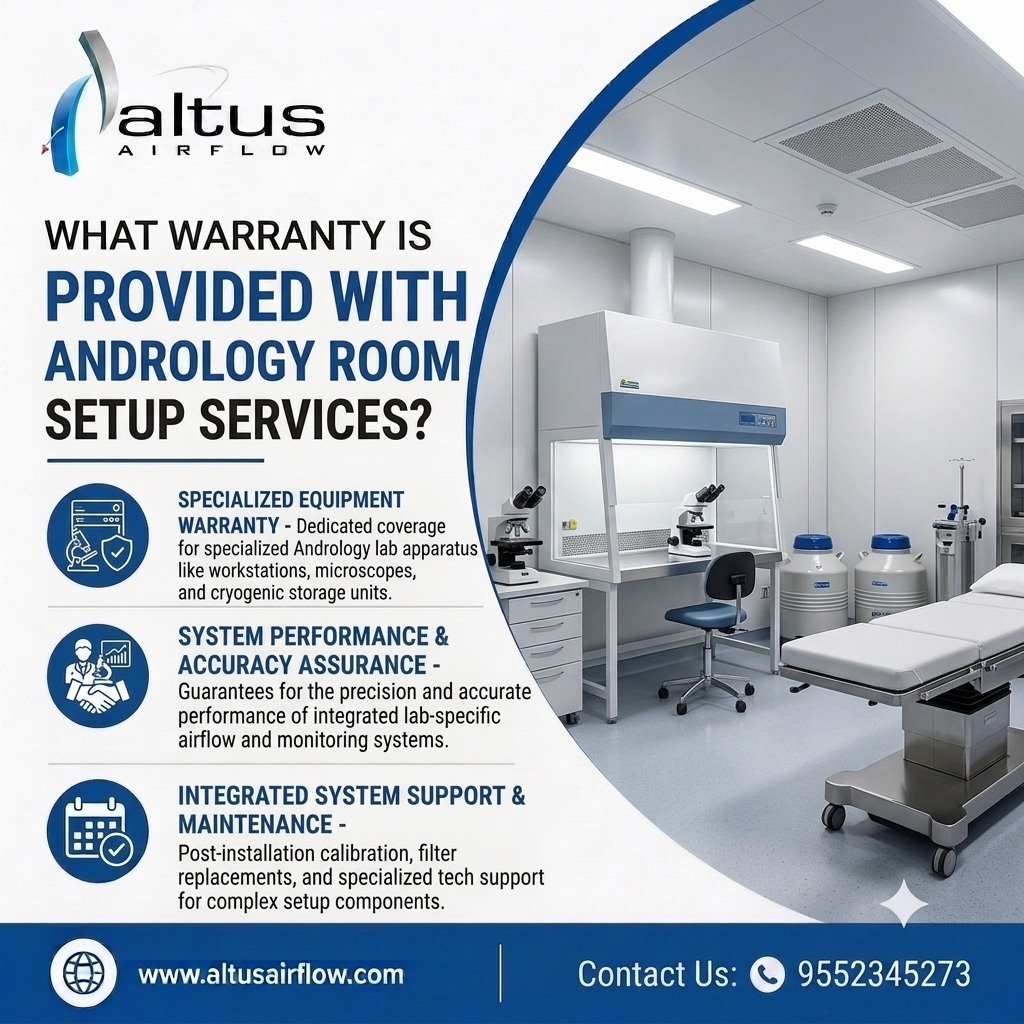
Altus Airflow provides engineering and infrastructure solutions for controlled healthcare and laboratory environments, where reliable performance is important for long-term operation. When planning an andrology room, hospitals and fertility centres invest in specialized HVAC systems, modular panels, electrical infrastructure, filtration, monitoring systems, flooring, doors, and other integrated components. Understanding the warranty associated with Andrology Room Setup Services is therefore an important part of project planning. A warranty can provide assurance regarding workmanship and specified supplied components while also defining the responsibilities of the service provider and facility after installation.
Warranty terms for an andrology room can vary according to the project scope, equipment manufacturers, selected materials, installation conditions, and contractual requirements. Some components may have separate manufacturer warranties, while the installation and workmanship may be covered under the project provider’s warranty. Hospitals should review the warranty document carefully to understand the coverage period, exclusions, maintenance requirements, response procedures, and conditions for making a claim. Warranty coverage should also be distinguished from annual maintenance contracts, because warranty generally addresses specified defects or failures, while maintenance agreements focus on routine servicing and performance support.
1. What Does an Andrology Room Warranty Cover?
A project warranty generally covers specified defects in materials, workmanship, or installed systems for a defined period. The exact coverage depends on the agreement signed between the healthcare facility and service provider.
For an andrology room, warranty coverage may relate to modular construction, HVAC installation, electrical work, flooring, doors, filtration systems, monitoring infrastructure, and other components included within the contracted scope.
2. Warranty on Modular Wall Panels
Modular wall panels form an important part of many controlled laboratory environments. Their warranty may cover manufacturing defects, installation-related issues, surface problems, or structural concerns depending on the selected panel system.
The warranty period and exclusions should be confirmed before purchase. Damage caused by improper use, unauthorized modifications, impact, or unsuitable cleaning practices may fall outside standard warranty coverage.
3. Warranty on Ceiling Systems
Ceiling systems may include modular panels, access panels, lighting integration, service openings, and other components. Warranty terms can cover installation workmanship and specified material defects.
Facilities should maintain documentation of the installed ceiling system and follow recommended maintenance procedures. Unauthorized alterations may affect warranty validity.
4. HVAC System Warranty
HVAC systems are critical for maintaining specified temperature, humidity, airflow, and pressure conditions. Warranty coverage may apply to installed HVAC equipment and components according to the manufacturer’s and project provider’s terms.
Different components, such as air-handling units, controls, fans, dampers, sensors, and other equipment, may have different warranty periods. The final contract should clearly identify the applicable coverage.
5. HEPA Filter Warranty
HEPA filters may have separate manufacturer warranties or replacement conditions. Warranty coverage can differ based on filter type, manufacturing defects, installation, handling, and operating conditions.
Filter performance should also be verified through appropriate integrity testing and maintenance. Normal filter loading or contamination resulting from operation is generally a maintenance consideration rather than a manufacturing defect.
6. Electrical System Warranty
Electrical installation may include wiring, distribution boards, control panels, sockets, lighting, emergency circuits, and related components.
Warranty coverage can apply to installation workmanship and specified electrical components. However, electrical failures resulting from external power fluctuations, unauthorized modifications, overloading, or improper use may be excluded depending on the agreement.
7. Flooring Warranty
Laboratory flooring needs to withstand regular cleaning, equipment movement, and routine operational use. Warranty coverage may address manufacturing or installation defects in the selected flooring system.
The facility should follow the manufacturer’s recommended cleaning methods and avoid chemicals or procedures that could damage the surface. Proper maintenance helps preserve both performance and warranty eligibility.
8. Door and Access System Warranty
Controlled laboratory doors may include specialized frames, seals, hardware, vision panels, automatic mechanisms, or access-control interfaces.
Warranty terms may cover installation defects or faults in supplied components. Mechanical wear caused by regular operation may instead be handled through routine maintenance, depending on the contract.
9. Environmental Monitoring System Warranty
Andrology rooms may use sensors and monitoring systems for temperature, humidity, pressure, and other environmental parameters.
The warranty for these systems can vary by manufacturer. Sensor replacement, calibration, software support, and electronic component failures may have different terms, so facilities should review the documentation supplied with the system.
10. Warranty on Workmanship
Workmanship warranty is separate from product warranty. It generally addresses defects caused by improper installation or construction work performed by the project provider.
For example, problems involving panel installation, sealing, joints, duct connections, or other installation-related defects may fall under workmanship coverage if they meet the conditions specified in the contract.
Different Warranty Periods for Different Components
An entire andrology room does not necessarily have one uniform warranty period. Individual products and systems may have different manufacturer warranties.
For example, HVAC equipment, sensors, filters, electrical components, flooring, doors, and modular panels may each carry separate warranty terms. A project handover document should identify these periods clearly.
Manufacturer Warranty and Project Warranty
It is important to distinguish between a manufacturer’s warranty and the warranty offered by the project provider.
A manufacturer may provide warranty coverage for a specific product, while the installation company may provide coverage for installation workmanship or project integration. The facility should know which party needs to be contacted for different types of defects.
What Can Void a Warranty?
Warranty coverage may become invalid if the installed system is modified without authorization or if components are misused.
Other potential exclusions can include damage from accidents, external events, improper cleaning, unauthorized repairs, electrical problems, structural alterations, or failure to perform required maintenance. The exact exclusions should always be checked in the signed warranty terms.
Importance of Preventive Maintenance
Preventive maintenance can help preserve the performance of an andrology room and its supporting systems. HVAC filters, sensors, controls, electrical systems, doors, seals, and other components require periodic inspection.
Facilities should maintain service records because some warranty agreements may require evidence that recommended maintenance has been performed.
Warranty and HVAC Servicing
Regular HVAC servicing helps maintain airflow, temperature, humidity, and pressure performance. It can also help identify developing problems before they become major failures.
The warranty document should specify whether routine servicing must be carried out by the original provider, an authorized agency, or another qualified service organization.
Warranty Claims Process
A clear warranty claim procedure helps facilities address problems efficiently. The agreement should explain whom to contact, what information must be provided, and how inspection and corrective action will be handled.
A typical claim may require the project reference, component details, description of the problem, photographs, maintenance records, and relevant test reports.
Inspection Before Warranty Approval
After receiving a warranty complaint, the service provider may inspect the affected component or system to determine the cause of the problem.
The inspection helps distinguish between a manufacturing defect, installation issue, normal wear, accidental damage, maintenance-related problem, or external cause. This assessment determines whether the issue falls within the agreed warranty coverage.
Replacement of Defective Components
Where a covered defect is confirmed, the responsible party may repair or replace the affected component according to the warranty terms.
The replacement process may vary depending on product availability and manufacturer procedures. Facilities should clarify whether labor, transportation, replacement parts, and installation costs are included.
Warranty for Integrated Systems
An andrology room contains multiple interconnected systems. A problem in one component can sometimes affect another system.
For this reason, the project agreement should clearly explain the provider’s responsibility for system integration. This is particularly important for HVAC controls, environmental monitoring, electrical systems, and other interconnected infrastructure.
Warranty Does Not Replace Maintenance
A warranty and an annual maintenance contract serve different purposes. Warranty generally addresses specified defects during the warranty period, while an AMC provides scheduled inspections, servicing, preventive maintenance, and technical support.
Facilities should not assume that routine maintenance is automatically included within warranty coverage.
Documentation Required at Handover
A complete handover package should include warranty certificates, equipment manuals, test reports, commissioning records, calibration certificates, maintenance instructions, and supplier information where applicable.
This documentation makes it easier for facility teams to understand the warranty conditions and contact the appropriate service provider when necessary.
Warranty for Testing and Commissioning
Testing and commissioning establish whether the installed systems meet defined performance criteria at handover. However, successful commissioning does not necessarily mean that all future performance issues are automatically covered.
Warranty terms should specify what happens if a covered system fails after commissioning and during the warranty period. Periodic validation may also be required separately.
Role of Andrology Room Setup Services in Warranty Support
Andrology Room Setup Services may include post-installation assistance depending on the project’s scope. This can involve responding to defects, coordinating component suppliers, providing technical inspections, and assisting with corrective actions.
However, the exact support available depends on the contract. Facilities should confirm warranty duration, response time, exclusions, replacement terms, and service responsibilities before finalizing the project.
Questions Hospitals Should Ask Before Signing
Before selecting a project provider, hospitals should ask several practical warranty questions. These include the warranty duration, covered components, exclusions, response time, claim procedure, maintenance conditions, manufacturer warranties, and responsibility for replacement parts.
They should also confirm whether warranty support remains valid after an annual maintenance contract is transferred to another provider or after approved modifications are made.
How to Evaluate Warranty Terms?
Warranty duration is only one part of evaluating a project agreement. Facilities should also examine what is actually covered, how quickly claims are handled, who performs repairs, what documentation is required, and which components have separate manufacturer warranties.
A clearly written warranty can reduce misunderstandings and establish responsibilities between the healthcare facility, project provider, equipment manufacturers, and maintenance teams.
Conclusion
A well-defined warranty can provide useful post-installation support for an andrology room, but coverage depends on the project’s contractual terms and the individual components installed. Altus Airflow can structure Andrology Room Setup Services around defined project requirements while providing appropriate documentation and support according to the agreed scope. Altus Airflow can also help facilities understand component warranties, workmanship coverage, maintenance responsibilities, and post-installation support so that warranty obligations are clear from project handover onward.
FAQs
1. What warranty is provided with Andrology Room Setup Services?
Andrology Room Setup Services may include warranty coverage for specified workmanship, modular components, HVAC installation, electrical systems, flooring, doors, monitoring systems, and other supplied infrastructure, depending on the project contract.
2. Does the HVAC system have a separate warranty?
Yes. HVAC equipment may have manufacturer-specific warranty terms in addition to installation or workmanship coverage provided by the project provider.
3. Are HEPA filters covered under warranty?
HEPA filters may have separate manufacturer warranty terms. Normal filter loading or contamination is generally handled through routine maintenance and replacement procedures.
4. Does warranty cover regular maintenance?
Usually, warranty and routine maintenance are separate. Preventive servicing may be provided under an AMC or another maintenance agreement.
5. What documents are required for a warranty claim?
Depending on the contract, facilities may need the project reference, equipment details, issue description, photographs, service records, and relevant test or maintenance reports.
Read Our Previous Blog —————> How do Turnkey Andrology Room Solutions maintain sterile laboratory environments?