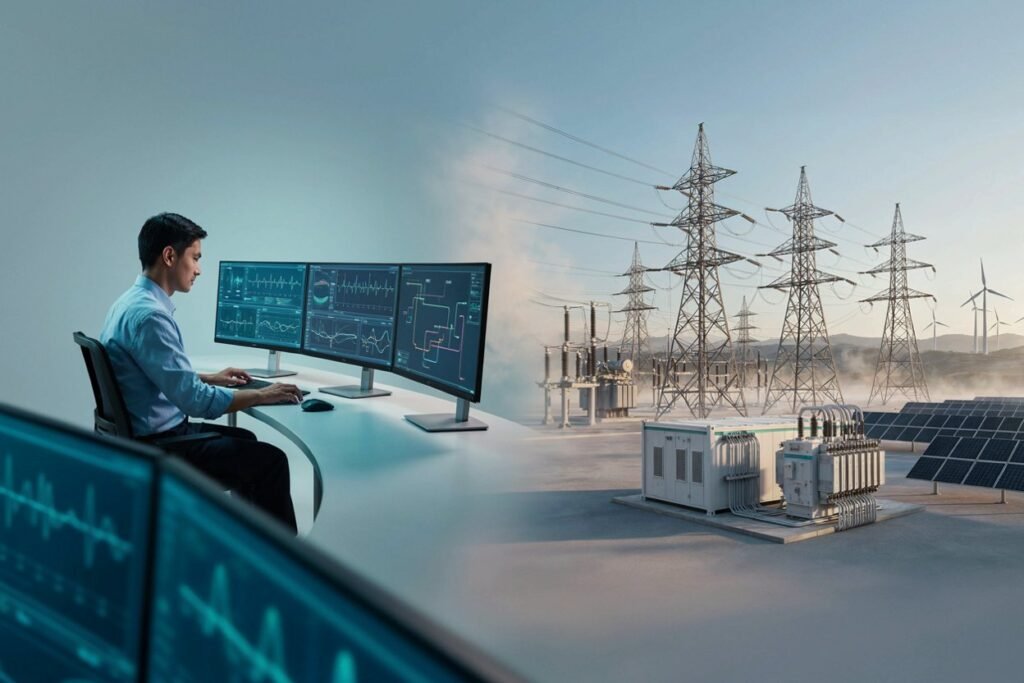
The rapid growth of solar, wind, battery storage, and other renewable technologies is changing the way electrical grids are planned and operated. Unlike traditional generation, many modern renewable facilities connect to the grid through power electronic inverters. These inverter-based resources can respond very differently to disturbances, voltage changes, and frequency events.
As renewable penetration increases, engineers need advanced simulation tools to understand these interactions before projects are connected to the transmission or distribution network. PSCAD grid studies provide a detailed electromagnetic transient simulation environment that helps engineers investigate complex grid behavior and evaluate how renewable projects will perform under a wide range of operating conditions.
From analyzing inverter controls to evaluating fault responses, PSCAD can provide valuable insight into the dynamic behavior of renewable generation and its interaction with the wider power system.
1. Understanding PSCAD in Renewable Energy Engineering
PSCAD is a power system simulation platform widely used for electromagnetic transient (EMT) studies. It allows engineers to represent electrical equipment, control systems, network components, and protection functions in detailed simulation models.
Traditional power system studies often rely on RMS-based simulations for steady-state and electromechanical behavior. These studies remain important, but they may not capture every fast electrical phenomenon associated with modern inverter-based generation.
PSCAD can model rapid changes that occur over very short time intervals. This makes it particularly useful for studying power electronic converters, inverter controls, switching behavior, control interactions, and system responses to disturbances.
For renewable energy developers, this capability can help identify technical challenges before they appear during commissioning or actual grid operation.
2. Supporting Renewable Power System Modeling
Modern renewable facilities can contain multiple interconnected components, including photovoltaic panels, wind turbine generators, inverters, transformers, collector systems, transmission lines, and plant-level controllers. Accurately representing the interaction between these components is essential for meaningful grid analysis.
Renewable power system modeling in PSCAD can incorporate detailed representations of inverter controls and electrical equipment. Engineers can examine how a renewable plant behaves when connected to different grid conditions, including strong and weak grid environments.
Models can also be used to investigate voltage variations, current responses, active and reactive power behavior, and control-system interactions. By creating a realistic representation of the project and surrounding network, engineers can assess potential issues and refine the design before implementation.
This modeling approach is especially valuable for large renewable projects where a relatively small control interaction can affect overall grid performance.
3. Analyzing Inverter-Based Resources
The increasing deployment of inverter-based resources has introduced new technical considerations for grid planners. Solar photovoltaic plants, battery energy storage systems, and many modern wind generation systems depend heavily on inverter controls.
Inverter-based resource analysis helps engineers understand how these resources respond during normal operation and grid disturbances. For example, engineers may examine the response of an inverter to voltage dips, frequency changes, faults, or variations in grid strength.
PSCAD simulations can be used to evaluate control functions such as voltage regulation, reactive power control, current limiting, fault ride-through behavior, and other grid-support functions.
Detailed analysis can reveal whether an inverter’s controls interact unexpectedly with other equipment or with nearby renewable facilities. Identifying these interactions early can help project teams modify control settings, equipment specifications, or system configurations.
4. Fault and Transient Performance Studies
Renewable projects must be capable of responding appropriately to electrical disturbances. Faults on transmission lines, substations, or other parts of the network can produce rapid voltage and current changes that may challenge inverter controls.
PSCAD is useful for examining these transient conditions in greater detail. Engineers can simulate different fault types and locations and observe how renewable generation responds during and after the disturbance.
These simulations can help assess questions such as:
- Does the renewable plant remain connected during an applicable grid disturbance?
- How does the inverter respond to voltage depressions?
- Does the plant provide the required reactive current response?
- How quickly does active and reactive power recover?
- Are there undesirable control interactions during fault recovery?
The answers can support equipment selection, control tuning, protection coordination, and interconnection compliance activities.
5. PSCAD for Grid Interconnection and Compliance
Before a major renewable facility connects to a utility network, developers generally need to demonstrate that the project will operate reliably without creating unacceptable impacts on the grid. Interconnection studies therefore play an important role in project development.
PSCAD can support detailed investigations where electromagnetic transient analysis is required. Engineers can use simulation results to evaluate the behavior of the proposed facility under representative network conditions and disturbances.
The results may also complement other studies, including load flow, short-circuit, transient stability, and dynamic simulations. Using different study methods together provides a broader understanding of project performance.
For renewable developers, early modeling can also reduce project risk. Problems discovered during a detailed design stage may be easier and less expensive to address than issues discovered during commissioning or grid testing.
6. Building More Reliable Renewable Energy Systems
As renewable penetration continues to grow, accurate modeling will become increasingly important for maintaining a stable and resilient electrical network. The challenge is no longer simply connecting renewable generation to the grid; engineers must understand how thousands of inverter-based devices interact with one another and with conventional network equipment.
PSCAD provides a powerful environment for investigating these interactions at an electromagnetic transient level. When combined with appropriate network data, validated equipment models, and experienced engineering judgment, it can provide valuable insight into renewable plant behavior.
For developers, utilities, and engineering teams, detailed simulation can support better technical decisions throughout the project lifecycle—from preliminary interconnection assessments and equipment selection to control validation and commissioning preparation.
Ultimately, effective PSCAD grid studies help bridge the gap between theoretical renewable power system designs and their real-world electrical behavior. As solar, wind, and battery projects become an increasingly important part of modern power networks, advanced simulation and inverter-based resource analysis will remain essential tools for developing reliable, compliant, and grid-friendly renewable energy infrastructure.