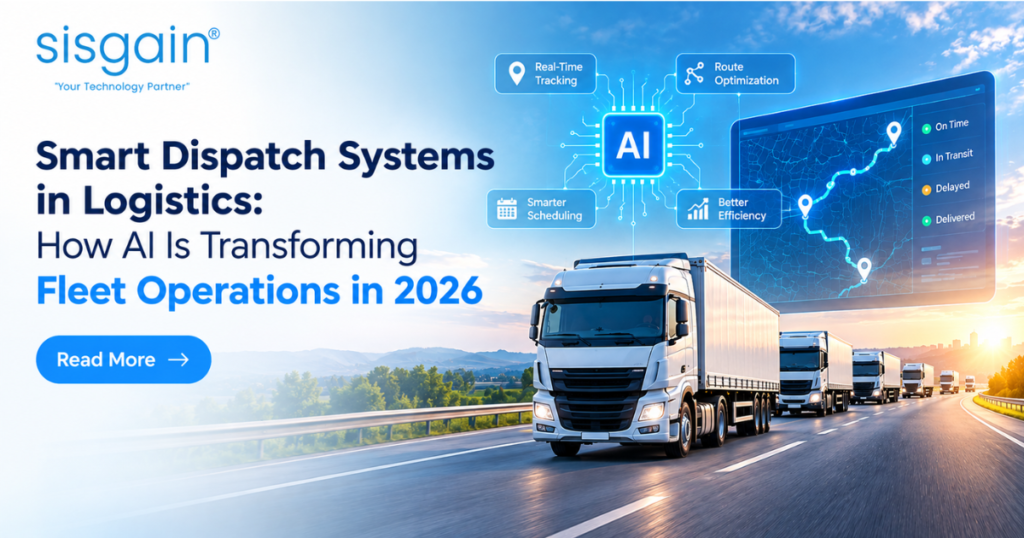
Why Dispatch Is Becoming an Intelligent Operation
For decades, the dispatcher has been the nerve center of any logistics operation. This person or team is responsible for assigning drivers to loads, allocating vehicle capacity, building routes, setting delivery schedules, keeping customers informed, and reacting the moment something goes wrong — a breakdown, a missed window, a sudden change in traffic. It’s a job that demands constant judgment calls, often made with incomplete information and under time pressure.
That model worked reasonably well when shipment volumes were predictable and fleets were small. But as delivery windows tighten, freight volumes grow, and fleets become more complex, manual dispatch starts to strain under its own weight. A dispatcher juggling phone calls, spreadsheets, and a whiteboard simply cannot process the volume of variables — driver location, vehicle capacity, live traffic, weather, customer priority — fast enough to make consistently optimal decisions.
This is where smart dispatch systems in logistics come in. A smart dispatch system combines artificial intelligence, real-time operational data, route optimization engines, fleet information, predictive analytics, and automated workflows to support — and increasingly, to help make — dispatch decisions. In the U.S. logistics market, where e-commerce expectations, driver shortages, and rising fuel costs are converging, these systems are quickly becoming less of a luxury and more of an operational necessity.
The central shift underway is this: dispatch is moving from reactive coordination, where teams respond to problems after they happen, to intelligent, continuously optimized execution, where systems anticipate and adjust in real time.
What Is a Smart Dispatch System in Logistics ?
Definition of Smart Dispatch
A smart dispatch system is software that uses operational data, optimization algorithms, and — increasingly — artificial intelligence to support or automate the decisions dispatchers traditionally made by hand. Rather than relying purely on a dispatcher’s memory and intuition, these systems pull in live data streams and apply models that weigh multiple constraints simultaneously.
Traditional Dispatch vs. Smart Dispatch
The contrast between the two approaches is stark:
| Traditional Dispatch | Smart Dispatch |
|---|---|
| Manual assignments | Data-driven assignments |
| Static route planning | Dynamic route optimization |
| Reactive decisions | Predictive decisions |
| Phone/email coordination | Automated communication |
| Separate data sources | Connected operational data |
| Manual exception handling | AI-assisted exception management |
Core Components
Smart dispatch platforms typically draw on several interconnected systems: a Transportation Management System (TMS) that houses order and shipment data; GPS and telematics for real-time vehicle tracking; fleet management systems that monitor vehicle health and availability; driver mobile applications for two-way communication; traffic and weather feeds; customer and order management systems; APIs that connect all of the above; AI and machine learning models that generate recommendations; and analytics dashboards that give dispatchers visibility into performance.
Many logistics businesses find that off-the-shelf platforms don’t fully match their fleet structure, service types, or operational rules. In these cases, companies increasingly turn to custom logistics app development to build dispatch platforms tailored precisely to their vehicle mix, delivery models, and compliance requirements, rather than forcing their operations to fit a generic tool.
Why Smart Dispatch Matters More in 2026
Several operational pressures are converging on U.S. logistics businesses right now. Customers expect faster, more precise delivery windows. Driver and labor availability remains constrained in many regions. Fuel and operating costs continue to squeeze margins. Traffic congestion in major metro corridors adds unpredictability to even well-planned routes. Shipment complexity is increasing as businesses handle more SKUs, more delivery types, and more service tiers. And underlying all of this is a growing demand for real-time visibility — customers, shippers, and internal stakeholders all want to know where a shipment is at any given moment.
At the same time, AI adoption across logistics is shifting from back-office analytics toward execution-oriented applications. Transport planning, demand forecasting, and shipment visibility are among the areas where logistics organizations are concentrating their AI investment, because these are the functions where better decisions translate directly into cost savings and service improvements.
The 2026 shift can be understood as an evolution along a spectrum:
Manual Dispatch → Digital Dispatch → Automated Dispatch → AI-Assisted Dispatch → Intelligent/Agentic Dispatch
It’s worth being clear that not every organization needs — or should pursue — fully autonomous dispatch. Human oversight remains essential for complex, high-value, or safety-related decisions. The realistic goal for most businesses is meaningful AI assistance, not full automation.
How Smart Dispatch Systems Work
At a high level, smart dispatch follows a continuous operational flow:
Orders → Data Collection → AI Analysis → Driver/Vehicle Matching → Route Optimization → Dispatch → Real-Time Monitoring → Exception Detection → Re-Optimization
Step 1: Collect Operational Data. The system gathers information on incoming orders, vehicle capacity, driver availability and location, delivery windows, live traffic and weather conditions, historical route performance, and vehicle status.
Step 2: Analyze Constraints. The platform evaluates distance, capacity limits, driver availability, delivery priorities, service-level requirements, and vehicle restrictions (such as size or weight limits for certain routes).
Step 3: Recommend or Make Dispatch Decisions. Based on this analysis, the system determines which driver should receive a given load, which vehicle is appropriate, which route makes sense, and how stops should be sequenced.
Step 4: Monitor Execution. As drivers move through their routes, real-time information continuously updates the dispatch picture — location, progress against schedule, and any emerging issues.
Step 5: Re-Optimize. When conditions change — a road closure, a delayed pickup, a vehicle issue — the system can recommend a new route, a different driver assignment, or an adjusted delivery sequence.
The important distinction from older automated systems is that modern AI dispatch platforms are designed around this continuous decision cycle, rather than treating dispatch as a single, one-time assignment made at the start of the day.
Ways Smart Dispatch Systems Are Transforming Logistics

Intelligent Driver and Vehicle Assignment
Instead of simply assigning the nearest available driver, AI-driven systems weigh multiple factors at once: vehicle capacity, driver availability and location, route compatibility, specific driver skills or certifications, delivery requirements, and even historical performance on similar routes. This produces assignments that are better matched to the actual job, not just the closest match.
Dynamic Route Optimization
Rather than relying on a static plan set at the beginning of the day, smart dispatch systems continuously reevaluate routes as conditions change — factoring in traffic congestion, road closures, weather, shifting delivery priorities, multi-stop sequencing, vehicle restrictions, and updated arrival estimates.
It’s worth making an important distinction here: AI does not necessarily replace the underlying routing and optimization engine that enforces hard constraints like vehicle capacity or delivery windows. Instead, AI typically improves the predictions, recommendations, and decision workflows layered on top of that engine, while the optimization engine continues to enforce the operational rules.
Real-Time Exception Management
Disruptions are inevitable — vehicle breakdowns, late departures, missed delivery windows, unexpected traffic, failed delivery attempts, or sudden changes in driver availability. Smart dispatch systems are designed to identify these exceptions as they emerge, rather than waiting for a dispatcher to notice a problem manually. Once detected, the system can recommend possible responses, giving dispatchers a head start on resolution.
Predictive ETA and Delivery Visibility
Predictive ETA capabilities combine GPS data, live traffic conditions, historical travel patterns, typical stop duration, current route conditions, and past delivery history to generate more context-aware arrival estimates. This helps dispatchers flag potentially late shipments earlier — often before a customer even notices a delay — rather than discovering the problem only when a delivery window has already passed.
Automated Dispatcher Workflows
A significant share of a dispatcher’s day is spent on repetitive tasks: sending status updates, notifying drivers, alerting customers, confirming dispatches, handling documentation, updating assignments, and managing routine communication. Automating these workflows frees dispatchers to focus their attention on exceptions and customer-critical decisions — the parts of the job that genuinely require human judgment.
Better Fleet Utilization
Intelligent dispatch systems give organizations visibility into vehicle utilization, empty miles, driver availability, capacity usage, route density, and idle time. This visibility supports better operational decisions over time. It’s worth noting that actual efficiency gains vary considerably by organization, and businesses should be cautious of vendors promising specific percentage improvements without context — results depend heavily on the starting point and how well the system is implemented.
AI-Assisted Decision Making
Perhaps the most significant shift is the move from software that simply records dispatch decisions to software that actively supports them. Dispatchers can now pose operational questions directly to the system: Which available driver should take this shipment? Which route minimizes delay risk? Which delivery should be prioritized? What should happen if this vehicle becomes unavailable?
In 2026, TMS providers are increasingly embedding AI directly into dispatch and execution workflows, rather than confining AI capabilities to reporting and analytics dashboards.
The Role of AI and Agentic AI in Smart Dispatch
It’s useful to distinguish between three levels of system intelligence.
Traditional automation follows simple conditional logic: if X happens, perform Y. AI-assisted dispatch goes further, analyzing data and recommending the best action for a human to approve. Agentic dispatch represents the next step: the system monitors conditions, reasons about the situation, decides within defined rules, executes the decision, and then monitors the outcome.
Potential agentic capabilities include monitoring shipment conditions, identifying exceptions, recommending alternative drivers, triggering route re-optimization, updating stakeholders automatically, and escalating high-risk situations to a human.
That said, human-in-the-loop governance remains critical, particularly for high-value shipments, customer-critical deliveries, safety-related decisions, regulatory constraints, and unusual operational situations that fall outside a system’s trained patterns. Industry examples from 2026 show execution-focused AI moving steadily into dispatch, carrier management, booking, and tracking workflows — but rarely without a layer of human oversight built in.
How Smart Dispatch Connects With the Modern Logistics Technology Stack
Smart dispatch shouldn’t operate as an isolated application. It functions best as one layer within a connected technology stack:
ERP → TMS → WMS → Fleet Management → GPS/Telematics → Driver Mobile App → Customer/Tracking Portal
APIs serve as the connectivity layer linking these systems together, allowing data to flow in real time rather than sitting in disconnected silos. For logistics businesses looking to connect their TMS, ERP, WMS, GPS, telematics, and external data sources, custom API development is often the difference between a dispatch system that works in isolation and one that reflects a true, real-time operational picture.
Driver-facing mobile applications are another critical piece of this stack, handling dispatch notifications, navigation, delivery status updates, proof of delivery, driver communication, and real-time status changes. Because driver experience directly affects how well a smart dispatch system performs in the field, many companies invest in dedicated mobile app development services to build driver apps suited to their specific workflows and vehicle types.
Business Benefits of Smart Dispatch Systems
Rather than making broad, generic claims, it’s more useful to focus on specific operational areas where smart dispatch systems tend to deliver value: faster dispatch decision-making, better fleet utilization, improved shipment visibility, more responsive exception handling, reduced manual administrative work, better route planning, improved internal and customer communication, more consistent dispatch processes, better availability of operational data, and greater scalability as operations grow.
Actual results depend heavily on factors like data quality, integration maturity, existing operational processes, fleet size, and the quality of implementation. This point matters more than it might seem — 2026 research on transportation AI consistently identifies poor data quality as one of the most significant obstacles preventing organizations from scaling these systems successfully.
Read more – Proactive Network Monitoring: How to Prevent Downtime Before It Happens
Challenges Businesses Should Consider Before Implementing Smart Dispatch
Smart dispatch is not a plug-and-play solution, and businesses should go in with clear eyes about the challenges involved.
Poor data quality is often the biggest obstacle — bad or incomplete operational data undermines the reliability of any AI system built on top of it. Legacy systems, including older TMS, ERP, or fleet management platforms, may lack the modern integration capabilities smart dispatch requires. Integration complexity is a real hurdle, since multiple systems need to exchange accurate information in real time for the platform to function as intended.
Employee adoption also matters — dispatchers need training and, just as importantly, confidence in the system’s recommendations before they’ll rely on them in high-pressure moments. AI governance needs to be defined upfront, covering human approval processes, escalation rules, auditability, access controls, and data security. And finally, organizations should think carefully about measuring ROI: defining KPIs before implementation, rather than trying to assess success only after the system is already live.
How to Implement a Smart Dispatch System in a U.S. Logistics Business
A practical rollout generally follows seven steps.
Step 1: Identify Dispatch Bottlenecks. Determine where manual work is causing delays or inefficiencies in the current process.
Step 2: Define High-Value Use Cases. Start with focused areas such as route optimization, driver assignment, ETA prediction, or exception alerts rather than attempting a full overhaul at once.
Step 3: Connect Data Sources. Integrate the TMS, GPS, ERP, WMS, telematics, and driver applications so the system has a complete operational picture.
Step 4: Start With AI-Assisted Decisions. Allow dispatchers to review and approve system recommendations before introducing greater automation.
Step 5: Introduce Automation Gradually. Begin automating repetitive, low-risk tasks before expanding to higher-stakes decisions.
Step 6: Establish KPIs. Track metrics like dispatch time, on-time delivery rate, empty miles, fleet utilization, exception resolution time, manual workload, and customer visibility.
Step 7: Scale Based on Results. Expand successful use cases across additional fleets, regions, or transportation modes once the initial rollout proves its value.
Because every fleet’s operations, compliance requirements, and customer commitments differ, many businesses partner with providers offering logistics software development services to build, integrate, customize, and scale smart dispatch platforms around their specific needs, rather than adapting their operations to fit a generic system.
What the Future of Smart Dispatch Looks Like
Looking ahead, smart dispatch is likely to continue evolving toward more predictive capabilities, greater use of AI agents, continuous (rather than periodic) route optimization, more autonomous exception management, voice-enabled dispatcher interfaces, richer connected-vehicle data, cross-platform orchestration across multiple systems, more intelligent carrier selection, and increasingly personalized customer communication.
But it’s worth being clear about what this future is not: it’s not simply “AI replacing dispatchers.” A more realistic and practical model is one where AI handles repetitive analysis and routine execution, while people continue to oversee complex decisions, manage relationships, and handle the exceptions that require genuine judgment.

Conclusion: From Dispatch Management to Intelligent Logistics Execution
The transformation underway in logistics dispatch can be summarized as a shift in operating logic. Traditional dispatch follows a cycle of Plan → Assign → Monitor → React. Smart dispatch follows a fundamentally different cycle: Understand → Predict → Optimize → Execute → Learn.
Smart dispatch systems are becoming an important part of the modern logistics technology ecosystem — but only when they’re supported by quality data, strong system integrations, clear operational workflows, and appropriate human oversight. Organizations that treat these as prerequisites, rather than afterthoughts, are the ones most likely to see meaningful returns from the investment.
For logistics businesses exploring what this could look like for their own operations, the next step is usually a conversation about customized logistics technology built around their specific fleet, data, and delivery model.
Frequently Asked Questions
1. What is a smart dispatch system in logistics?
A smart dispatch system is software that combines real-time operational data, route optimization, and AI to support or automate dispatch decisions like driver assignment, routing, and exception handling — moving beyond manual, phone-and-spreadsheet coordination.
2. How does AI improve logistics dispatch?
AI improves dispatch by analyzing multiple variables at once — driver location, vehicle capacity, traffic, delivery priorities — to recommend better assignments, predict delays, generate more accurate ETAs, and flag exceptions before they escalate into bigger problems.
3. Can smart dispatch systems optimize routes in real time?
Yes. Rather than relying on a fixed morning plan, smart dispatch systems continuously reassess routes based on live traffic, weather, road closures, and changing delivery priorities, recommending adjustments as conditions shift throughout the day.
4. How does smart dispatch improve fleet utilization?
By giving dispatchers better visibility into vehicle capacity, empty miles, driver availability, and route density, smart dispatch systems support more informed decisions about how vehicles and drivers are matched to loads, improving utilization over time.
5. Can smart dispatch integrate with a TMS?
Yes. Smart dispatch platforms typically connect to a TMS, along with ERP, WMS, GPS, telematics, and driver mobile applications, through APIs — creating a connected operational picture rather than isolated data sources.
6. Does AI dispatch replace human dispatchers?
Not typically. Most implementations follow a human-in-the-loop model, where AI handles repetitive analysis and recommendations while dispatchers retain oversight of complex, high-value, or safety-related decisions. Automation tends to expand gradually as trust in the system builds.