Learn how a loan origination system works, step by step — from lead capture to disbursement. A practical LOS guide for banks and NBFCs.
Every loan a bank or NBFC disburses starts long before money moves — it starts with a lead, a form, a document, and a decision. The software that manages this entire journey, from the moment a borrower expresses interest to the moment funds hit their account, is called a Loan Origination System, or LOS. For lending institutions still relying on spreadsheets, email chains, and manual file movement between departments, understanding exactly how a modern LOS works is the first step toward faster approvals, lower operating costs, and fewer compliance headaches.
This guide breaks down the loan origination process stage by stage, explains what happens at each step inside the system, and shows why banks and NBFCs are increasingly moving to purpose-built loan origination software instead of patchwork manual processes. Whether you are a lending operations leader evaluating new technology, a fintech product manager, or simply trying to understand the mechanics of how loans get approved, this article walks through the complete lifecycle in plain language.
What Is a Loan Origination System (LOS)?
A Loan Origination System is a software platform that automates and manages the entire process of acquiring, evaluating, and approving a loan application — from initial inquiry through to disbursement. Instead of a loan officer manually chasing documents, re-entering data across multiple tools, and coordinating approvals over email, an LOS centralizes every step into one digital workflow.
At its core, an LOS handles four things: capturing applicant information, verifying identity and creditworthiness, assessing risk and making a lending decision, and generating the paperwork needed to formalize the loan. Along the way, it applies business rules, compliance checks, and approval hierarchies automatically, so that every application is processed consistently, regardless of which branch, agent, or channel it came through.
For banks and NBFCs specifically, an LOS is usually the front-end of a larger lending technology stack. It works alongside credit bureau integrations, KYC and AML verification tools, e-signature platforms, and — once the loan is disbursed — hands the account off to a Loan Management System (LMS) for ongoing servicing, repayment tracking, and collections.
Why Loan Origination Matters for Banks and NBFCs
The origination stage is where lending institutions win or lose on three fronts simultaneously: speed, risk, and cost.
Speed matters because borrowers increasingly compare lenders the way they compare any other purchase — the institution that can say yes fastest, with the least friction, tends to win the business. A manual origination process that takes five to seven days to approve a personal loan simply cannot compete with a digital-first NBFC that responds in under an hour.
Risk matters because origination is where the underwriting decision is made. Every rule, every document check, and every credit score pulled during origination directly affects the quality of the loan book. A weak origination process lets bad risk in; a strong one filters it out before it ever reaches the books.
Cost matters because origination is labor-intensive by nature — it involves data entry, document verification, follow-ups, and coordination across credit, compliance, and operations teams. Every manual touchpoint adds cost per loan. Automating origination doesn’t just speed things up; it directly reduces the cost of acquiring and processing each loan, which matters enormously at scale.
Because origination sits at the intersection of customer experience, credit risk, and operating cost, it’s usually the first part of the lending stack that banks and NBFCs choose to modernize.
LOS vs LMS: What’s the Difference?
The terms “Loan Origination System” and “Loan Management System” are often used loosely, but they cover two different phases of a loan’s life.
A Loan Origination System (LOS) governs everything that happens *before* a loan is disbursed: lead capture, application intake, document collection, KYC, credit checks, underwriting, approval, and the generation of the sanction letter and loan agreement.
A Loan Management System (LMS) governs everything that happens *after* disbursement: EMI scheduling, repayment tracking, interest accrual, penal charges, restructuring, collections, and closure.
Some platforms combine both functions into a single system, while others specialize in one or the other and integrate through APIs. For a bank or NBFC, the important thing is that data flows seamlessly from origination into servicing — a borrower’s KYC details, loan terms, and repayment schedule generated during origination should carry over automatically into the LMS without re-entry, since re-keying data is one of the most common sources of servicing errors.
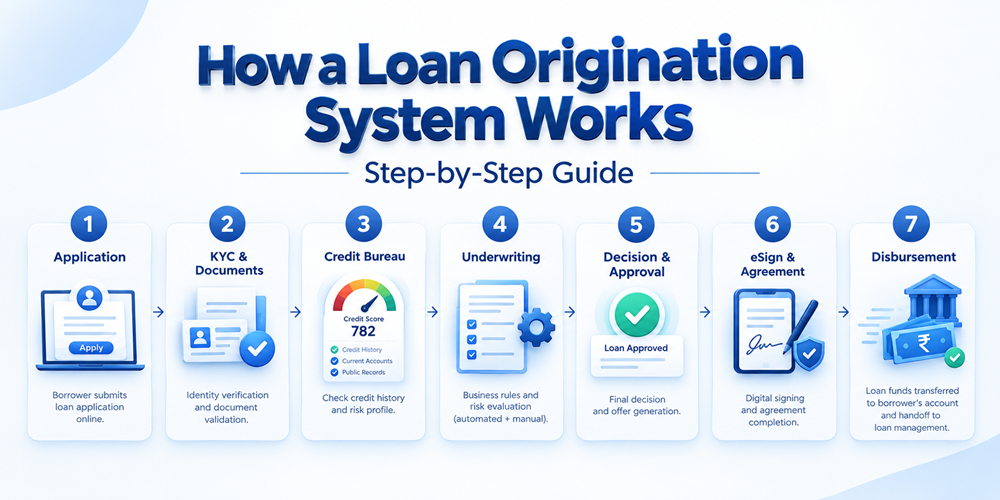
How a Loan Origination System Works: Step-by-Step
Beneath the interface, every LOS — regardless of vendor — follows a broadly similar sequence of stages. The exact configuration varies by loan product (a working-capital loan for an NBFC’s business customers will have more document requirements than a small-ticket personal loan), but the core workflow below holds true across most institutions.
Step 1: Lead Capture and Pre-Qualification
The process begins the moment a prospective borrower shows interest — whether through a website form, a mobile app, a branch walk-in, a call center agent, or a referral from a loan aggregator or DSA (direct selling agent). The LOS captures this lead along with basic details: name, contact information, loan amount requested, and purpose.
Many systems run a pre-qualification check at this stage using minimal information — a soft credit pull, basic income declaration, or bureau score check — to instantly tell the applicant whether they’re likely to qualify, and for roughly what amount and rate. This step matters commercially: it filters out clearly ineligible applicants early, before the institution spends time and cost on full processing, and it gives genuinely qualified borrowers a fast, encouraging first response.
Step 2: Loan Application Submission
Once pre-qualified, the applicant completes a full application. A well-designed LOS presents this as a guided, multi-step digital form rather than a static PDF — auto-saving progress, validating fields in real time (correct PAN format, valid mobile number, valid pincode), and adapting which fields appear based on the loan type and applicant category (salaried versus self-employed, individual versus business).
The system typically pulls in some data automatically at this stage — for instance, prefilling personal details from a returning customer’s profile, or using OCR to auto-populate fields from an uploaded ID document — to reduce manual typing and data-entry errors on both sides.
Step 3: Document Collection and Upload
Every loan requires supporting documentation: identity proof, address proof, income proof (salary slips, bank statements, ITRs, or GST returns for business loans), and product-specific documents like property papers for secured loans. The LOS provides a structured checklist based on the loan product and applicant type, and lets the borrower upload files directly — often from a phone camera, with in-app cropping and quality checks to reject blurry or incomplete scans before they even reach the processing team.
Behind the scenes, the system tags, indexes, and stores each document against the applicant’s file, so that credit and compliance teams can review everything from a single case view rather than hunting through email attachments or physical folders.
Step 4: KYC and AML Verification
Before any credit decision is made, regulated lenders must verify the applicant’s identity and screen for fraud, money laundering, and sanctions risk. A modern LOS automates this through integrations with government and third-party verification services: PAN and Aadhaar verification, video KYC, facial matching against ID photos, and checks against watchlists and politically-exposed-persons (PEP) databases.
This stage is heavily regulated, and the LOS typically logs every check performed, along with timestamps and the verification source, to create an audit trail that satisfies regulatory reporting and internal compliance review. Where a check fails or returns an ambiguous result, the system routes the case to a human compliance reviewer rather than auto-rejecting or auto-approving.
Step 5: Credit Bureau Check and Credit Scoring
With identity confirmed, the LOS pulls the applicant’s credit report from one or more bureaus and retrieves their credit score, existing loan and credit card exposure, repayment history, and any defaults or write-offs on record. For business loans, this may extend to commercial bureau data and banking transaction analysis.
The system then applies a scoring model — which can range from a simple bureau-score cutoff to a sophisticated, weighted model combining bureau data, income, existing obligations, and alternative data sources like utility or telecom payment history — to generate an internal risk score or grade for the applicant. This score feeds directly into the next stage.
Step 6: Underwriting and Risk Assessment
Underwriting is where the institution’s credit policy is actually applied to an individual case. The LOS runs the application through a rules engine: minimum income thresholds, maximum debt-to-income ratio, loan-to-value limits for secured loans, sector or industry exclusions, and dozens of other policy checks configured by the credit team.
Rules-based, low-risk, well-documented applications can often be auto-approved end-to-end with no human touch. Borderline cases, high-ticket loans, or applications that trip a policy exception are routed to a credit underwriter with all the supporting data — bureau report, documents, income analysis, and the system’s own risk score — assembled in one screen, so the underwriter can make a fast, informed manual decision rather than starting from scratch.
Step 7: Loan Approval or Rejection Decision
Based on the underwriting outcome, the LOS records a final decision: approved, rejected, or approved with conditions (a lower amount, a higher rate, or a requirement for additional collateral or a co-applicant). This decision, along with the reasoning and the policy rules that drove it, is logged for audit and regulatory purposes — an increasingly important requirement as regulators scrutinize algorithmic and automated lending decisions.
The applicant is notified immediately through their preferred channel — SMS, email, or in-app notification — closing the gap between decision and communication that, in manual processes, often takes days.
Step 8: Sanction Letter and Offer Generation
For approved applications, the LOS automatically generates a sanction letter or offer document, populated with the approved loan amount, tenure, interest rate, processing fee, EMI schedule, and any conditions attached to the approval. Because this is templated and system-generated, it eliminates the manual drafting errors — wrong figures, outdated terms, missing clauses — that are common when offer letters are prepared by hand.
The applicant reviews the offer within the same digital journey and can accept, request modification, or decline directly through the platform.
Step 9: Loan Agreement and e-Signing
Once the applicant accepts the offer, the LOS generates the full loan agreement and supporting legal documents, again auto-populated from the data already captured earlier in the process. Most systems integrate with e-signature and e-stamping providers, allowing the borrower to sign digitally — via Aadhaar-based e-sign, OTP-based consent, or a digital signature certificate — rather than requiring a physical branch visit.
This step also typically triggers mandate setup for repayments — e-NACH or standing instruction registration — so that the EMI collection mechanism is in place before disbursement even happens.
Step 10: Disbursement
With the agreement signed and the repayment mandate registered, the LOS initiates disbursement, usually by generating a payment instruction that integrates with the bank’s or NBFC’s core banking or payment system to transfer funds directly to the borrower’s account. For secured loans, this step may be held until additional conditions — such as property registration or lien marking — are confirmed.
The system logs the disbursement date, amount, and reference, marking the application as complete from an origination standpoint.
Step 11: Handoff to Loan Management
The final step isn’t customer-facing but is critical operationally: the LOS passes the complete loan record — borrower details, KYC documents, sanctioned terms, repayment schedule, and mandate information — to the Loan Management System (or LMS module) that will handle servicing for the life of the loan. A clean, automated handoff here prevents the data mismatches and manual re-entry that commonly cause EMI calculation errors, servicing delays, and customer complaints down the line.
Key Features to Look for in a Modern LOS
Not every loan origination platform is built the same way. When banks and NBFCs evaluate LOS software, a few capabilities tend to separate genuinely modern platforms from legacy or semi-automated ones:
- Configurable workflows: The ability to set up different origination journeys for different products (personal loans, business loans, loans against property, gold loans) without needing custom development for each one.
- Rules-engine-driven underwriting: Credit policy encoded as configurable rules rather than hard-coded logic, so risk teams can adjust eligibility criteria without waiting on engineering resources.
- Pre-built integrations: Ready connections to credit bureaus, KYC/AML verification providers, e-signature and e-stamping services, and core banking or payment systems.
- Straight-through processing (STP): The ability to fully automate low-risk, rules-compliant applications end-to-end, reserving human underwriter time for genuinely borderline cases.
- Real-time dashboards and audit trails: Visibility into pipeline status, turnaround times, approval rates, and a complete, timestamped log of every decision and document for regulatory audit.
- Omnichannel intake: A single system that captures leads consistently whether they originate from a website, mobile app, branch, call center, or partner/DSA channel.
- Seamless LMS handoff: Native integration or a shared data model with the servicing system, so approved loans move into repayment tracking without manual re-keying.
Benefits of Automating Loan Origination
Institutions that move from manual or semi-manual origination to a dedicated LOS typically see improvement across several measurable dimensions:
Faster turnaround times. Applications that took days of back-and-forth for documents and approvals can often be processed in hours, or in minutes for straight-through-processed cases, directly improving conversion and customer satisfaction.
Lower cost per loan. Automating data entry, document verification, and routine underwriting decisions reduces the manual effort — and therefore the staffing cost — required to process each application, which matters especially for high-volume, small-ticket lending.
Better risk quality. Consistent, rules-based application of credit policy reduces the variability and human error that can let weak applications slip through, or unnecessarily reject good ones, when decisions are made ad hoc.
Stronger compliance posture. Automated logging of every KYC check, credit pull, and approval decision creates a defensible audit trail, which is increasingly important as regulators tighten scrutiny of lending practices, fair-lending compliance, and data handling.
Scalability without proportional headcount growth. Because routine cases are handled by the system rather than by staff, loan volume can grow significantly faster than the operations team needs to grow to support it.
Improved borrower experience. A guided digital application, instant pre-qualification feedback, and fast decisions meaningfully improve how borrowers perceive the lender — and increase the likelihood they return or refer others.
Common Challenges in Loan Origination — and How LOS Solves Them
Even well-run lending operations run into recurring friction points during origination. A well-designed LOS is built specifically to address these:
Document chasing and incomplete applications. Manual processes often stall because a required document is missing and no one follows up promptly. An LOS enforces document checklists upfront and sends automated reminders, reducing drop-off from incomplete files.
Inconsistent underwriting decisions. When different loan officers apply credit policy slightly differently, risk quality becomes unpredictable. A rules engine applies the same policy every time, with exceptions routed for consistent, documented human review.
Data re-entry errors. Manually transferring applicant data between origination, credit bureau tools, and the servicing system introduces errors. An integrated LOS captures data once and passes it through the entire workflow and into the LMS without re-typing.
Slow fraud detection. Manual document review can miss forged or manipulated documents. Automated OCR, facial matching, and bureau cross-checks catch inconsistencies far faster and more reliably than manual review alone.
Limited visibility into pipeline health. Without a centralized system, it’s difficult for operations leaders to know how many applications are stuck, where, and why. Real-time dashboards make bottlenecks immediately visible so they can be addressed before they affect large volumes of applicants.
Key Metrics to Track in Loan Origination
Once an LOS is in place, its real value shows up in the numbers operations and credit teams can finally measure consistently. A few metrics matter most:
Turnaround Time (TAT). The time from application submission to final decision, and separately, from decision to disbursement. Tracking TAT by loan product and channel highlights exactly where bottlenecks form.
Approval rate and straight-through-processing (STP) rate. What percentage of applications are approved, and of those, what percentage are approved without any human intervention. A rising STP rate is usually a direct sign that the rules engine is well-tuned and that manual underwriting capacity is being spent where it’s actually needed.
Drop-off rate by stage. Digital applications inevitably see some abandonment — the question is where. A spike in drop-off at the document upload stage, for instance, often points to a confusing checklist or an overly demanding requirement that could be simplified.
Cost per loan originated. Total origination cost (technology, staff time, verification fees) divided by loans processed, tracked over time as automation increases, is one of the clearest ways to demonstrate the LOS’s return on investment to leadership.
Bureau-to-disbursement conversion. Of applicants who clear the credit bureau check, what share go on to be disbursed. A low conversion here can indicate friction later in the journey — document issues, offer terms borrowers reject, or delays in e-signing — rather than a credit-quality problem.
Monitoring these metrics on an ongoing basis is what turns an LOS from a one-time technology upgrade into a continuously improving part of the lending operation.
Choosing the Right LOS Partner
For banks and NBFCs evaluating loan origination technology, the right platform should fit the institution’s specific product mix, regulatory environment, and existing technology stack — rather than forcing operations to adapt to a rigid, one-size-fits-all tool. Look for a vendor with proven integrations into the credit bureaus and KYC/AML providers relevant to your market, configurable workflows that your credit and risk teams can adjust without heavy engineering dependency, and a clear data model that connects cleanly to your loan management and core banking systems.
Roopya.money works specifically in this space, building loan management and origination technology purpose-built for banks and NBFCs. If your institution is evaluating how to modernize its lending workflow — from first customer touchpoint through disbursement and into servicing — it’s worth looking at how a purpose-built LOS and LMS combination can shorten approval times, tighten risk controls, and reduce the operational cost of every loan you originate.
A Loan Origination System is far more than a digital application form — it’s the operational backbone that takes a borrower from initial interest to a disbursed, compliant, properly documented loan. By automating lead capture, document collection, KYC and AML checks, credit scoring, underwriting, and agreement generation, a modern LOS lets banks and NBFCs approve more loans, faster, at lower cost, and with tighter risk control than manual processes ever could. As lending volumes grow and borrower expectations shift toward instant digital experiences, the institutions that invest in strong origination technology today are the ones best positioned to scale profitably tomorrow.
Frequently Asked Questions
Q1. What is the difference between a Loan Origination System and a Loan Management System?
A Loan Origination System (LOS) manages everything before a loan is disbursed — application, KYC, credit checks, underwriting, and approval. A Loan Management System (LMS) takes over after disbursement, handling EMI tracking, repayments, and collections through the life of the loan.
Q2. How long does the loan origination process typically take?
It depends on the loan product and how automated the process is. Manual origination can take several days to weeks, while a fully digital, rules-driven LOS can approve and disburse simple, low-risk loans such as personal loans within hours, or even minutes, through straight-through processing.
Q3. Can a Loan Origination System handle multiple loan products?
Yes. Modern LOS platforms are built with configurable workflows, so a single system can manage different journeys — personal loans, business loans, loans against property, gold loans — each with its own document requirements, eligibility rules, and approval hierarchy.
Q4. Is a Loan Origination System only for large banks?
No. NBFCs, small finance banks, fintech lenders, and cooperative banks all use LOS platforms, often finding them even more valuable relative to their size, since automation lets a lean operations team handle significantly higher loan volumes without proportional headcount growth.
Q5. How does a Loan Origination System reduce credit risk?
It applies a lending institution’s credit policy consistently to every application through a rules engine, pulls verified credit bureau data automatically, and creates a documented audit trail for every decision — reducing the inconsistency and manual error that often let weak applications through under fully manual review.
Q6. Does a Loan Origination System replace human underwriters?
Not entirely. It automates routine, low-risk, clearly rules-compliant decisions end-to-end, but routes borderline, high-value, or policy-exception cases to a human underwriter — with all supporting data already assembled — so underwriters spend their time on the cases that genuinely need judgment.
Q7. What integrations does a Loan Origination System typically need?
Common integrations include credit bureaus, PAN/Aadhaar and other KYC verification services, AML and watchlist screening providers, e-signature and e-stamping platforms, payment or core banking systems for disbursement, and the institution’s Loan Management System for post-disbursement servicing.