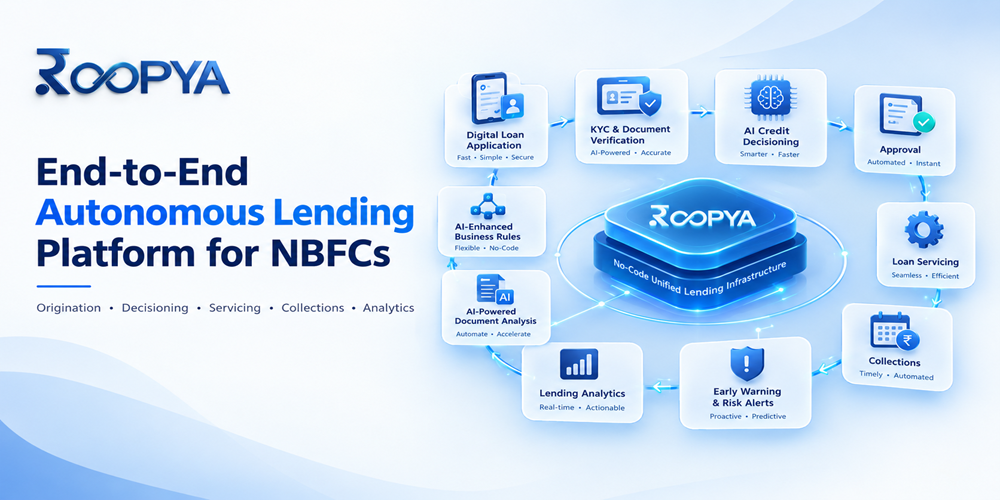
Roopya's end-to-end autonomous lending platform helps NBFCs automate origination, underwriting, servicing & collections. Go live in 1 day.
Non-Banking Financial Companies (NBFCs) sit at the centre of India’s credit story. They reach borrowers that traditional banks often can’t — first-time earners, gig workers, small businesses and thin-file customers in tier-2 and tier-3 India. But the very speed and reach that make NBFCs powerful also expose their biggest weakness: most still run lending operations on a patchwork of legacy systems, spreadsheets and manual approvals that were never designed for today’s loan volumes or borrower expectations.
An end-to-end autonomous lending platform changes that equation. Instead of stitching together separate tools for origination, underwriting, servicing and collections, an NBFC runs its entire lending lifecycle on one connected, largely self-operating system. Roopya (roopya.money) was built specifically to give NBFCs, banks, MFIs and loan service providers this kind of infrastructure — on a no-code foundation that can go live in a single day. This guide explains what an autonomous lending platform actually is, why NBFCs need one now, what it should include, and how to evaluate one before you commit.
What Is an End-to-End Autonomous Lending Platform?
An end-to-end autonomous lending platform is a unified software system that automates the complete loan journey — from the moment a customer applies to the day the loan is fully repaid or recovered — with minimal manual intervention at each stage. “End-to-end” means the platform covers every functional layer of lending: origination, credit decisioning, disbursal, servicing, collections, early-warning monitoring and analytics. “Autonomous” means the system is built to make and execute routine decisions on its own, using configurable business rules and AI models, rather than routing every application through a human underwriter or operations executive.
This is a meaningful shift from the traditional Loan Origination System (LOS) or Loan Management System (LMS) most NBFCs are used to. Those tools typically automate one slice of the lifecycle — say, digital applications — while everything downstream (servicing, collections, risk monitoring) still runs on separate software, outsourced vendors or manual processes. An autonomous platform removes those seams. Data captured at login flows straight through to underwriting, disbursal, the repayment schedule and the collections engine, without being re-entered or re-verified at every handoff.
Why NBFCs Need Autonomous Lending Now
Three forces are pushing NBFCs toward autonomous, unified lending infrastructure.
1. Borrower expectations have changed permanently
Customers who can open a savings account or book a cab in minutes expect the same from a loan application. An approval that takes days, or a process that asks for the same document twice, now actively costs NBFCs conversions to faster-moving competitors and fintech lenders.
2. Regulatory scrutiny keeps tightening
The RBI’s continued focus on digital lending guidelines, fair practices, data privacy and outsourcing risk means NBFCs need platforms that stay compliant automatically — not ones that require a manual audit every time a rule changes. A platform that is “always updated” for regulatory change removes this burden from internal teams.
3. Loan books are growing faster than back-office capacity
Scaling a lending business the old way means scaling headcount in underwriting, operations and collections at roughly the same rate as loan volume. Autonomous platforms decouple growth from headcount: business rule engines, AI-based document checks and automated collections workflows let a lean team manage a much larger and more complex portfolio.
Core Modules of an End-to-End Lending Platform
A genuinely end-to-end platform needs to cover the following layers, working together on one data model rather than as bolted-on point solutions.
Loan Origination System (LOS)
This is the front door of the lending journey: digital application forms, automated credit scoring, document verification and real-time decisioning. A strong LOS should support multiple loan products — personal, business, gold, home, auto and payday loans — from configurable templates rather than custom development for each product.
Loan Management System (LMS)
Once a loan is disbursed, the LMS takes over: portfolio management, payment processing, amortisation schedules and a self-serve customer portal. This is where operational efficiency compounds — every manual step removed here scales across the entire active loan book, not just one application.
Collections System
Recovery performance depends on getting the right message, through the right channel, to the right borrower, at the right time. An automated collections engine should support reminders, structured collection workflows, flexible payment plans and agent management, all driven by the same borrower and repayment data as the rest of the platform.
Early Warning System (EWS)
Rather than reacting after a loan turns delinquent, an EWS uses predictive analytics and behavioural signals to flag risk before it materialises — enabling proactive intervention, restructuring or outreach while a loan is still recoverable, not after it has already slipped into NPA territory.
Lending Analytics and Reporting
Portfolio analytics, performance metrics, risk assessment and trend analysis give leadership real-time visibility into the health of the book. Advanced reporting — custom dashboards, regulatory reports, exports and scheduled reports — should require no manual data assembly, since the underlying data already lives in one system.
| Capability | What It Means for Your NBFC |
| Straight-through processing | Applications move from login to disbursal with minimal manual touchpoints |
| No-code configuration | Product, policy and workflow changes go live in hours, not dev sprints |
| 300+ pre-integrated APIs | Bureaus, KYC, banking, e-sign and payments connect without custom builds |
| AI-based underwriting | Alternative data and ML scoring widen approvals without adding risk |
| Real-time monitoring | Early-warning signals flag stress before it becomes an NPA |
| Usage-based pricing | Technology cost scales with loan book, not the other way around |
How AI Powers Autonomous Lending
Automation alone gets an NBFC part of the way there. What makes a platform truly autonomous is AI operating inside each of these modules to make judgement calls that used to require a human.
- AI-powered document analysis: OCR and NLP extract and verify identity documents, bank statements and financial records in seconds, flagging inconsistencies or signs of fraud that a manual reviewer might miss.
- AI-enhanced business rule engine: a self-learning rule engine studies historical approvals and rejections to suggest policy improvements and adapt to changing market conditions, while keeping a human in the loop for final sign-off.
- Intelligent credit decisioning: machine learning models evaluate alternative data and behavioural signals alongside traditional bureau scores, widening responsible access to credit for thin-file and new-to-credit borrowers.
- AI-driven analytics: natural-language reporting lets teams ask questions in plain English and get instant portfolio insights, trend detection and executive summaries — work that used to take analysts hours.
Together, these capabilities are what let a platform move from simply digitising paperwork to actually making and executing lending decisions with limited manual review — which is the defining trait of an autonomous lending platform.
Key Benefits for NBFCs
- Faster time-to-market: pre-configured loan products and workflows mean a new product can launch in days rather than the months a custom build would take.
- Lower cost of ownership: usage-based, pay-as-you-go pricing avoids the heavy upfront licence and infrastructure spend of legacy systems.
- Reduced operational risk: a no-code business rule engine lets compliance and credit teams update policy directly, cutting dependence on engineering backlogs and reducing the chance of manual error.
- Better borrower experience: straight-through processing and self-serve portals mean faster decisions and fewer repeat document requests, which improves conversion and retention.
- Stronger portfolio quality: early-warning signals and AI-based scoring catch risk earlier and support more accurate underwriting decisions.
- Easier scaling: because origination, servicing, collections and analytics share one data model, growing loan volume doesn’t require a proportional increase in back-office headcount.
How Roopya Delivers End-to-End Autonomous Lending
Roopya was purpose-built as unified lending infrastructure for NBFCs, banks, MFIs and loan service providers, covering the full lifecycle described above on a single no-code platform rather than as separate products that need to be integrated.
- Fastest go-live: streamlined, plug-and-play onboarding gets lenders processing loans in as little as one day.
- Pay-as-you-use pricing: zero upfront cost, with spend tied to actual platform usage rather than a large fixed licence fee.
- Always-compliant infrastructure: the platform is continuously updated to reflect the latest regulatory requirements, reducing compliance overhead for internal teams.
- Truly no-code configuration: business users configure products, policies and workflows through a visual interface, without writing code.
- 300+ pre-integrated APIs: credit bureaus, identity verification, banking data and payment gateways are ready to use out of the box.
- 20+ pre-configured loan products: personal, business/SME, gold, home, auto and payday loan journeys are available as ready-to-launch templates.
- AI-powered fraud detection: pre-built fraud checks help protect the lending business from fraudulent applications and identity theft.
- Open API architecture: REST APIs allow the platform to connect cleanly with a lender’s existing CRM, ERP and other business systems.
Beyond the core lending platform, Roopya also offers dedicated Lending Analytics capabilities — including credit risk analytics, scorecard development, Probability of Default (PD), Exposure at Default (EAD) and Loss Given Default (LGD) implementation, Expected Credit Loss (ECL) calculation, pricing analytics and credit risk model validation — for NBFCs that need deeper quantitative risk infrastructure alongside origination and servicing.
Implementation: Getting Live in a Day
One of the most common objections to switching lending infrastructure is implementation time. A typical custom-built LOS/LMS rollout can take three to six months of development, testing and integration work. Autonomous, no-code platforms compress this dramatically because the heavy lifting — API integrations, product templates, compliance workflows — is already built and pre-tested.
A realistic go-live path looks like this:
- Product configuration: select from pre-configured loan products or configure a new one using the no-code product builder.
- Policy and rule setup: define credit policies, approval thresholds and workflow rules through the business rule engine.
- Integration mapping: connect existing systems (CRM, ERP, core banking) via open APIs, and activate the required bureau, KYC and payment integrations from the pre-built library.
- Testing and sign-off: run test applications end-to-end across origination, decisioning and disbursal.
- Go live: begin processing real applications, with analytics and reporting active from day one.
Choosing the Right Autonomous Lending Partner: A Checklist
Before selecting a platform, NBFCs should evaluate vendors against a short list of non-negotiables:
- Does it genuinely cover the full lifecycle — origination, servicing, collections, early warning and analytics — on one data model, or will you still need separate systems stitched together?
- Can business teams configure products and policies without raising a development ticket?
- How many integrations (bureaus, KYC, payments, fraud) come pre-built versus requiring custom development?
- Is the pricing model aligned with your usage, or does it require large upfront capital commitment?
- How is the platform kept current with regulatory changes, and who owns that responsibility?
- What AI capabilities are built in for document verification, fraud detection and credit decisioning — and how transparent are they for audit and compliance purposes?
For NBFCs, the choice is no longer between manual and digital lending — most institutions have already digitised parts of their journey. The real choice now is between a fragmented stack of point solutions and a single, end-to-end autonomous lending platform that removes manual handoffs across the entire loan lifecycle. Platforms like Roopya show what this looks like in practice: no-code configuration, 300+ pre-integrated APIs, AI-powered decisioning and fraud detection, and a go-live timeline measured in days rather than months. For NBFCs looking to grow loan books without proportionally growing operational risk or headcount, an end-to-end autonomous lending platform is quickly becoming the baseline, not the differentiator.
Ready to see it in action? Request a demo of Roopya to explore how an end-to-end autonomous lending platform can run your NBFC’s full loan lifecycle from a single, no-code infrastructure.
3. FAQ Content
What is an end-to-end autonomous lending platform?
An end-to-end autonomous lending platform is a unified software system that automates the complete loan lifecycle — origination, underwriting, disbursal, servicing, collections and reporting — with minimal manual intervention, using no-code rule engines, pre-integrated APIs and AI-based decisioning.
How is Roopya different from a traditional Loan Origination System (LOS)?
A traditional LOS typically stops at origination and needs separate systems for servicing, collections and analytics. Roopya combines LOS, LMS, Collections, Early Warning and Lending Analytics on one no-code infrastructure, so NBFCs run the entire lending lifecycle from a single platform.
How quickly can an NBFC go live on Roopya?
Roopya is built for fast onboarding, with lenders able to configure a loan product and go live in as little as one day using pre-configured loan products, templates and pre-integrated APIs, instead of the months typically needed for custom-built systems.
Does Roopya require coding or a dedicated tech team?
No. Roopya is a truly no-code platform. Business teams can configure loan products, credit policies, approval workflows and communication templates through a visual interface, without writing code or depending on engineering resources.
What kind of pricing model does Roopya use?
Roopya follows a pay-as-you-use pricing model with zero upfront cost, so NBFCs pay based on actual platform usage rather than large upfront licence or implementation fees.
Can Roopya integrate with credit bureaus, KYC and payment systems?
Yes. Roopya offers 300+ pre-integrated APIs covering credit bureaus, identity and KYC verification, banking data, fraud checks and payment gateways, so lenders don’t need to build or manage these integrations separately.
How does AI improve lending decisions on the platform?
Roopya uses AI for document analysis, fraud detection, alternative-data-based credit scoring and business-rule optimisation, which speeds up decisioning, reduces manual errors and helps lenders extend credit more accurately to thin-file and new-to-credit borrowers.
Is Roopya suitable for both NBFCs and loan service providers?
Yes. Roopya is designed for banks, NBFCs, MFIs and loan service providers who want to launch, manage or scale digital lending products such as personal, business, gold, home, auto or payday loans on a single infrastructure.