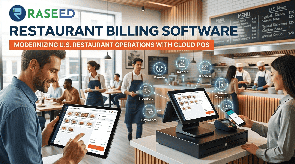
The U.S. restaurant industry is entering 2026 with a difficult combination of strong consumer demand and persistent operating pressure. The National Restaurant Association projects restaurant and foodservice sales will reach $1.55 trillion nationwide in 2026, while operators continue to deal with uneven traffic, elevated costs and pressure to improve productivity.
That environment is changing what restaurants expect from Restaurant Billing Software.
A POS terminal that simply records a sale is no longer enough for many restaurants. Operators increasingly need one system connecting dine-in orders, takeout, online ordering, payments, kitchen operations, inventory and reporting.
The shift is particularly relevant during peak periods. A disconnected POS can create duplicate order entry, delayed kitchen tickets, reconciliation work and limited visibility across terminals. A connected cloud POS, by contrast, can give managers a centralized view of transactions and operations.
The National Restaurant Association says operators are planning technology investments in areas including digital ordering, automation and data analytics to improve efficiency and manage costs.
What Is Changing in U.S. Restaurant Billing?
The U.S. market differs significantly from India. There is no nationwide GST system or single restaurant tax rate. Restaurants generally need to account for applicable state and local sales taxes, with requirements varying by jurisdiction. Federal reporting also creates specific recordkeeping obligations for qualifying food-and-beverage establishments, including reporting gross receipts on IRS Form 8027 when applicable.
That makes configuration and accurate transaction records important.
For restaurant operators, four technology requirements stand out:
1. Faster Order-to-Kitchen Workflows
Modern KOT billing software should move orders from the server, counter, kiosk or online channel to the appropriate kitchen station quickly.
The objective is simple: eliminate unnecessary re-entry.
A connected workflow can help staff capture table orders, send kitchen tickets, modify items and close checks without repeatedly entering the same information.
2. Multi-Terminal Synchronization
Busy restaurants may have a host stand, bar terminal, cashier station, handheld devices and kitchen systems operating simultaneously.
Multi-terminal billing requires those devices to work from synchronized order information.
This is one reason cloud POS architecture is gaining attention. The International Food and Beverage Technology Association’s 2026 POS white paper identifies scalability, remote access, flexibility, speed, security and integration as important priorities for the next generation of restaurant POS systems.
3. Digital and Contactless Payments
Customers increasingly expect convenient payment options, including cards, mobile wallets and QR-based payment experiences.
The National Restaurant Association’s technology research has found substantial consumer acceptance of mobile ordering, QR ordering and contactless payment options.
For restaurants, the benefit extends beyond convenience. When payments are integrated directly with the POS, transaction records can flow into reporting and reconciliation workflows without unnecessary manual entry.
4. Inventory Connected to Sales
Restaurant profitability depends heavily on controlling food and supply costs.
A modern system should connect sales with inventory and stock tracking so managers can understand what is being sold and how those sales affect available inventory.
The National Restaurant Association previously identified inventory control and management as a significant technology investment area, noting the potential to reduce spoilage and improve operational control.
Why Cloud POS Is Replacing Standalone Systems
The important U.S. restaurant technology shift is not simply from “old software” to “new software.”
It is from isolated systems to connected operating platforms.
Imagine a Friday evening rush.
A customer places a dine-in order through a server. Another customer orders pickup through the restaurant website. A third order arrives through a delivery channel. Meanwhile, the kitchen is processing existing tickets and the manager needs to know current sales.
A standalone terminal treats these as separate transactions.
A connected cloud POS for restaurants can provide a shared operational layer across ordering, payments, kitchen workflows and reporting.
This matters because technology adoption is becoming an operational issue rather than simply an IT decision. The National Restaurant Association reports that 60% of restaurant operators consider their businesses part of the technology mainstream, while nearly three in ten believe they are behind competitors.
The market is also moving beyond basic POS. Current restaurant technology discussions increasingly center on connected kitchens, digital ordering, automation, analytics and integrated payment experiences.
That creates a clear challenge for restaurants still relying on isolated desktop billing systems: the problem isn’t necessarily that the system cannot print a receipt. The problem is that it may not share information effectively with everything else happening inside the business.
What Restaurant Owners Should Do Next
Step 1: Map Every Order Channel
Document how orders currently enter the business:
- Dine-in
- Takeout
- Phone
- Restaurant website
- QR ordering
- Third-party delivery
- Kiosks
Then identify where employees manually re-enter information.
Those are the first workflows worth fixing.
Step 2: Test the Complete POS Workflow
Don’t evaluate a restaurant POS alternative only by looking at its checkout screen.
Test the complete process:
Order → Kitchen → Modification → Payment → Receipt → Inventory → Reporting
Check whether the system supports multiple terminals, tableside ordering, digital payments, discounts, refunds, split checks, inventory deductions and centralized reporting.
Step 3: Evaluate a Cloud-Native Platform
For restaurants considering a move away from standalone POS infrastructure, Raseed restaurant billing software is one cloud-oriented option to evaluate.
Raseed’s restaurant product positioning focuses on features such as table-side KOT printing, real-time multi-terminal synchronization, restaurant billing and inventory workflows.
For an operator, the important question is not simply whether these features exist. The restaurant should test them against its actual service model: peak-hour ordering, kitchen communication, payment processing, multiple terminals and end-of-day reporting.
That is the right way to evaluate whether a cloud-native POS system can replace an older standalone setup.
The Next 12–18 Months: POS Becomes an Operating System
Over the next 12–18 months, restaurant POS technology is likely to move further beyond basic billing.
QR-based ordering, handheld devices, contactless payments, digital wallets, integrated online ordering, automated inventory updates, loyalty programs and AI-assisted analytics are increasingly becoming parts of the broader restaurant technology stack.
The National Restaurant Association says operators are looking toward digital ordering, automation and data analytics to streamline operations and improve productivity.
The result is a different definition of Restaurant Billing Software.
The future system won’t simply answer “What did we sell?”
It will increasingly help answer:
“What was ordered, where did it come from, how was it paid for, what did it consume from inventory, and what should the restaurant do next?”
For U.S. restaurant owners, that is the real significance of the cloud POS transition.