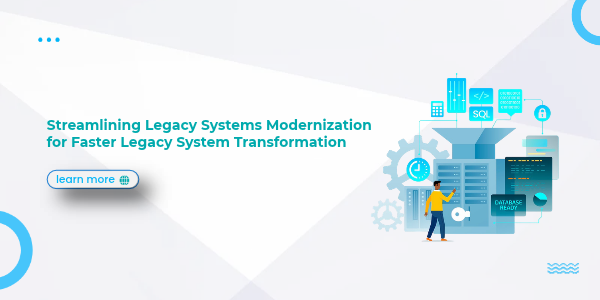
Streamlining Legacy Systems Modernization for Faster Legacy System Transformation
Legacy systems often support critical business processes, applications, and data. However, as these systems age, organizations may face growing maintenance requirements, integration challenges, technical debt, and limitations in scalability. Modernizing them can address these challenges, but a complex or poorly planned modernization program can create its own delays. Legacy Systems Modernization therefore needs a structured approach that balances speed, technical requirements, business priorities, and operational continuity. By streamlining the modernization process, organizations can accelerate Legacy System Transformation while continuing to support essential business operations.
What Is Legacy Systems Modernization?
Legacy Systems Modernization involves updating aging applications, infrastructure, architecture, or technology components to meet current business and technical requirements.
Depending on the system, organizations may use approaches such as:
- Rehosting – Moving an application to modern infrastructure with minimal changes.
- Replatforming – Moving selected components to a newer platform.
- Refactoring – Restructuring application code while retaining its core functionality.
- Rearchitecting – Redesigning the architecture to improve scalability and flexibility.
- Rebuilding – Developing selected capabilities using modern technologies.
- Replacing – Moving to a different solution when the existing system no longer meets business requirements.
The right approach depends on the application’s business value, technical condition, dependencies, and future requirements.
Why Streamline Legacy Modernization?
Modernization programs can involve multiple applications, technologies, teams, and dependencies. Without clear priorities, organizations may spend significant time assessing systems without progressing toward implementation.
A streamlined approach can help organizations:
- Prioritize high-value workloads
- Reduce unnecessary complexity
- Identify dependencies earlier
- Improve development efficiency
- Minimize operational disruption
- Create repeatable modernization processes
- Accelerate transformation initiatives
The objective is not simply to modernize faster, but to create a more predictable path from assessment to transformation.
-
Build a Clear Application Inventory
Start by creating visibility into the existing environment.
Assess:
Applications → Infrastructure → Data → Dependencies → Integrations → Business Criticality
Understanding these relationships helps teams identify which systems are interconnected and where modernization activities could affect other applications.
A centralized inventory can also provide a common reference point for architecture, development, infrastructure, security, and business teams.
-
Prioritize Applications
Not every legacy application needs to be modernized at the same time.
Prioritize systems based on:
- Business importance
- Technical complexity
- Maintenance effort
- Scalability requirements
- Integration challenges
- Security considerations
- Future business requirements
This creates a focused modernization roadmap instead of treating the entire application portfolio as one large project.
-
Select the Right Modernization Strategy
Once workloads have been assessed, select the appropriate modernization approach for each application.
For example:
Rehost → Replatform → Refactor → Rearchitect → Rebuild → Replace
Not every application needs deep architectural transformation. A stable application with infrastructure limitations may require a different approach from a tightly coupled application that needs significant architectural changes.
Choosing the appropriate strategy early can prevent unnecessary work and help teams move forward faster.
-
Break Large Programs Into Manageable Phases
Large modernization initiatives can become difficult to manage when every application is treated as a single transformation program.
A phased approach can follow:
Assess → Prioritize → Plan → Pilot → Modernize → Validate → Scale
Starting with selected applications or components allows teams to test the approach, identify dependencies, and incorporate lessons learned into subsequent phases.
-
Improve Integration During Modernization
Legacy applications often rely on tightly coupled integrations that make changes difficult.
Modernization can provide an opportunity to introduce:
- APIs
- Modular architectures
- Modern integration services
- Cloud services
- Event-driven approaches
These capabilities can make it easier to connect existing applications with modern platforms, data systems, automation solutions, and digital applications.
-
Automate Where Possible
Automation can help streamline repetitive activities across the modernization lifecycle.
Organizations can consider automation for:
- Testing
- Application deployment
- Infrastructure provisioning
- Monitoring
- Data validation
- Environment management
Automating repeatable tasks can reduce manual effort and create greater consistency across modernization projects.
-
Protect Business Continuity
Speed should not come at the expense of operational stability.
Organizations can use:
- Incremental releases
- Parallel operations
- Automated testing
- Controlled deployments
- Data synchronization
- Rollback procedures
These approaches allow teams to modernize critical systems progressively while continuing to support existing business operations.
-
Establish a Repeatable Modernization Framework
Once an organization completes its initial modernization projects, the lessons learned can be converted into reusable processes.
A repeatable framework can define:
Assessment → Architecture → Migration → Testing → Deployment → Monitoring
Standard templates, assessment criteria, governance processes, and deployment practices can help teams approach subsequent modernization initiatives more consistently.
-
Measure Transformation Progress
Modernization should be measurable.
Organizations can track indicators such as:
- Application performance
- Deployment frequency
- Maintenance effort
- Infrastructure utilization
- Incident volume
- Development effort
- Integration performance
- Operational costs
These metrics can help teams understand whether modernization is addressing the intended technical and business challenges.
Accelerating Legacy System Transformation
Successful Legacy Systems Modernization requires more than adopting newer technologies. It requires a clear understanding of the existing environment, focused priorities, appropriate modernization strategies, and a phased implementation model.
A streamlined journey can be summarized as:
Discover → Assess → Prioritize → Modernize → Validate → Optimize
By establishing repeatable processes and modernizing workloads in manageable phases, organizations can accelerate Legacy System Transformation while maintaining business continuity and creating a more scalable, maintainable, integrated, and adaptable technology environment