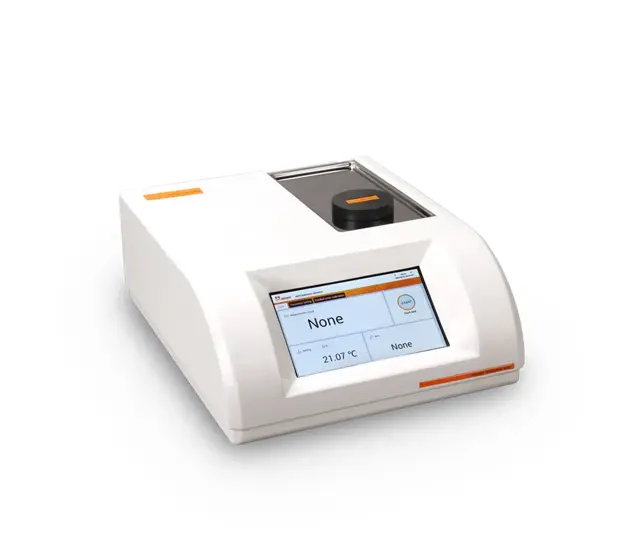
Choosing the right automatic refractometer requires careful evaluation of accuracy, measurement range, temperature control, sample handling, software, and application requirements. Refractometers are widely used in pharmaceutical, food and beverage, chemical, research, and industrial laboratories to determine refractive index, concentration, or related sample properties. An automatic model can simplify routine measurements, but the right instrument should be selected according to the type of samples being tested and the laboratory’s analytical requirements.
What Is an Automatic Refractometer?
An automatic refractometer is a laboratory instrument that measures the refractive index of a sample using an optical detection system. When light passes through a sample, its behavior changes according to the sample’s optical properties. The instrument detects this change and calculates the refractive index.
Depending on the instrument and application, measurements may also be converted into concentration values such as Brix, alcohol concentration, or other user-defined scales.
Unlike a manual refractometer, an automatic system generally requires less operator intervention. The user places a sample on the measurement surface, starts the analysis, and allows the instrument to detect and calculate the result.
1. Identify Your Application
Before comparing different models, determine what you want to measure. The requirements for a pharmaceutical laboratory may differ from those of a food-processing facility or chemical laboratory.
Common applications include:
- Pharmaceutical raw-material testing
- Chemical analysis
- Food and beverage testing
- Sugar and syrup analysis
- Research applications
- Concentration measurement
- Quality-control testing
Knowing your primary application helps determine the required measurement range, accuracy, temperature control, sample volume, and software functions.
2. Check Measurement Accuracy
Accuracy is one of the most important specifications to examine before purchasing an automatic refractometer.
Small differences in refractive index can be significant in some laboratory applications. Therefore, compare the manufacturer’s stated accuracy and repeatability rather than focusing only on the instrument’s resolution.
Important specifications may include:
- Refractive index accuracy
- Refractive index resolution
- Repeatability
- Measurement range
- Measurement time
- Temperature accuracy
The required performance should be based on your laboratory’s analytical methods and acceptance criteria.
3. Evaluate the Measurement Range
Different samples can have different refractive-index values. Therefore, the refractometer should provide a range that covers the materials routinely analyzed in your laboratory.
A wider range may offer greater flexibility, but laboratories should avoid selecting a model simply because it has the largest available range.
Instead, compare the instrument’s range with your current sample requirements and consider potential future applications.
4. Look at Temperature Control
Temperature can have a significant influence on refractive index. Even relatively small temperature changes can affect measurement results for certain materials.
For this reason, temperature control is an important consideration when selecting an automatic refractometer.
Depending on the model, the instrument may include integrated temperature measurement and temperature-control technology. Check:
- Temperature measurement range
- Temperature accuracy
- Temperature stability
- Heating or cooling capability
- Automatic temperature compensation
- Measurement conditions
If your testing method requires measurements at a specific temperature, make sure the instrument can maintain the required conditions.
5. Consider Sample Volume
Sample volume can affect laboratory productivity, especially when expensive, limited, or difficult-to-obtain samples are being analyzed.
Before buying, check the minimum sample volume required by the instrument and compare it with your normal testing procedures.
Low-volume measurement can be particularly useful for laboratories working with valuable pharmaceutical materials, research samples, or specialized chemical compounds.
Also consider how easily the measurement cell can be cleaned between samples.
6. Examine the Measurement Cell
The measurement cell or sample surface is another important component. It should be compatible with the types of samples used in your laboratory.
Consider:
- Chemical compatibility
- Cleaning requirements
- Resistance to scratches
- Sample-contact materials
- Ease of filling
- Ease of cleaning
- Risk of cross-contamination
A well-designed sample area can make routine analysis faster and reduce the possibility of measurement errors caused by improper sample handling.
7. Check Measurement Speed
If your laboratory analyzes many samples every day, measurement speed can directly affect productivity.
Automatic refractometers can often provide results quickly once the sample has been introduced and the measurement conditions have stabilized.
However, the stated measurement time should be considered alongside sample preparation, cleaning, temperature stabilization, and result documentation.
A fast optical measurement does not necessarily mean the entire testing process will be fast.
8. Evaluate Automation Features
Automation is one of the main benefits of an automatic refractometer. Depending on the model, automated functions may include sample detection, measurement, temperature monitoring, calculations, and result storage.
Some instruments may also provide programmable methods for different sample types.
When comparing models, determine which automated functions are genuinely useful for your laboratory. Avoid paying for advanced features that will not contribute to your normal workflow.
9. Review Software and Data Management
Modern laboratory instruments increasingly rely on software for measurement control and data management.
Check whether the refractometer can:
- Store measurement results
- Export data
- Generate reports
- Connect to a computer
- Print results
- Record sample information
- Support user access controls
For regulated environments, laboratories should also evaluate the instrument’s electronic-record and data-integrity capabilities against their applicable requirements.
Good data-management functionality can make results easier to retrieve, review, and document.
10. Consider Calibration
Regular calibration is essential for maintaining reliable refractive-index measurements.
Before purchasing, find out how the instrument is calibrated and what reference materials are required. Some systems may provide guided calibration procedures to simplify routine verification.
Ask the supplier about:
- Calibration frequency
- Reference standards
- Calibration documentation
- Verification procedures
- Service support
- Maintenance requirements
The laboratory should also establish appropriate calibration and verification procedures based on its quality system and analytical methods.
11. Check Compatibility With Your Samples
Not every refractometer is suitable for every sample type. Highly viscous, volatile, opaque, corrosive, or particulate-containing samples may require specific measurement approaches or additional sample preparation.
Discuss your actual sample characteristics with the supplier before purchasing.
For example, consider whether your samples are:
- Liquid or semi-liquid
- Clear or colored
- Viscous
- Volatile
- Corrosive
- Temperature-sensitive
- Contaminated with suspended particles
Understanding sample behavior can help prevent compatibility problems after installation.
12. Evaluate Cleaning and Maintenance
Cleaning requirements should be practical for everyday laboratory use. Residues left on the measurement surface can influence subsequent measurements and potentially cause cross-contamination.
Check how easily the measurement cell can be cleaned and whether the manufacturer specifies particular cleaning agents.
Also review preventive maintenance requirements, replacement components, and service intervals.
13. Compare Total Cost of Ownership
Purchase price should not be the only consideration. The total cost can include installation, calibration standards, maintenance, software, accessories, consumables, and technical support.
A model with a slightly higher initial price may provide features that reduce operating effort over time, while a simpler model may be sufficient for basic applications.
Compare the complete ownership requirements rather than comparing instrument prices alone.
14. Consider Technical Support
After-sales support can be important for laboratories that rely on their instruments for routine quality control.
Before purchasing, ask about:
- Installation
- Operator training
- Calibration support
- Preventive maintenance
- Troubleshooting
- Software assistance
- Availability of replacement parts
- Service response procedures
A supplier with appropriate technical support can help laboratory personnel maintain the instrument and resolve operational issues efficiently.
Final Thoughts
Choosing an automatic refractometer should begin with a clear understanding of your laboratory’s testing requirements. Evaluate accuracy, measurement range, temperature control, sample volume, measurement cell design, speed, automation, software, calibration, maintenance, and technical support before making a decision.
The most suitable model is not necessarily the one with the greatest number of features. Instead, it should provide the measurement performance, sample compatibility, workflow efficiency, and data-management capabilities required for your specific applications.
By comparing technical specifications against actual laboratory needs, you can select an automatic refractometer that supports reliable measurements and efficient routine quality-control operations.