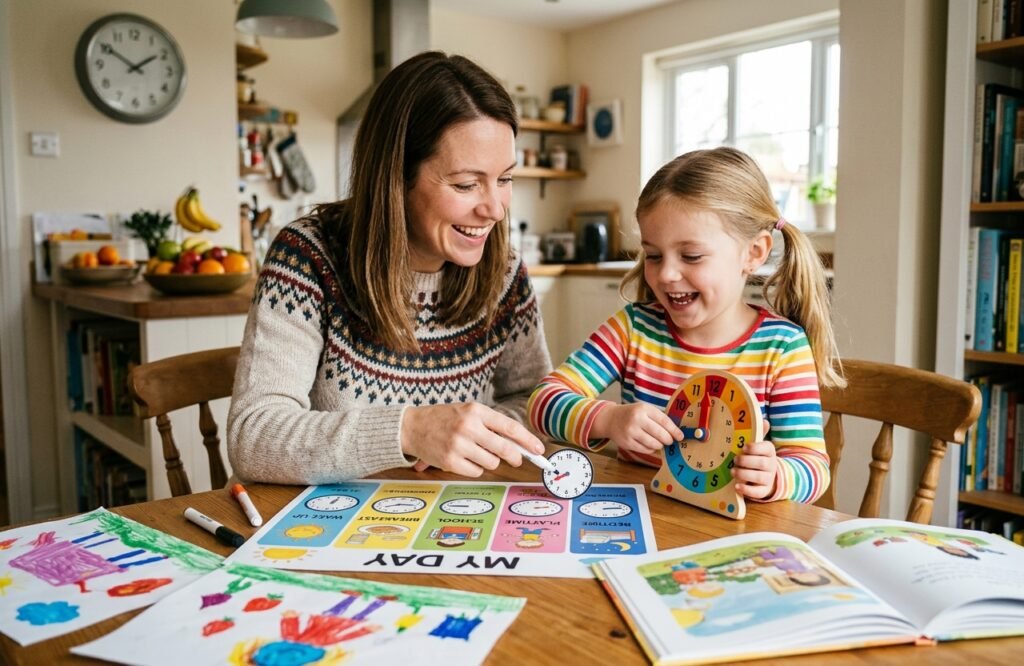
Learning to tell time is an important skill that helps children become more independent and understand how their day is organised. However, simply teaching numbers on a clock may not always be enough. Children learn more effectively when they can connect new concepts to activities they already understand. This is why How toTeach Kids About Telling Time With Routines is a practical approach for parents, caregivers, and teachers.
Daily routines provide natural opportunities to explain hours, minutes, morning and evening, and the sequence of activities. Instead of making time learning feel like a difficult maths lesson, adults can make it part of everyday life. From waking up and eating breakfast to going to school and getting ready for bed, familiar routines can help children understand what different times mean and why time matters.
Why Are Routines Helpful for Learning Time?
Children often understand events before they understand the numbers associated with those events. For example, a child may know that breakfast happens after waking up and bedtime happens after dinner. These familiar patterns create a foundation for understanding time.
When parents connect these activities to specific times, children gradually learn that routines happen according to a schedule. Saying, “We have breakfast at 8 o’clock,” gives a child a real-life example of what 8:00 means.
Routines also provide repeated practice. Children hear and see the same times every day, making it easier to remember them. Repetition can strengthen their understanding without making learning feel repetitive or stressful.
Start With Familiar Daily Activities
A simple way to begin is by choosing activities that happen at approximately the same time each day. Morning routines are particularly useful because they usually follow a predictable order.
For example, parents might say:
- “We wake up at 7 o’clock.”
- “Breakfast is at 8 o’clock.”
- “School starts at 9 o’clock.”
- “We eat dinner at 7 o’clock.”
- “Bedtime is at 9 o’clock.”
At first, focus on whole hours rather than asking children to understand every minute. Once they become comfortable recognising the hour hand and understanding basic times, you can introduce half-hours and quarter-hours.
Use a Clock During Everyday Conversations
A teaching clock can make time easier to understand because children can physically move the hands and observe how they change. Keep a clock somewhere children can easily see it and use it during normal activities.
When it is time for lunch, ask, “Can you look at the clock and tell me what time it is?” If the child needs help, explain which hand represents the hour and which represents the minutes.
You can also move the hands to show a specific time and ask the child to identify it. Connecting the clock to a real event makes the lesson more meaningful than simply completing worksheets.
Connect Time to the Order of Routines
Children need to understand that time is not only about reading numbers. It also describes when one event happens compared with another.
Try asking questions such as:
“What do we do before breakfast?”
“What happens after school?”
“Is bedtime before or after dinner?”
“What happens first in the morning?”
These questions help children understand sequence and develop an awareness of how activities fit together throughout the day.
Once children understand sequence, introduce the clock. For example, explain that breakfast comes first at 8:00, school begins at 9:00, and lunch takes place later in the day.
Teach Morning Afternoon and Evening
Understanding the difference between morning, afternoon, evening, and night can make telling time easier. Young children may initially struggle with the idea that the same number can appear at different parts of the day.
Use their routine to explain these differences. You could say, “We have breakfast in the morning,” or “We get ready for bed in the evening.”
You can also create a simple daily timeline showing morning activities, afternoon activities, and evening activities. Pictures of familiar routines can make the concept easier for younger children.
Turn Time Learning Into a Game
Games can make How to Teach Kids About Telling Time With Routines more enjoyable. Instead of always asking direct questions, create small challenges based on the child’s daily schedule.
For example, write several routine activities on cards and add times to them. Ask the child to match each activity with the correct time.
Another activity is a “What Happens Next?” game. Give the child one routine and ask what normally comes afterward. You can then discuss approximately what time the next activity takes place.
A pretend schedule can also be fun. Ask children to create a morning routine for a fictional character and decide what time each activity should happen.
Use Timers to Demonstrate Passing Time
Timers are useful for teaching children that time moves continuously. Set a timer for five or ten minutes and ask children what they can accomplish before it rings.
For example, you could say, “You have ten minutes to put away your toys.” When the timer ends, explain that ten minutes have passed.
This activity helps children develop a practical sense of duration. They begin to understand that five minutes is shorter than ten minutes and that activities take different amounts of time.
Gradually Introduce Minutes
Once children understand whole hours and basic daily routines, begin introducing minutes. Explain that an hour contains 60 minutes and that the minute hand moves around the clock as time passes.
Start with simple examples such as 5, 10, 15, 30, 45, and 60 minutes. Connect these numbers to real activities.
For instance, “We will leave for school in 15 minutes” gives children a practical reason to think about minutes. You can later introduce phrases such as “half past,” “quarter past,” and “quarter to.”
Avoid introducing too many concepts at once. Children learn time more confidently when each new idea builds on something they already understand.
Create a Visual Daily Schedule
A visual schedule can be particularly helpful for young children. Use simple words, pictures, and clock faces to represent important activities.
For example:
7:00 – Wake up
8:00 – Breakfast
9:00 – School
1:00 – Lunch
4:00 – Playtime
7:00 – Dinner
9:00 – Bedtime
Place the schedule somewhere visible. Encourage the child to check it throughout the day. Over time, this can help them connect clock times with activities and become more aware of their own schedule.
Be Patient and Encourage Practice
Learning to tell time can take time, particularly when children begin working with minutes. Avoid making mistakes feel like failures. Instead, correct errors calmly and explain the answer.
Short, regular practice sessions are often more effective than long lessons. A few minutes during breakfast, before school, or at bedtime can provide plenty of opportunities for learning.
Celebrate progress when children successfully identify a time or understand how long an activity will take. Positive encouragement can build confidence and motivation.
Conclusion
Teaching children to tell time does not have to involve complicated lessons or constant worksheets. Everyday routines provide a natural and effective way to introduce clocks, hours, minutes, sequence, and duration.
By connecting time with familiar activities, using visual schedules, playing simple games, and gradually introducing more advanced concepts, parents and teachers can make learning practical and enjoyable. The key is consistency and patience. With regular exposure to time during everyday routines, children can gradually develop both clock-reading skills and a stronger understanding of how time shapes their day.