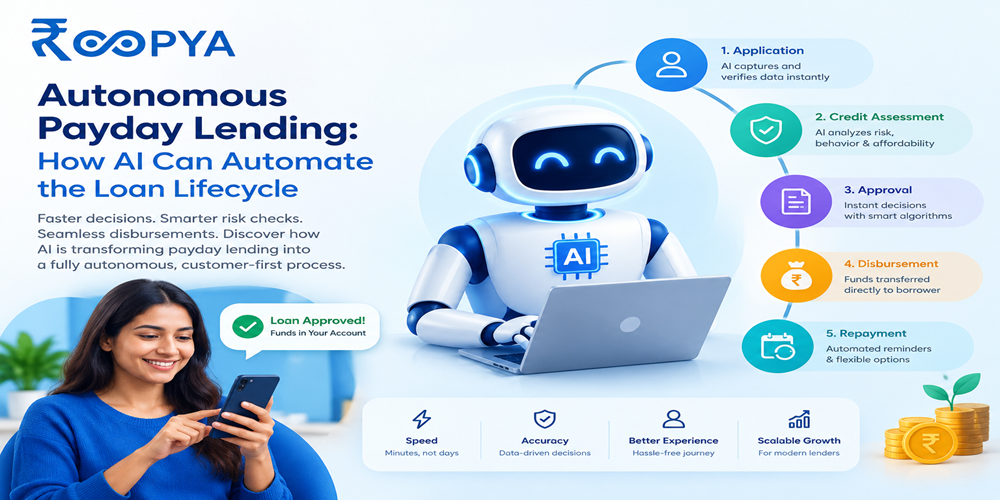
See how AI automates the payday loan lifecycle, from KYC and underwriting to disbursal and collections, with compliance controls for NBFCs and banks
Short-term, small-ticket lending has always been a race against the clock. A borrower who needs money before the next salary arrives expects an answer in minutes, not days. A lender, meanwhile, has to verify identity, judge repayment capacity, prevent fraud, disburse funds, and collect repayments, all on loans that are small in value and tight in margin. Doing that manually does not scale, and doing it carelessly creates regulatory and reputational risk.
This is why the conversation in banks and non-banking financial companies (NBFCs) is shifting from digital lending to autonomous lending. In an autonomous model, artificial intelligence and rule-based automation handle the routine work at every stage of the loan lifecycle, while people focus on policy, exceptions, and customer care. This guide explains what autonomous payday lending actually means, how AI fits into each stage, where human oversight must stay in place, and how to implement it responsibly.
What Is Autonomous Payday Lending?
Payday lending, often called salary-advance or short-tenure lending, refers to small loans repaid within a few weeks or by the borrower’s next salary date. Autonomous payday lending is the practice of running that entire product on a platform where the routine decisions and tasks are executed automatically, end to end, within limits that the lender sets.
It is worth being precise about the word autonomous. It does not mean unsupervised. It means that a well-configured system can take an application from submission to disbursal, and from repayment reminder to closure, without a person touching every file. The lender defines the credit policy, the risk appetite, the compliance rules, and the escalation triggers. The platform applies them consistently, at any hour, for any volume.
Three building blocks make this possible:
- A rule engine that encodes credit policy, eligibility, pricing, and compliance checks so that decisions are consistent and auditable.
- Machine learning models that read documents, score risk, detect fraud, and predict repayment behaviour using far more signals than a manual reviewer could weigh.
- An integration layer that connects credit bureaus, KYC providers, bank account verification, payment gateways, and communication channels through APIs, so data moves without re-keying.
Why Short-Term Lending Needs Automation Now
Several pressures are pushing lenders towards automation at the same time.
The first is unit economics. A payday loan has a small ticket size and a short tenure, so the cost to originate and service it must be very low. Every manual document check or phone call eats into a margin that is already thin. Automation reduces cost per loan, which is what makes serving small-ticket borrowers viable in the first place.
The second is customer expectation. Borrowers compare every lending experience to the best digital apps they use. If approval takes a day, many will already have moved on. Speed is not a luxury in this segment; it is the product.
The third is risk. Short-tenure lending attracts both genuine thin-file borrowers and bad actors. Fake documents, synthetic identities, and repeat defaulters move quickly across lenders. Manual reviewers struggle to catch them at volume, while machine learning models can compare patterns across thousands of applications in real time.
The fourth is regulation. In India, the Reserve Bank of India’s digital lending framework places clear expectations on disclosure, consent, data handling, and fund flow. Lenders that rely on spreadsheets and email trails find it hard to prove compliance; lenders with automated, logged workflows can show it on demand.
The Payday Loan Lifecycle, Stage by Stage
The clearest way to understand autonomous lending is to follow a single loan from first click to final repayment. At each stage below, we describe what the process looks like and what AI contributes.
1. Application and Onboarding
Friction at the front door is the biggest cause of drop-off. A modern onboarding journey captures only the data that is needed, pre-fills what it already knows, and works smoothly on a phone. Behind the scenes, the platform can capture explicit consent, record the device and location context, and create a single customer profile that follows the borrower through the lifecycle.
AI helps here in modest but valuable ways: validating fields as they are typed, detecting duplicate or repeat applicants, and routing the applicant to the correct product based on declared income and employment type. The goal is a journey short enough that a genuine borrower completes it, with enough signal captured that the system can make a good decision later.
2. KYC and Document Verification
Know-your-customer checks are mandatory, and they are also one of the slowest steps in a manual process. Automation replaces the back-and-forth with optical character recognition and computer vision that read identity documents, bank statements, and salary slips, extract the key fields, and cross-check them against each other and against official sources.
The value is not only speed. Document intelligence can flag tampered files, mismatched names, inconsistent dates, and low-quality scans that a tired reviewer might miss. Properly tuned models reach very high extraction accuracy, which allows the lender to reserve human review for the small share of files that the system marks as uncertain.
3. Credit Decisioning and Underwriting
This is the stage most people think of when they hear AI lending, and it is where the biggest gains and the biggest responsibilities sit. In payday lending, the borrower often has a thin credit history, so a bureau score alone may not tell the full story.
An autonomous decisioning engine combines several inputs: bureau data where available, bank statement analysis such as salary regularity and balance trends, employment and income signals, and, where permitted and consented, alternative data. It then produces a decision, a credit limit, and a price within the lender’s policy. A visual rule builder lets the credit team change thresholds, add policy rules, or run a champion-challenger test without waiting for a software release.
Two design principles matter. First, decisions should be explainable: the lender should be able to state which factors drove an approval or a decline. Second, the model should be monitored for drift and for unfair outcomes across customer groups, because a model that performed well last year may not perform well after the economy changes.
4. Fraud Detection
Fraud in short-term lending takes many forms, including identity theft, forged income documents, loan stacking across multiple lenders, and mule accounts used to receive funds. Rule-based checks catch the obvious cases; machine learning catches the patterns that rules do not anticipate.
Useful signals include device fingerprints, IP and geolocation anomalies, velocity of applications, mismatches between declared and observed data, and linkages between accounts that share phone numbers, devices, or bank details. Scoring each application for fraud risk before disbursal is far cheaper than recovering money afterwards.
5. Disbursal
Once approved, the loan agreement has to be presented, accepted, and recorded, and the money has to move. Automation handles key fact statement generation, digital acceptance, e-signature or e-mandate setup, and payment instruction to the borrower’s verified bank account through a payment gateway or banking API.
Straight-through disbursal is where the user experience becomes tangible. Funds reaching the account within minutes, with a clear confirmation and a repayment schedule, builds trust. Reconciliation of the disbursal against the lender’s books should happen automatically so that finance teams are not chasing mismatches the next morning.
6. Servicing and Repayment
A short-tenure loan has little room for servicing errors. The platform should calculate interest and fees accurately, generate the repayment schedule, send timely reminders, collect repayment through the agreed method, and post each payment to the correct loan account.
AI adds value by predicting which borrowers are likely to miss a due date and by choosing the best time and channel to remind them. A borrower who responds to a message on the morning of payday is a different customer from one who needs a nudge two days earlier. Self-service portals, where borrowers can view their balance, download statements, or request an extension within policy, also reduce inbound support load.
7. Collections
Even good portfolios have delinquencies. Autonomous collections starts early and stays respectful. The system segments overdue accounts by risk and behaviour, then runs a workflow of reminders, payment links, and, where appropriate, repayment plans. Only the accounts that need a conversation are passed to a human agent, with the full history on screen.
Predictive models can prioritise accounts by likelihood of recovery, so that agent time goes where it will make a difference. Equally important, the workflow can enforce conduct rules: permitted contact hours, approved scripts, frequency caps, and a complete log of every interaction. This protects the borrower and the lender alike.
8. Early Warning, Renewal, and Closure
The lifecycle does not end at repayment. Early warning models watch for signs of stress before a loan becomes overdue, such as a drop in salary credits or a change in repayment behaviour. When a loan is closed, the system issues the closure confirmation, updates credit bureau records, and evaluates whether the borrower qualifies for a repeat loan or a higher limit.
Responsible lenders treat repeat borrowing carefully. Automatic limit increases should follow policy and borrower consent, and the system should flag patterns of back-to-back borrowing that suggest the customer is in a debt cycle rather than a one-off cash gap.
Lifecycle at a Glance
| Stage | What gets automated | How AI helps |
| Application | Data capture, consent, pre-fill | Duplicate detection, product routing |
| KYC | Document reading, identity checks | OCR, tamper and mismatch detection |
| Underwriting | Eligibility, limit, pricing | Risk scoring, alternative data, explainable decisions |
| Fraud | Pre-disbursal screening | Device, network and behaviour anomaly models |
| Disbursal | Agreement, e-mandate, payout | Straight-through processing, auto reconciliation |
| Servicing | Schedules, reminders, posting | Repayment-risk prediction, channel timing |
| Collections | Workflows, payment links | Recovery prioritisation, conduct controls |
| Closure | Closure, bureau update, renewal | Early warning, repeat-loan eligibility |
Where Autonomy Should Stop: Human Oversight and Responsible Lending
Payday lending carries a particular responsibility. The same speed that helps a borrower in an emergency can harm one who is already stretched. An autonomous platform should therefore be built around guardrails, not just throughput.
- Affordability checks: approve only amounts the borrower can repay from observed income, and cap exposure per customer.
- Transparent pricing: show the full cost of the loan, including interest, fees, and the annualised rate, before the borrower accepts.
- Human review of edge cases: low-confidence model outputs, high-value exceptions, and borrower disputes should be routed to trained staff.
- Fair-lending monitoring: test models regularly for bias and document the results.
- Grievance handling: provide a clear route for complaints, with named contacts and defined response times.
The principle is simple: automate the routine, escalate the unusual, and always keep a person accountable for the policy.
Compliance by Design
Regulation should be built into the workflow rather than checked afterwards. For lenders operating in India, the RBI’s digital lending guidance covers areas such as disclosure of a key fact statement, borrower consent for data collection, direct disbursal to and repayment from the borrower’s own bank account, a cooling-off period, grievance redressal, and reporting of digital lending apps. Rules change over time, so lenders should confirm current requirements with their compliance team and the latest RBI circulars.
An autonomous platform helps in three practical ways. It enforces mandatory steps, so a loan cannot be disbursed unless the required disclosures and consents are on record. It keeps an immutable audit trail of every decision, document, and communication. And it produces regulatory and management reports from the same data that runs operations, which reduces reconciliation effort and the risk of inconsistent numbers.
Metrics That Show Whether Automation Is Working
Automation is only valuable if it improves outcomes. A balanced scorecard should combine speed, cost, quality, and conduct measures:
- Turnaround time: from application to disbursal, and the share of loans processed without manual touch.
- Approval rate and portfolio quality: approvals together with early-delinquency and loss rates, so that growth is not bought with risk.
- Cost per loan: origination and servicing cost, which should fall as straight-through processing rises.
- Fraud rate: confirmed fraud cases as a share of disbursals, and the amount prevented before payout.
- Collection efficiency: recovery rates by bucket and the cost of recovery.
- Customer experience: drop-off rate, complaint volume, and repeat-borrower satisfaction.
How to Implement Autonomous Lending Step by Step
Lenders do not need to automate everything at once. A phased approach reduces risk and builds confidence.
- Map the current process. Document each step, owner, turnaround time, and failure point in the existing payday loan journey.
- Define the credit and compliance policy in rules. Convert the policy into explicit, testable rules before layering on machine learning.
- Start with high-volume, low-risk automation. Document extraction, notifications, reconciliation, and reporting deliver quick wins.
- Introduce models with guardrails. Run new scoring or fraud models in shadow mode, compare against human decisions, then go live with limits.
- Integrate data sources. Connect bureaus, KYC, bank verification, and payment gateways through APIs rather than manual uploads.
- Monitor, review, and refine. Track the scorecard above, review model drift, and adjust policy as the portfolio evolves.
A no-code, configurable platform shortens this journey because credit and operations teams can change rules themselves instead of queuing for engineering work.
How Roopya Supports Autonomous Payday Lending
Roopya is an autonomous lending platform built for banks, NBFCs, microfinance institutions, and loan service providers. It brings the lifecycle described above into one system, so lenders do not need to stitch together separate tools.
- Loan Origination System: digital applications, automated credit scoring, document verification, and real-time decisioning.
- Loan Management System: portfolio management, payment processing, repayment schedules, and a customer portal.
- Collections System: automated reminders, collection workflows, payment plans, and agent management.
- Early Warning System: risk prediction, behavioural analytics, and alert management.
- Lending Analytics and Advanced Reporting: portfolio performance dashboards and regulatory reports.
- No-code business rule engine, 300+ pre-integrated APIs covering credit bureaus, payment gateways, and verification services, and pre-configured loan products including payday loans.
Because the platform is configurable and priced on usage, a lender can launch a payday product quickly, test it on a small portfolio, and scale as results justify. To see how this would work for your institution, explore the Roopya platform at roopya.money or use the contact page to request a walkthrough.
Frequently Asked Questions
What is autonomous payday lending?
Autonomous payday lending is the use of AI and rule-based automation to run a short-term, small-ticket loan product from application to closure with minimal manual intervention. The lender sets the credit policy, risk limits, and compliance rules, and the platform applies them consistently and logs every decision.
How does AI help in the payday loan lifecycle?
AI reads and verifies documents, scores credit and fraud risk, predicts repayment behaviour, chooses the best reminder timing and channel, and prioritises collection efforts. This reduces turnaround time and cost per loan while improving consistency and portfolio quality.
Is automated loan approval safe and compliant?
It can be, when compliance is built into the workflow. The platform should enforce mandatory disclosures and consents, maintain an audit trail, keep decisions explainable, and route low-confidence cases to human reviewers. Lenders should confirm current regulatory requirements with their compliance team.
Can AI underwrite borrowers with a thin credit history?
Yes, within limits. Besides bureau data, models can use bank statement analysis, salary regularity, and, where permitted and consented, alternative data. Lenders should keep exposure caps in place and monitor models for drift and bias.
Which loan stages can be fully automated?
Routine stages such as data capture, document extraction, eligibility checks, agreement generation, disbursal, reminders, payment posting, reconciliation, and reporting can be highly automated. Exceptions, disputes, and high-value or low-confidence decisions should stay with trained staff.
How long does it take to launch an automated payday loan product?
Timelines depend on the lender’s policy readiness, integrations, and regulatory approvals. A configurable no-code platform with pre-built integrations and pre-configured loan products can shorten the technical setup considerably compared with building a system from scratch.
Who can use Roopya for payday lending?
Roopya is designed for banks, NBFCs, microfinance institutions, and loan service providers that want to originate, manage, and collect loans, including payday loans, on one platform.
Autonomous payday lending is not about removing people from lending. It is about removing repetitive work, delay, and inconsistency from a product where speed and cost decide viability. When AI handles verification, scoring, fraud screening, servicing, and early collections, lenders can serve more borrowers faster, at lower cost, and with a full audit trail. When human oversight, affordability limits, and transparent pricing wrap around that automation, the result is lending that is both efficient and responsible.
For banks and NBFCs evaluating this shift, the practical path is to start with a clear policy, automate the routine stages first, introduce models with guardrails, and measure results honestly. A configurable platform such as Roopya makes that path shorter. Visit roopya.money to explore the platform or request a demonstration.