Segway Tour in San Francisco What Makes a Route Suitable
A successful city tour is rarely about simply drawing a line between famous landmarks. For Segway operators, the route itself is part of the experience. The best routes balance sightseeing with movement, allowing guests to explore comfortably while operators maintain safety and control. Planning a Segway ride therefore involves much more than selecting photogenic streets. It requires a practical assessment of how a route performs in real-world conditions.
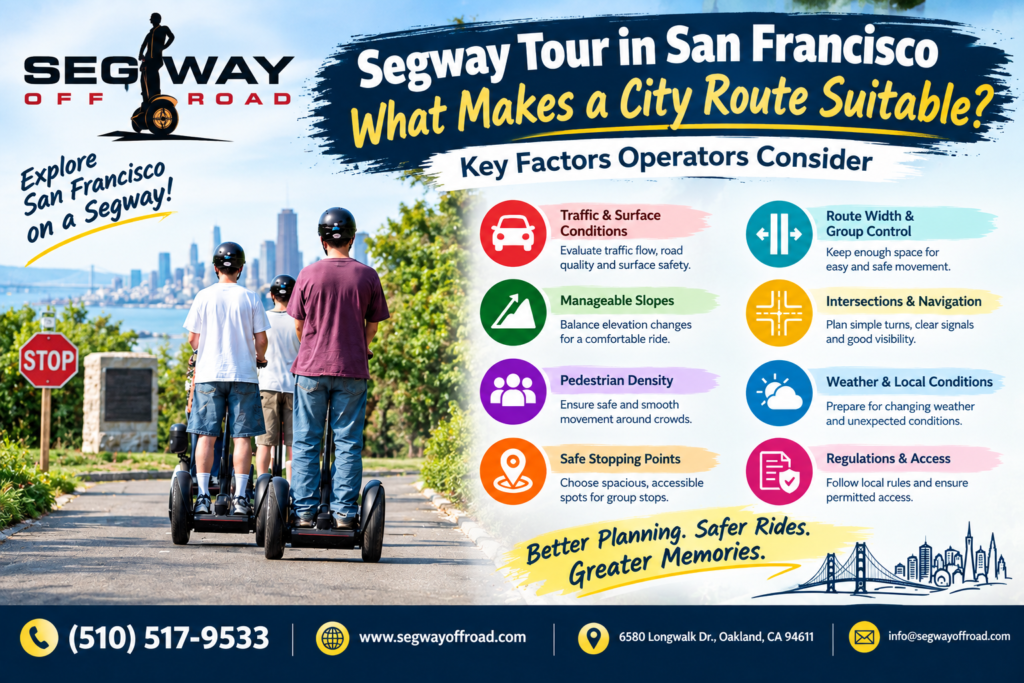
Traffic and Surface Conditions
Traffic patterns are among the first factors operators evaluate. A route with heavy vehicle movement, complicated intersections, frequent lane changes, or limited visibility can create unnecessary challenges.
Road surfaces matter just as much. Broken pavement, cracks, loose gravel, drainage channels, steep curb transitions, and construction zones can affect stability and rider confidence. A Segway tour in San Francisco must account for changing pavement conditions because urban routes can include different streets, paths, and pedestrian areas.
Manageable Slopes
Elevation can make a city visually interesting, but it also affects route suitability.
A sustained or abrupt slope can make the experience more demanding. Descents require particular attention because speed control and braking become more important. Operators also consider whether riders have sufficient space to manage changes in elevation.
This is especially relevant when planning a Segway ride through a hilly destination. A route should provide variety without turning sightseeing into a physically demanding journey.
Pedestrian Density
A city route can be technically accessible yet unsuitable because of pedestrian congestion. Operators assess how crowded sidewalks, plazas, waterfront paths, shopping districts, and attractions become at different times of day.
High pedestrian density creates a more complex operating environment. Riders must respond to people crossing unexpectedly, groups stopping for photographs, children changing direction, and visitors unfamiliar with the route. Operators may therefore select wider pathways or schedule certain sections when foot traffic is lighter.
For a Segway tour in San Francisco, pedestrian flow can be particularly important around popular attractions. The route needs sections where a group can move responsibly and comfortably.
Safe Stopping Points
Sightseeing requires stopping, so operators evaluate more than the moving portions of a route. Good stopping points provide enough space for the group to gather without blocking pedestrians, entrances, driveways, or traffic.
Operators consider sightlines, available space, accessibility, and the time needed to bring the group to a controlled stop. A thoughtfully designed Segway ride uses these pauses to create rhythm. Riders move through the city, stop for information or photographs, and continue without repeated bottlenecks or unsafe regrouping.
Route Width and Group Control
The width of a route influences how easily an operator can manage a group. Narrow paths can make it difficult for riders to maintain appropriate spacing, particularly when pedestrians or cyclists are present.
A route may work well for a small private group but become impractical for a larger tour. When developing a Segway tour in San Francisco, operators can examine each section independently rather than treating the itinerary as one continuous route. This helps identify where group control could become difficult and where an alternative path may provide better flow.
Intersections and Navigation
Complex intersections can increase the operational demands of a city tour. Operators review traffic signals, turning movements, crossing distances, visibility, and the time available to move a group safely.
Navigation also matters. A route with frequent turns can be harder for guests to follow while they are watching pedestrians, traffic, and their surroundings.
A strong Segway ride therefore combines interesting destinations with straightforward navigation. The route should feel exploratory without requiring riders to make confusing decisions at every block.
Weather and Local Conditions
Weather can change how a route performs. Rain can make surfaces slippery, while strong winds can affect exposed sections. Heat may make long stretches without shade uncomfortable, and poor visibility can create additional challenges.
Operators may also modify itineraries when construction, weather, events, or temporary closures affect normal conditions.
For a Segway tour in San Francisco, environmental factors can vary between exposed waterfront areas, dense urban streets, and elevated viewpoints. Flexibility is therefore an important part of route planning.
Regulations and Access
Not every attractive city space is suitable or permitted for Segway use. Operators must understand local rules governing sidewalks, bicycle paths, public spaces, road access, and group activities.
Temporary construction, public events, street closures, and pedestrian-only zones can also affect an established itinerary. Responsible operators monitor these changes and maintain alternatives where appropriate.
This awareness helps ensure that a Segway ride is planned around legitimate access rather than assuming every visible route is available for commercial touring.
Making the Route Work
Ultimately, route selection balances safety, logistics, sightseeing, and rider experience. Strong routes do not simply collect famous attractions. They connect them in a sequence that offers manageable movement, useful stops, clear navigation, and visual variety.
For operators, every block has a purpose. A Segway tour in San Francisco may depend on how carefully its route accounts for traffic, terrain, pedestrian behavior, stopping space, regulations, and changing conditions before the first rider arrives.
A well-designed urban route feels effortless to the guest because the difficult planning happened behind the scenes. That is the craft of city Segway tour planning: turning a complex urban environment into a route that is engaging, controlled, practical, and comfortable from start to finish. Route testing can also include trial runs, timing checks, observation of peak pedestrian periods, and reviews of temporary access changes. These checks help operators refine the itinerary before guests arrive and keep the experience consistent across different tour groups and operating days carefully.