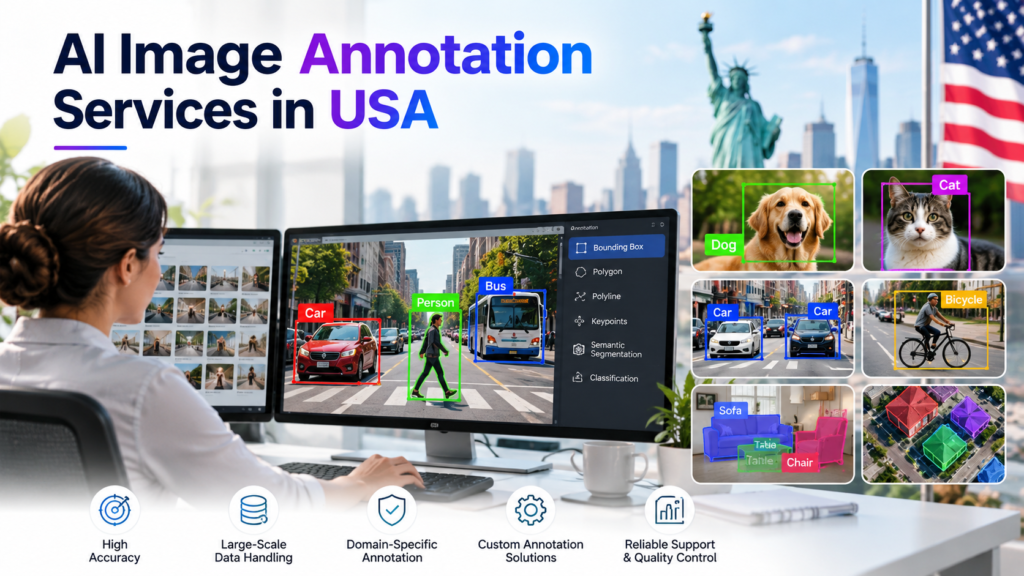
Artificial intelligence can only perform as well as the data used to train it. When an AI model works with images, it needs to understand what is present in each image, where objects appear, and how different visual elements should be interpreted. This is where AI Image Annotation Services become important. By adding accurate labels, tags, boundaries, and other information to images, businesses can create structured datasets that help machine learning models learn more effectively.
For example, a model designed to identify vehicles in traffic camera footage needs to distinguish between cars, buses, trucks, motorcycles, and pedestrians. If the training images are poorly labeled, the model may learn incorrect patterns and produce unreliable results.
High-quality annotation helps reduce these problems by giving AI systems clear and consistent training examples. From computer vision and autonomous vehicles to healthcare imaging, retail, and security applications, accurate image labeling can directly influence model performance.
This blog explains how AI Image Annotation Services improve AI model accuracy, what annotation methods are commonly used, the challenges businesses face, and how Vision Infotech can support organizations that need reliable AI training data.
What Is AI Image Annotation?
AI image annotation is the process of adding meaningful labels or information to images so that machine learning models can understand their contents.
An unannotated image may simply look like a collection of pixels to a computer. Annotation gives those pixels context. For instance, a photograph of a road can be labeled to identify cars, pedestrians, traffic lights, road signs, and lane markings.
Depending on the AI application, annotation may involve:
- Drawing bounding boxes around objects
- Creating polygons around irregular shapes
- Marking individual pixels through segmentation
- Adding classification labels
- Identifying key points on objects
- Tagging specific image attributes
- Highlighting areas of interest
The goal is to create structured training data that allows a computer vision model to recognize similar patterns in new images.
How Do AI Image Annotation Services Improve AI Model Accuracy?
The connection between annotation and model accuracy is straightforward: better training examples generally give machine learning systems a stronger foundation for learning.
Here are the main ways annotation improves AI model performance.
1. Provides Clear Training Examples
Machine learning models learn from examples. If those examples are incomplete, inconsistent, or incorrectly labeled, the model can struggle to understand what it is expected to identify.
AI Image Annotation Services provide clearly labeled datasets that help models associate visual patterns with the correct outcomes.
Consider a retail company developing an image recognition system for products. If hundreds of images are correctly labeled according to product type, brand, size, or other relevant characteristics, the model receives more useful information during training.
Over time, these examples can help the system recognize similar products in images it has never seen before.
2. Reduces Incorrect Predictions
Poor-quality training data can introduce errors into an AI model. These errors may later appear as false detections or incorrect classifications.
Suppose an autonomous driving system is trained to identify pedestrians. If some pedestrians are not labeled correctly in training images, the model may fail to recognize people in similar situations.
Accurate annotation helps reduce these gaps. AI Image Annotation Services can apply consistent labeling rules across large datasets, making it easier for models to learn the correct visual relationships.
This does not guarantee perfect predictions, but it can significantly strengthen the quality of the training foundation.
3. Helps Models Recognize Object Boundaries
Object detection often requires more than simply knowing that an object exists. The model may also need to understand exactly where that object is located.
Bounding boxes and polygon annotations provide this information.
For example, an agricultural AI system may need to identify individual fruits on a plant. Precise boundaries can help the model distinguish one fruit from another, even when objects overlap.
Similarly, medical imaging systems may require detailed segmentation to identify specific regions within an image.
Accurate boundaries make training data more precise and can improve the model’s ability to locate objects correctly.
4. Supports Different Computer Vision Applications
Different AI applications require different types of image annotations.
A facial recognition system may require facial landmarks, while an autonomous vehicle system may need bounding boxes, polygons, and lane markings. A medical imaging application could require pixel-level segmentation.
Professional AI Image Annotation Services can select annotation techniques according to the model’s requirements rather than applying one method to every project.
This is important because using an unsuitable annotation format can limit the usefulness of the resulting dataset.
Common Image Annotation Techniques
Understanding annotation methods helps businesses decide what type of data preparation their AI project requires.
Bounding Box Annotation
Bounding boxes are rectangular boxes drawn around objects in an image. They are widely used for object detection.
For example, an image containing three vehicles can have separate boxes around each vehicle. Each box can then be assigned a label such as car, truck, or bus.
Bounding boxes are relatively straightforward and work well when the approximate location of an object is sufficient.
Polygon Annotation
Polygon annotation provides more detailed object boundaries than rectangular boxes.
Instead of placing a box around an object, annotators mark points around its edges. This is useful for objects with irregular shapes.
For instance, a manufacturing AI system inspecting components may need to identify the exact shape of a defective part.
Semantic Segmentation
Semantic segmentation assigns a category to individual pixels in an image.
For example, an autonomous driving dataset could classify pixels as road, vehicle, pedestrian, building, sky, or vegetation.
This approach provides detailed visual information and is useful when precise object regions matter to the AI application.
Keypoint Annotation
Keypoint annotation identifies important points within an object.
Human pose estimation is a common example. Keypoints can mark the shoulders, elbows, wrists, knees, and ankles of a person.
This allows AI systems to analyze movement, posture, and body positioning.
Why Annotation Consistency Matters
Accuracy is not only about labeling a large number of images. AI Image Annotation Services also need to maintain consistency across the entire dataset.
Imagine that one annotator labels a partially visible vehicle as a car, while another labels a similar image as an unknown object. The model receives conflicting signals.
Consistent annotation guidelines can reduce this problem.
A professional workflow may define:
- Which objects should be labeled
- How partially visible objects should be handled
- How overlapping objects should be treated
- Which labels should be used
- How image quality issues should be recorded
- When an annotation should be reviewed
These rules help create a more uniform dataset and make the training data easier for machine learning systems to interpret.
The Role of Quality Control in AI Image Annotation
Annotation quality should be checked before the dataset is used for model training.
A strong quality-control process can include multiple levels of review. Annotators may first complete the labeling, followed by another team member checking samples for mistakes. More complex projects may use automated checks along with human review.
Quality control can identify problems such as:
- Missing objects
- Incorrect labels
- Poor object boundaries
- Duplicate annotations
- Inconsistent classifications
- Unclear or incomplete segmentation
This is one reason businesses often work with specialized AI Image Annotation Services rather than treating annotation as a simple data-entry task.
The quality of the final dataset depends on the process used to create and validate it.
How AI Image Annotation Supports Model Training
Once images have been properly annotated, the dataset can be used to train a computer vision model.
The model studies relationships between image features and their corresponding labels. During training, it adjusts its internal parameters based on how accurately it predicts the expected results.
A well-prepared dataset gives the model a stronger learning foundation.
For example, a healthcare company developing an image analysis system may have thousands of medical images. If the relevant regions are accurately labeled by trained annotators and reviewed for consistency, the dataset can provide useful examples for model development.
However, annotation should not be viewed as the only factor affecting accuracy. Model architecture, dataset size, image quality, training methodology, validation, and testing also influence final performance.
Real-World Example: Retail Product Recognition
Consider an online retailer that wants an AI system to identify products from customer-uploaded photographs.
The system may need to recognize shoes, shirts, bags, watches, and other products.
A dataset containing thousands of properly labeled product images can help the model learn visual characteristics such as shape, category, and position.
If the annotations are inconsistent, the model may confuse similar products. If the images are accurately labeled and represent different angles, lighting conditions, and backgrounds, the model has more varied examples from which to learn.
This illustrates how AI Image Annotation Services can contribute to practical computer vision applications.
AI Image Annotation Services in USA: Why Businesses Need Reliable Data
Companies using AI in the United States are applying computer vision across industries such as healthcare, manufacturing, transportation, retail, agriculture, and security.
For organizations developing AI products, creating high-quality training datasets can become a major part of the development process. AI Image Annotation Services in USA can help businesses organize large image datasets, establish annotation standards, and prepare data according to project requirements.
For example, a US-based logistics company developing an automated warehouse vision system may need thousands of images labeled according to packages, workers, equipment, and storage areas.
A structured annotation workflow can make this training data more useful while helping development teams focus on model engineering and application development.
How to Choose the Right Annotation Partner
Choosing an annotation provider should involve more than comparing the number of images a company can process.
Businesses should evaluate several factors.
Annotation Expertise
The provider should understand the annotation technique required for the project and the specific needs of computer vision models.
Quality Assurance
Ask how annotations are reviewed and how errors are identified and corrected.
Scalability
AI projects can grow quickly. The provider should have a process that can support larger datasets without compromising consistency.
Data Security
Businesses should understand how images are stored, accessed, transferred, and protected, particularly when datasets contain sensitive information.
Communication
Clear communication is important when annotation guidelines change or new edge cases appear during a project.
Industry Understanding
A provider familiar with the client’s industry can better understand the context behind different images and labels.
Why Choose Vision Infotech for AI Image Annotation?
Vision Infotech helps businesses prepare structured and reliable image datasets for AI and machine learning applications. Our approach focuses on understanding the project’s objective before defining annotation workflows.
We can support different annotation requirements, including object detection, image classification, polygon annotation, segmentation, and keypoint labeling.
The focus is not simply on processing more images. It is on creating useful training data with consistent labeling and appropriate quality checks.
Businesses working with Vision Infotech can benefit from:
- Project-specific annotation guidelines
- Human-reviewed image labeling
- Quality-control processes
- Support for different annotation formats
- Scalable data preparation workflows
- Clear communication throughout the project
- Support for AI and machine learning data requirements
For organizations looking for AI Image Annotation Services in USA, having a reliable technology partner can make the data preparation stage more manageable and structured.
How Businesses Can Get Better Results From Image Annotation
Businesses can improve the value of their annotation projects by preparing clear requirements before work begins.
Start by defining exactly what the AI model needs to recognize. Then determine which annotation method provides the required information.
It is also useful to create a small pilot dataset before processing thousands or millions of images. The pilot can reveal unclear labels, difficult edge cases, and annotation problems early.
Another important step is continuous quality monitoring. Annotation guidelines may need to evolve as new image types appear. Updating the guidelines and communicating changes to annotators can help maintain dataset consistency.
Finally, businesses should evaluate the dataset based on its usefulness for the intended AI application rather than focusing only on the number of annotated images.
The Future of Image Annotation for AI
As computer vision becomes part of more business processes, the demand for structured visual training data is likely to continue growing.
AI systems are being developed to interpret medical images, inspect industrial products, understand road environments, analyze retail products, monitor agricultural conditions, and perform many other visual tasks.
This makes high-quality data preparation increasingly important. Automated annotation tools may speed up parts of the process, but human expertise and quality control remain valuable for difficult images, unusual cases, and domain-specific requirements.
Businesses that treat annotation as an important part of their AI development strategy can build a stronger foundation for model training and testing.
Conclusion
Accurate AI models begin with useful training data. AI Image Annotation Services help transform raw images into structured datasets that machine learning systems can understand and learn from. Through bounding boxes, polygons, segmentation, classification, and keypoint annotation, businesses can provide models with the visual information needed for different computer vision applications.
The biggest benefit is not simply the number of images that can be labeled. It is the quality, consistency, relevance, and reliability of the resulting dataset. Proper annotation can reduce labeling errors, improve object recognition, support better model training, and provide a stronger foundation for AI applications.
For businesses developing computer vision solutions, choosing the right annotation approach and quality-control process is an important investment. Vision Infotech can help organizations build structured image datasets according to their AI project requirements, supporting the journey from raw visual data to more reliable machine learning models.