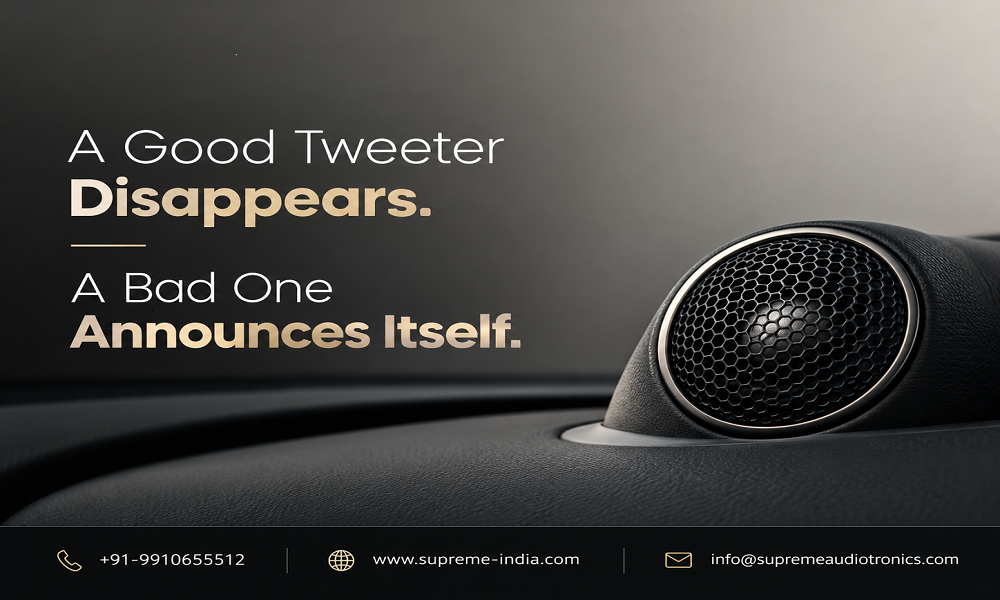
Weak tweeter, dead giveaway: harshness up top. Cymbals hiss instead of shimmer. Vocals turn thin and piercing past a certain volume, and most listeners can’t name exactly what’s wrong. They just feel it, usually with a hand reaching for the volume knob, turning things down instead of up.
The job itself sounds simple on paper. Reproduce everything above roughly 2kHz, cleanly, without adding character of its own. Describing that takes one sentence. Actually, building a tweeter that does it well, at a price that won’t require a second mortgage, takes a lot longer to get right.
Dome Material Changes Everything, Quietly
Silk first. Softer top end, forgiving on bad recordings, smooth rather than aggressive. That’s why most budget and mid-range systems default to it. Forgiving sells better than accurate, most of the time, especially to ears that were never trained to hear the difference in the first place.
Then there’s titanium and aluminum. Harder-edged accuracy, extended response, faster transients, picking up detail a silk dome just rounds off and smooths away. Comes at a cost, though. Feed a titanium tweeter a badly mastered track, and it exposes every flaw mercilessly. Zero forgiveness.
We have swapped domes on the same crossover more times than I can count, purely to hear what changes. Same crossover point. Same enclosure. Wildly different personality, and the dome material alone is responsible for all of it. People walk in assuming the driver matters most. Material matters at least as much, usually more.
Crossover Design Decides Whether a Tweeter Survives
A tweeter fed bass frequencies it was never built to handle dies fast, sometimes within minutes of an aggressive source. Proper crossover design keeps low frequencies away entirely, routing them to a midrange or woofer instead, protecting the delicate voice coil from excursion it can’t physically survive. Sensitivity mismatches cause an entirely different headache. Pair a hot tweeter with a less efficient midrange and the result turns bright and fatiguing inside twenty minutes. Nothing broken, technically. Just unbalanced. An attenuation resistor or an L-pad dropped into the crossover network fixes it, bringing output levels back in line so neither driver steamrolls the other.
A tweeter manufacturer serious about build quality publishes actual frequency response graphs, not just a vague range printed on packaging with nothing behind it. Numbers on their own don’t tell the whole story, honestly, but a manufacturer willing to show the curve at least signals they measured something real before shipping.
Why Location Matters for a Tweeter Manufacturer in Delhi
Supreme India operates as a tweeter manufacturer in Delhi, working within a supply chain dense enough that component sourcing and quality testing happen without the long shipping delays that plague manufacturers further from major ports and component suppliers.
Local manufacturing also means faster iteration. A design tweak based on listening feedback can go from idea to tested prototype in weeks rather than months, something that matters a lot when fine-tuning something as sensitive as dome material and crossover point.
What Actually Matters When Comparing Options
Power handling numbers deserve scrutiny before they get trusted. A tweeter rated for 100 watts RMS sounds impressive on a spec sheet, but that rating means nothing without knowing the testing methodology behind it. Ask directly how the manufacturer arrived at that figure: continuous pink noise testing or a brief burst test, because the two produce wildly different real-world numbers.
Build quality around the voice coil and surround matters more long-term than any single headline spec. A tweeter that sounds great on day one but degrades within a year wasn’t actually a good purchase, whatever the initial impression suggested.
FAQs
What frequency range does a tweeter typically handle?
Generally from around 2kHz up to 20kHz, though the exact crossover point varies by speaker system design.
Is a titanium dome tweeter better than a silk dome?
Not universally better, just different. Titanium offers more detail and accuracy, while silk sounds smoother and more forgiving on lower-quality recordings.
Why do tweeters fail if not protected by a crossover?
Bass frequencies cause excessive excursion in a driver not designed for it, which can damage or destroy the voice coil quickly.
Does a higher power rating always mean a better tweeter?
No. Build quality, dome material, and crossover integration matter more than the power rating alone.
How can I tell if a tweeter manufacturer tests quality properly?
Look for published frequency response data and clear testing methodology rather than vague marketing claims about sound quality.