Modern commercial spaces increasingly use creative architectural features to attract attention and deliver memorable visual experiences. Instead of relying on conventional flat display panels, businesses are exploring curved walls, cylindrical structures, wave-shaped installations, and other unconventional designs. These applications require display technology that can adapt to different surfaces without compromising visual quality.
Soft LED modules make these custom configurations possible. Their flexible construction allows LED displays to follow selected curved surfaces, creating seamless visual effects across convex, concave, and S-shaped walls. For businesses planning an indoor led screen installation, this technology offers greater freedom to integrate digital content into architectural designs.
Understanding how flexible modules work, where they can be installed, and which technical factors influence performance helps designers and businesses create effective custom LED display solutions.
What Are Soft LED Modules?
Soft LED modules are display components designed with flexible printed circuit boards and adaptable materials that allow them to bend within specified limits. Unlike conventional rigid LED modules, which are generally intended for flat mounting surfaces, soft modules can accommodate certain curved shapes.
The flexibility comes from the module’s construction. Components are arranged on a flexible circuit board, while the surrounding materials provide support and protection. Depending on the product design, the module can be attached to a compatible curved mounting structure to create a customised LED wall.
However, flexibility does not mean a module can bend into every shape. Each model has a minimum bending radius and specific installation requirements. Exceeding these limits may damage components, create uneven surfaces, or affect display performance.
Flexible LED screens are particularly useful when a project requires unusual display geometry, such as curved reception counters, rounded columns, sculptural walls, and wave-shaped installations.
Convex LED Walls: Creating Outward Curves
How Convex Configurations Work
A convex wall curves outward toward the viewer, similar to the exterior of a cylinder. Soft LED modules can follow this shape when installed on a compatible curved frame.
The result is a display surface that wraps around an architectural feature instead of ending at a flat edge. This configuration can create a strong visual focal point in environments where visitors approach the display from different directions.
For example, a shopping mall may use a convex LED wall around a central column to display promotional campaigns. A hotel may install an outward-curving screen behind its reception desk to introduce the brand through motion graphics and welcome messages.
Key Design Considerations
The curve must be designed around the module’s permitted bending radius. A tighter curve may require a different module specification or a specially engineered support structure.
Designers should also consider viewing distance and pixel pitch. Fine-pitch displays are often suitable for spaces where visitors stand close to the screen, while larger pixel pitches may work for displays viewed from farther away.
Content should be created for the curved surface. Large text, logos, and important visual elements must remain legible when viewed from different angles.
Concave LED Walls: Building Immersive Visual Experiences
Understanding Inward Curves
A concave wall curves inward, creating a surface that partially surrounds the viewer. This configuration can make digital content feel more immersive because the display occupies a wider portion of the viewer’s field of vision.
Soft LED modules can be arranged along a suitable concave structure to produce an inward-facing display. The final curvature depends on the mounting system, module flexibility, and project requirements.
Concave LED walls are suitable for corporate experience centres, exhibition booths, museums, control rooms, and branded presentation spaces. For instance, a showroom could use an inward-curving display to present product features, animated environments, or large-scale visual demonstrations.
Planning for Viewing Angles
A concave display needs careful viewing-angle planning. The design should account for where visitors stand, how far they are from the screen, and whether the content must be visible to several people simultaneously.
Pixel pitch, brightness, colour consistency, and image processing also influence the viewing experience. For close-up applications, finer pixel pitch can help produce sharper images. However, the ideal specification depends on the actual viewing distance, content, and budget.
Installers should ensure that the supporting structure follows the intended curve accurately. Uneven mounting can create visible irregularities across the display and reduce the overall quality of the installation.
S-Shaped LED Walls: Combining Convex and Concave Curves
What Makes an S-Shaped Display Different?
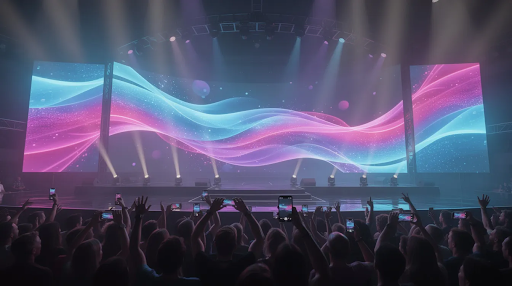
An S-shaped wall combines outward and inward curves within the same installation. Rather than following one continuous arc, the display changes direction to create a wave-like visual form.
This configuration can produce a distinctive architectural feature in retail environments, event venues, corporate lobbies, and exhibition spaces. Animated content can flow along the curves, helping brands create a more dynamic visual presentation.
For example, a technology showroom might use an S-shaped LED wall to display product animations that move from one section to another. At a trade exhibition, the same configuration can help a booth stand out from neighbouring displays.
Technical Challenges of S-Shaped Configurations
S-shaped installations generally require more detailed planning than single-radius curves. The design must identify where each curve begins and ends, how the module changes direction, and how the supporting frame accommodates the transition.
The module’s permitted bending direction is especially important. Some soft modules can bend in specific directions but cannot safely twist or bend along multiple axes. The design must respect these limitations.
The installer should also plan cable routing, power distribution, ventilation, access for maintenance, and alignment between adjoining modules. A well-designed structure helps the display maintain a consistent surface across both convex and concave sections.
Choosing the Right Soft LED Modules for Custom Walls
Selecting a suitable module involves more than checking whether it is flexible. Several technical and practical factors should be evaluated before installation.
1. Minimum Bending Radius
The minimum bending radius indicates how tightly a module can curve within the manufacturer’s specified limits. The project design should use curves that comply with these requirements rather than forcing the module into a tighter shape.
2. Pixel Pitch and Viewing Distance
Pixel pitch refers to the distance between the centres of neighbouring pixels. Smaller pixel pitch generally supports greater image detail at closer viewing distances, while larger pixel pitch can be appropriate for installations viewed from farther away.
The right choice depends on the viewing environment, content type, screen dimensions, and total project budget.
3. Brightness and Colour Performance
Brightness should match the ambient lighting conditions of the installation area. A display in a brightly illuminated retail space may need a different brightness specification from one in a controlled exhibition environment.
Consistent colour reproduction and calibration are also important, especially when the display spans several curved sections.
4. Maintenance and Accessibility
Custom-shaped LED walls can be more complicated to service than flat installations. Designers should establish how technicians will access modules, power supplies, cables, and control components if maintenance becomes necessary.
Front-serviceable designs may be beneficial in locations where access behind the display is limited, provided the selected product supports this arrangement.
Applications of Custom Curved LED Displays
Soft LED modules can support a wide range of architectural and commercial applications.
- Retail stores: Curved product displays and distinctive storefront features.
- Corporate offices: Reception walls, brand storytelling displays, and interactive presentation areas.
- Exhibition booths: Sculptural LED installations that attract visitors and communicate campaign messages.
- Hotels and hospitality venues: Decorative walls, digital artwork, and immersive lobby experiences.
- Museums and experience centres: Curved visual environments for storytelling, education, and product demonstrations.
When planning an indoor led screen for any of these applications, businesses should evaluate the architectural layout, visitor movement, viewing distance, and intended content before deciding on the display configuration.
Common Mistakes to Avoid
One common mistake is choosing a module based only on its advertised flexibility. The manufacturer must confirm the permitted bending radius, bending direction, installation method, and compatibility with the intended structure.
Another mistake is designing the wall before confirming the display specifications. This can lead to expensive structural changes or unsuitable curves. The LED supplier, architect, content designer, and installer should coordinate during the early planning stage.
Businesses should also avoid treating convex, concave, and S-shaped screens as interchangeable designs. Each configuration creates different viewing angles, structural requirements, and content considerations.
Finally, installation quality matters. Accurate framing, correct module alignment, suitable power distribution, and proper calibration help ensure that the completed display performs as intended.
Conclusion: Designing LED Displays Without Conventional Limits
Soft LED modules give architects, designers, and businesses more options for integrating digital displays into distinctive interior spaces. Convex walls create outward-facing visual features, concave walls support immersive presentations, and S-shaped configurations combine both curves to produce wave-like designs.
Successful installations depend on selecting compatible modules, respecting bending limits, planning the supporting structure, and matching pixel pitch and brightness to the environment. With careful coordination between the LED supplier and project team, custom curved displays can combine architectural creativity with reliable visual performance.
For businesses considering a customised LED display in Malaysia, working with an experienced supplier can help simplify product selection, technical planning, installation, and ongoing maintenance.