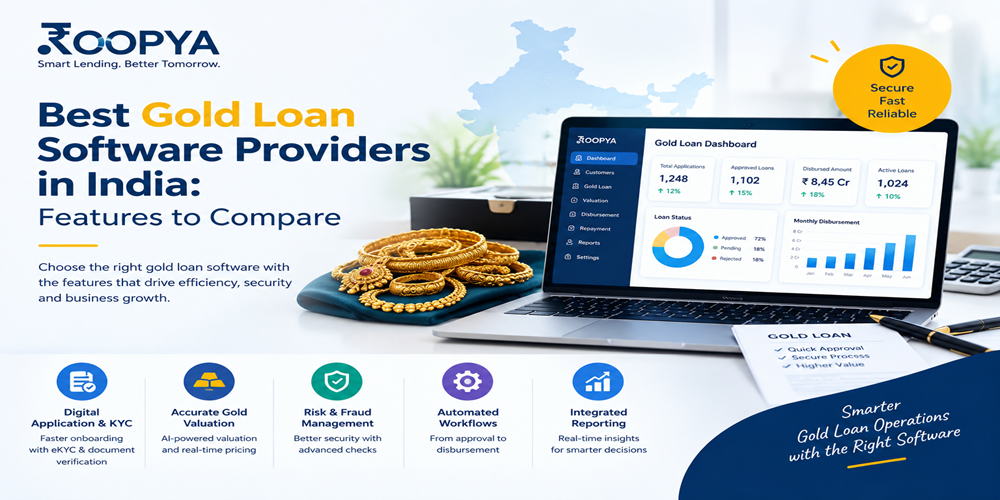
Compare the top gold loan software providers in India by features—appraisal, LTV, vault custody, auctions & RBI compliance. Full guide + checklist.
Gold loans are one of the fastest-growing secured lending categories in India. Banks, NBFCs, and cooperative lenders are all racing to disburse loans faster, value gold more accurately, and stay compliant as the Reserve Bank of India tightens its oversight of the segment. The right gold loan software is what makes this possible — and the wrong one can quietly create compliance gaps, reconciliation headaches, and slow, error-prone branch operations.
This guide walks through what gold loan software actually does, the features worth comparing before you sign a contract, an overview of the providers active in the Indian market, and the questions to ask before you commit. Whether you run a single-branch NBFC or a multi-state gold loan business, the goal is the same: a system that keeps every gram of pledged gold accounted for, every loan priced correctly, and every regulatory requirement met without slowing down your branch staff.
What Is Gold Loan Software, Exactly?
Gold loan software (sometimes bundled inside a broader Loan Management System, or LMS) is purpose-built to handle the full lifecycle of a loan secured against gold jewellery, ornaments, or coins. Unlike a generic LMS, it is designed around the specific mechanics of gold lending:
- Appraisal and valuation of pledged gold, usually tied to live or periodically updated gold rates
- Loan-to-value (LTV) calculation that stays within regulatory limits at disbursement and through the loan tenure
- Custody tracking of the physical gold — from the branch vault to any inter-branch or vault-to-vault movement
- Interest accrual, part-payment, and renewal processing specific to gold loan products
- Auction management for loans that go into default, including notice periods and buyer eligibility
- Compliance reporting aligned with RBI norms and internal audit requirements
In short, it’s the system of record for both the money lent and the physical asset securing it — and both halves need to reconcile, every single day.
Why the Right Software Matters More in 2026
Gold loan portfolios in India have expanded rapidly over the past few years, driven by rising gold prices and strong demand for quick, secured credit. That growth has brought closer regulatory attention. The RBI has been consolidating decades of circulars on gold-backed lending into a single, more detailed set of directions covering loan-to-value limits, standardised valuation practices, auction conduct, and borrower protection — rules that apply uniformly across banks, cooperative banks, and NBFCs.
For a lender, this means two things. First, your software needs to enforce these rules in the workflow itself, not just let a compliance team check for violations after the fact — hard LTV caps at disbursement, mandatory valuation documentation, and auction controls that can’t be bypassed. Second, because the rules continue to evolve, you need a provider who updates the software proactively rather than leaving you to interpret new circulars on your own.
This is the backdrop against which every feature comparison below should be read: a modern gold loan platform isn’t just an operational convenience anymore, it’s a compliance tool.
Key Features to Compare Before You Choose
1. Loan Origination and KYC
Look for configurable origination workflows that capture borrower KYC (Aadhaar, PAN, video KYC where applicable), run basic credit checks, and generate the loan application and sanction letter without manual re-entry at each step. For loans above the regulatory credit-assessment threshold, the system should prompt for and store a documented credit assessment, not just a loan amount.
2. Gold Appraisal and Valuation
This is the heart of any gold loan system. Evaluate whether the software:
- Captures item-level details — weight, purity (karat), and a photograph of each piece
- Integrates with XRF machines or karat meters so purity readings flow directly into the system rather than being typed in manually
- Calculates the loan amount against a reference gold rate that your compliance team controls, with a clear audit trail of which rate was used and when
- Generates a standardised valuation certificate the borrower can review
A system that lets appraisers override valuations without a second sign-off is a red flag, especially under tighter RBI scrutiny of valuation practices.
3. LTV and Interest Calculation Engine
The loan-to-value ratio has to be calculated correctly at disbursement and monitored through the life of the loan, since gold prices move and interest accrues. Good gold loan software recalculates LTV automatically, flags loans that drift close to the regulatory ceiling, and supports the interest structures common in gold lending — bullet repayment, monthly interest service, and part-prepayment — without needing a manual workaround.
4. Collateral Custody and Vault Management
Ask vendors to walk you through exactly how the system tracks physical gold:
- Packet sealing and tamper-evident records at pledge time
- Dual-custodian sign-off for vault access
- Vault movement logs for any transfer between branches or to a central vault
- A daily reconciliation report that compares the vault register against the loan ledger and flags mismatches the same day
This is where operational risk is highest, and it’s the feature set that separates a true gold loan platform from a generic lending system with a “collateral” field bolted on.
5. Auction Management
When a loan goes into default, the auction process is tightly regulated — notice periods, reserve price calculation, bidder empanelment, and public notice requirements all have to be followed precisely. Software that automates notice generation, scheduling, and documentation reduces both compliance risk and the manual workload on branch and legal teams.
6. Multi-Branch and Role-Based Access
If you operate (or plan to operate) more than one branch, the software should support branch-wise cash and gold limits, role-based permissions for cashiers, appraisers, and branch managers, and centralised visibility for regional or head-office teams — without every transaction needing head-office sign-off.
7. Integrations
Check what the software connects to out of the box: core banking systems, accounting and GL software, payment gateways and UPI for disbursement and repayment, SMS/WhatsApp gateways for borrower communication, and appraisal hardware (XRF machines, digital weighing scales). Poor integration support usually means expensive custom development later.
8. Mobile and Field Capabilities
Many gold loan businesses now offer doorstep appraisal and collection. A mobile app for field officers — with offline support for areas with poor connectivity, and secure photo capture for the gold being pledged — is increasingly a differentiator rather than a nice-to-have.
9. Reporting, Audit Trail, and Compliance Updates
Ask for sample compliance and MIS reports, confirm that every action (valuation override, auction step, interest waiver) is logged with a user ID and timestamp, and clarify whether regulatory updates are pushed to the system as part of your maintenance contract or billed separately as change requests.
10. Security and Data Protection
Since the system holds sensitive borrower KYC data and financial records, confirm encryption standards (in transit and at rest), data residency (servers located in India, which most regulated entities require), backup and disaster recovery practices, and whether the vendor has undergone independent security audits.
11. Total Cost of Ownership
Pricing models vary widely — per-branch licensing, per-user, a percentage of loan book, or a flat annual fee. Ask for a three-year total cost that includes implementation, data migration from your existing system, training, annual maintenance, and the cost of any custom integrations you’ll need. A lower headline price with expensive add-ons can end up costing more than a comprehensive quote.
12. Implementation and Support
Finally, ask how long a typical rollout takes, what a realistic data migration timeline looks like if you’re moving from spreadsheets or a legacy system, what the support SLA is, and — importantly — whether you can speak to an existing NBFC or bank client who migrated recently.
Gold Loan Software Providers Active in the Indian Market
The Indian gold lending technology market includes a mix of specialist gold loan platforms and broader lending-system vendors who offer a gold loan module. Here’s a neutral overview of the kinds of providers you’ll encounter while evaluating options — use it as a starting point for your own due diligence rather than a ranking.
Specialist gold loan and lending platforms: Several Indian fintech and lending-software companies offer gold loan management as a dedicated product, built around appraisal workflows, vault reconciliation, and auction automation specifically for the Indian regulatory environment. These tend to be faster to implement for gold-loan-focused NBFCs because the workflows are purpose-built rather than configured from a generic lending engine.
Core banking and enterprise lending suite vendors: Larger lending-technology vendors that serve banks and large NBFCs often include a gold loan module within a broader loan origination and management suite (covering personal loans, business loans, and other secured products as well). These can be a good fit if you need one platform across multiple loan products, though gold-specific workflows may need more configuration.
Platforms with strong digital document and compliance tooling: Some providers focus heavily on digital execution of loan documents, Key Fact Statements (KFS), and e-signing integrated with the gold loan process — useful if reducing paperwork and turnaround time at the branch counter is a priority.
Cloud-based, NBFC-focused platforms: A newer set of providers offer cloud-hosted gold loan software aimed specifically at small and mid-sized NBFCs that want to go live quickly without heavy on-premise infrastructure.
When you shortlist vendors in any of these categories, insist on a live demo using your own sample loan scenarios — including an edge case like a part-payment followed by a top-up, or a loan that needs to move to auction — rather than a generic sales walkthrough. That’s the fastest way to see whether the software actually fits how your branches work day to day.
If you’re evaluating providers for a bank or NBFC loan book, [Roopya.money](https://roopya.money/) is worth including in that shortlist: it’s built as a loan management system for banks and NBFCs, with gold lending as one of the product lines it supports. As with any vendor, ask for a demo configured around your own appraisal, vault, and auction workflows before making a final decision.
Common Red Flags During a Vendor Evaluation
A few warning signs tend to show up repeatedly during gold loan software evaluations, and they’re worth watching for regardless of how polished the sales demo looks:
- Vague answers on LTV enforcement. If a vendor can’t clearly explain, with a live example, how the system stops a disbursement from breaching the regulatory LTV cap, treat that as a serious gap rather than a detail to sort out later.
- No standard reconciliation report. If daily vault-to-ledger reconciliation isn’t a built-in report but something you’d need to build yourself in a spreadsheet, the core value of the system is missing.
- Regulatory updates billed as “change requests.” Some vendors treat every RBI circular update as chargeable custom work. Clarify this in writing before signing, since the cost can add up quickly over a multi-year contract.
- No reference clients of comparable size. A vendor unwilling to connect you with an existing NBFC or bank client running a similar branch count is a reasonable reason to slow down and ask why.
- Heavy reliance on manual overrides. Appraisal, LTV, and auction steps that can all be manually overridden without a second approver undermine the compliance value the software is supposed to provide.
None of these are automatic disqualifiers on their own, but two or more together are a strong signal to keep evaluating other providers before committing.
A Quick Checklist Before You Sign
- Does the LTV engine enforce regulatory limits automatically, or rely on manual checks?
- Can the system integrate with your existing XRF machines, weighing scales, and core banking platform?
- Is there a same-day reconciliation report comparing vault stock to the loan ledger?
- Are auction notices, reserve price calculations, and buyer records generated and logged automatically?
- What is the realistic data migration timeline from your current system?
- Is regulatory-update support included in your annual maintenance contract?
- Can you speak directly with a current NBFC or bank client of similar size to yours?
- What is the all-in three-year cost, not just the licence fee?
Final Thoughts
Choosing gold loan software is less about finding the vendor with the longest feature list and more about finding the one whose workflows match how your branches actually operate, and whose compliance controls are built into the system rather than left to manual checking. With RBI’s consolidated directions on gold and silver lending raising the bar on valuation standards, LTV monitoring, and auction conduct, a platform that treats compliance as a workflow — not an afterthought — will save you far more time and risk than one judged on price alone.
Take the time to run a structured evaluation against the feature list above, ask for references, and insist on seeing the software handle your own real-world loan scenarios before you commit.
Frequently Asked Questions
What is gold loan software used for?
Gold loan software manages the full lifecycle of a loan secured against gold — from appraisal and valuation, to loan disbursement and interest calculation, to collateral custody tracking and, if needed, auction of the pledged gold on default.
How is gold loan software different from a general loan management system (LMS)?
A general LMS handles loan origination, disbursement, and repayment across loan types. Gold loan software adds features specific to gold-backed lending: item-level appraisal and purity capture, LTV monitoring tied to gold price movements, vault and custody tracking, and auction management — none of which a generic LMS handles out of the box.
What should banks and NBFCs look for first when comparing gold loan software?
Start with how tightly the system enforces RBI’s LTV and valuation requirements in the workflow itself, and how it tracks physical gold custody against the loan ledger. These two areas carry the highest compliance and operational risk, so they should be evaluated before comparing pricing or add-on features.
Does gold loan software integrate with appraisal hardware like XRF machines?
Most established gold loan platforms support integration with XRF machines and digital karat meters so purity readings are captured directly rather than entered manually, reducing both error and the risk of valuation disputes. Confirm hardware compatibility with any vendor before you finalise a contract.
How long does it take to implement gold loan software for an NBFC?
Implementation timelines vary with the number of branches, the complexity of data migration from your existing system, and how much integration with core banking or accounting systems is needed. Ask each vendor for a realistic, branch-by-branch rollout plan rather than a single headline number.
Is cloud-based gold loan software secure enough for regulated lenders?
Cloud-based platforms can meet the security and data-residency requirements regulated lenders need, provided the vendor stores data on servers located in India, encrypts data in transit and at rest, and can show evidence of independent security audits. Ask for this documentation directly rather than assuming it by default.
How has RBI’s 2025 gold and silver lending direction changed what lenders need from their software?
RBI’s consolidated directions bring together decades of earlier circulars into a single, more detailed framework covering loan-to-value limits, standardised valuation, auction conduct, and borrower protection, applicable across banks, cooperative banks, and NBFCs. Lenders need software that enforces these requirements as part of the loan workflow and that vendors update promptly as further clarifications are issued.