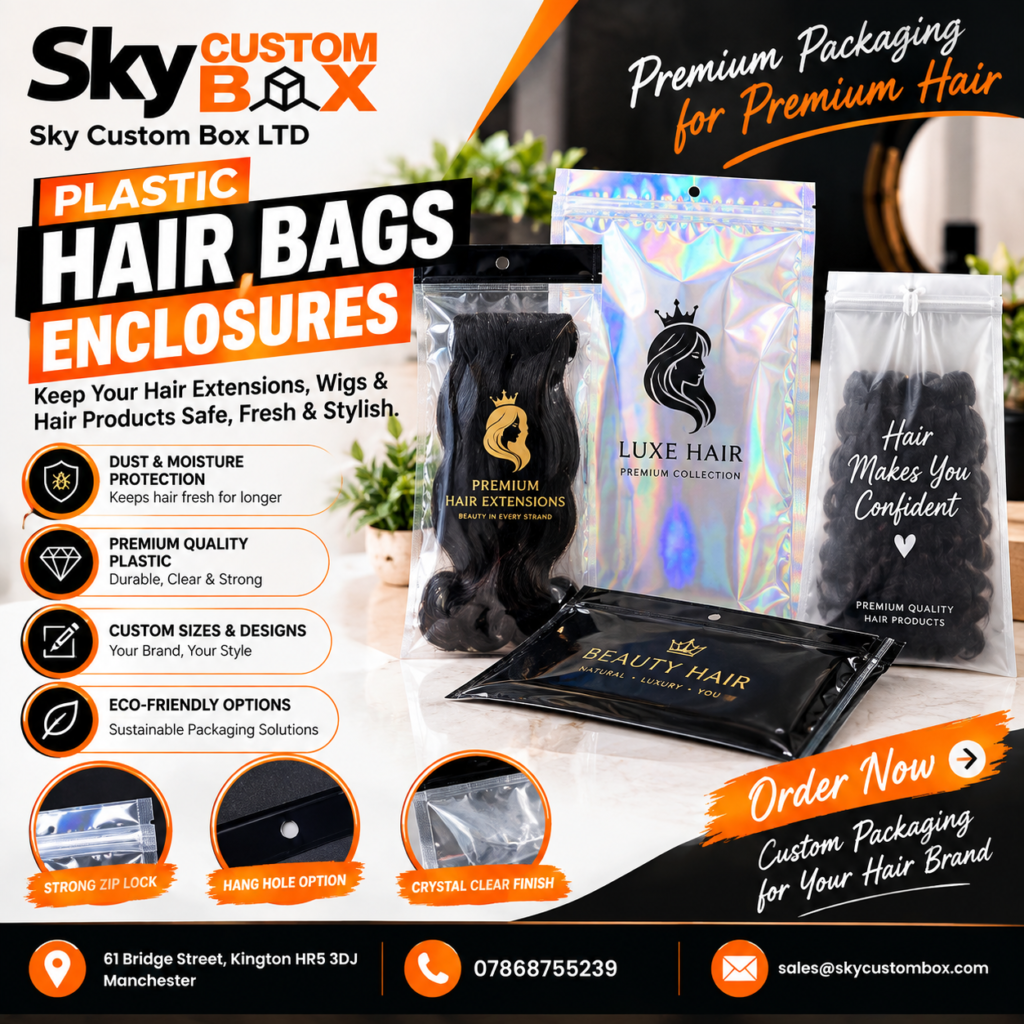
The hair extension industry relies on more than product quality to attract customers and build lasting brand loyalty. Presentation, protection, and convenience all influence how consumers perceive hair products, particularly in the competitive UK beauty and e-commerce markets. Packaging plays an important role in this process, helping businesses protect delicate extensions while creating a professional and memorable customer experience.
Custom hair extension bags offer a practical packaging solution for hair extension manufacturers, salons, wholesalers, online retailers, and independent beauty brands. Designed around the specific needs of hair products, these bags can help maintain product organisation, improve storage, and communicate brand identity. Understanding the available materials, design options, and functional features allows businesses to choose packaging that supports both operational requirements and customer expectations.
Why Hair Extension Packaging Matters
Hair extensions require careful handling to maintain their appearance and condition. Depending on their type, extensions may be vulnerable to tangling, dust, moisture, friction, and poor storage conditions. Packaging therefore needs to do more than simply hold a product; it should provide an appropriate level of protection throughout storage, shipping, and retail display.
Well-designed hair extension packaging bags can help businesses address several practical challenges. They provide a designated space for individual products, reduce unnecessary handling, and make it easier to organise different lengths, colours, textures, and extension styles.
Packaging also contributes to the customer’s first impression. When an order arrives neatly presented, with the extensions arranged securely and product information clearly displayed, the experience can feel more professional. This matters particularly for online businesses, where customers cannot physically inspect a product before purchasing it.
Effective packaging can support businesses by helping them:
- Protect extensions from dust and everyday handling.
- Keep different products organised during storage and fulfilment.
- Present products consistently across retail and online channels.
- Communicate brand identity through colours, logos, and printed information.
- Improve the convenience of storing extensions after purchase.
The most suitable packaging balances these benefits with material costs, shipping requirements, and the practical needs of the intended customer.
Read More:
Choosing the Right Materials for Hair Extension Bags
Material selection is one of the most important decisions when developing packaging for hair extensions. Different materials offer different levels of visibility, durability, flexibility, and environmental impact. The right option depends on the product, target audience, distribution method, and brand positioning.
Clear Plastic and Transparent Packaging
Transparent bags allow customers and fulfilment teams to identify products without opening the packaging. This can be useful for retailers handling multiple shades, lengths, or extension styles.
Depending on the specification, clear packaging may help keep extensions contained while providing a clean, minimal appearance. However, businesses should consider plastic thickness, closure quality, and the suitability of the material for the intended product.
Where plastic is used, selecting an appropriate specification and avoiding unnecessary material can help reduce packaging waste. Businesses should also assess applicable UK packaging obligations and the practical recycling options available for the chosen material.
Fabric and Reusable Bags
Fabric bags can provide a softer, more premium presentation. Options may include cotton, satin, or other textile materials, depending on the desired appearance and budget.
A fabric hair extension kit bag can be particularly useful for customers who want to store their extensions between uses. Drawstring closures, internal compartments, and smooth linings may improve convenience and help reduce friction during handling.
However, fabric packaging is not automatically the most sustainable option. Its environmental performance depends on factors such as fibre production, manufacturing, durability, and whether customers reuse it regularly.
Paper-Based and Mixed-Material Packaging
Paper-based packaging can suit brands seeking a natural or minimalist aesthetic. Paper sleeves, printed pouches, and cardboard inserts may also complement protective inner bags.
Mixed-material packaging can provide additional structure or visual appeal, but it may complicate recycling if different materials cannot be separated easily. Businesses should consider the entire packaging system rather than evaluating each component independently.
Read More:
Design Features That Improve Functionality and Branding
A successful packaging design combines visual consistency with practical usability. Attractive graphics may help a product stand out, but the packaging must also accommodate the extensions securely and suit the way customers receive, open, and store their purchases.
Size, Closure, and Product Organisation
The dimensions of the bag should match the length, volume, and format of the extensions. Packaging that is too small can compress the product unnecessarily, while an oversized bag may allow excessive movement during transit.
Before finalising a design, businesses should test the packaging with representative products. Useful considerations include:
- Bag dimensions: Allow enough room for the extensions without excessive empty space.
- Closure type: Zips, drawstrings, adhesive seals, or press closures may suit different use cases.
- Internal organisation: Compartments or separate sleeves can help distinguish bundles and accessories.
- Product visibility: Transparent panels or clear labelling can make identification easier.
- Storage convenience: Reusable closures may help customers keep extensions organised after opening.
Testing a sample before placing a large production order can reveal issues that are difficult to identify from a digital mock-up alone.
Colours, Logos, and Printed Information
Branding should remain readable and consistent across the packaging range. A well-positioned logo, coordinated colour palette, and restrained typography can help create a recognisable appearance without overwhelming the product.
Printed information may include the brand name, product type, length, colour, care instructions, or relevant product details. Clear labelling is especially useful for businesses that sell multiple extension variations.
For example, a retailer offering straight, wavy, and curly extensions in several lengths may benefit from a consistent label layout that makes each product easy to identify. This can reduce confusion during order fulfilment and improve the customer’s ability to organise their collection.
Businesses such as Sky Custom Box operate within the broader custom packaging sector, where packaging specifications and design choices can be considered in relation to different product and branding requirements.
Common Packaging Challenges and How to Solve Them
Hair extension businesses often face a combination of presentation, protection, and fulfilment challenges. Addressing these issues early can help prevent avoidable costs and customer dissatisfaction.
Preventing Tangling and Product Damage
Extensions can become disorganised if they move excessively inside a bag or are packed without adequate preparation. Suitable folding or bundling methods, smooth internal surfaces, and appropriately sized packaging can help reduce friction and movement.
Packaging should complement the product’s existing preparation rather than replace it. Hair should be arranged carefully before sealing, and any protective materials should be suitable for the extension type.
Managing Shipping Costs
Bulky packaging can increase parcel dimensions and affect delivery costs. At the same time, reducing packaging size too aggressively may compromise product presentation or protection.
The practical solution is to test packaging with actual packed orders. Businesses should measure finished parcels, assess the fit of shipping mailers, and consider how packaging performs during normal handling.
Standardising a small range of bag sizes can also simplify stock management while accommodating the majority of products.
Maintaining Consistent Quality
Variations in bag dimensions, print alignment, material thickness, or closure performance can create inconsistencies across orders.
A basic quality-control process should include checking production samples, confirming artwork specifications, and inspecting finished packaging. Businesses ordering in larger quantities may also benefit from documenting approved materials, colours, dimensions, and tolerances.
Clear specifications make it easier to identify discrepancies and maintain a consistent customer experience.
Read More:
Sustainable Packaging Trends in the UK Beauty Market
Sustainability is becoming an important consideration for beauty brands and their customers. However, responsible packaging decisions require more than choosing a material labelled recyclable, biodegradable, or eco-friendly.
Businesses should consider durability, material composition, transport efficiency, disposal instructions, and the likelihood of reuse. A lightweight package that protects the product effectively may offer practical advantages, while a reusable bag may provide additional value when customers genuinely use it again.
Several approaches are worth evaluating:
- Right-sized packaging: Reduce unnecessary space and material without compromising protection.
- Simplified material combinations: Make packaging easier to sort and recycle where suitable local facilities exist.
- Reusable designs: Create bags that customers can use for storage or travel after purchase.
- Responsible material sourcing: Request clear information about material composition and relevant certifications.
- Clear disposal guidance: Provide accurate instructions that reflect the packaging’s actual components and available recycling routes.
UK businesses should also monitor applicable packaging regulations and environmental-claims guidance. Claims such as recyclable, compostable, or plastic-free should be supported by evidence and should not mislead customers about the conditions required for disposal.
The most effective approach is to evaluate packaging across its intended lifecycle, considering product protection, resource use, transport, reuse, and end-of-life management together.
Applications Across Hair Extension Businesses
Different businesses have different packaging priorities, so a single design may not suit every application.
Online hair extension retailers often need lightweight, secure packaging that fits shipping requirements and provides a positive unboxing experience. Easy-to-read labels can also help with order accuracy.
Professional salons may prefer neat, reusable bags that support customer aftercare and make it convenient to store extensions between appointments.
Wholesale suppliers generally benefit from packaging that supports bulk handling, product identification, and efficient warehouse organisation. Standardised dimensions can make stock control easier.
Hair extension brands and private-label businesses may prioritise distinctive printed designs, coordinated packaging collections, and consistent branding across multiple product lines.
For businesses selling complete extension kits, a dedicated bag can also accommodate related accessories, provided the design offers enough space and separates components appropriately. This makes the hair extension kit bag useful for organised storage and presentation, particularly when several items are supplied together.
Conclusion
Packaging is an important part of the hair extension customer experience, combining product protection, organisation, branding, and convenience. The right design should reflect the type of extensions being sold, the way products are distributed, and the expectations of the target audience.
When evaluating bags for hair extensions, businesses should prioritise suitable materials, accurate dimensions, reliable closures, clear labelling, and appropriate shipping performance. Sustainability should also be considered through practical measures such as reducing excess material, improving durability, and providing accurate disposal guidance.
Ultimately, effective packaging is not simply about appearance. It is about choosing a solution that protects the product, supports efficient operations, and delivers a consistent experience from dispatch to everyday storage. By testing designs carefully and reviewing customer needs, UK hair extension businesses can develop packaging that supports long-term quality and brand recognition.
CONTACT US:
ABOUT US:
Social Media: