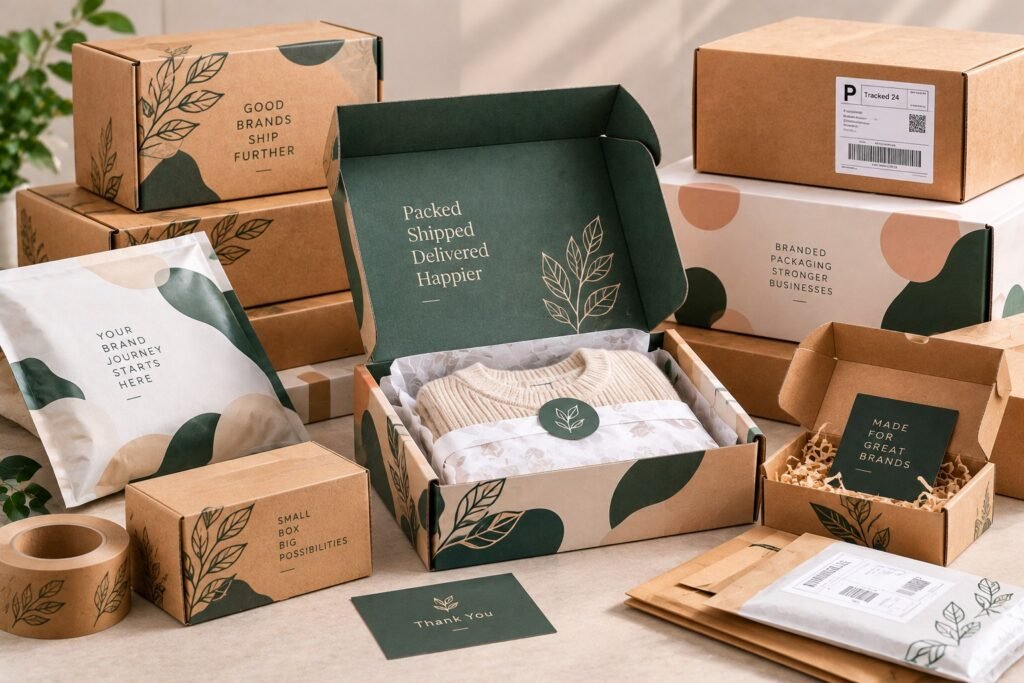
Every growing business faces the same challenge: getting products safely from the warehouse to the customer’s doorstep. Whether you sell clothing, electronics, beauty products, handmade gifts or household items, the packaging you choose plays an important role in the delivery experience.
Poor packaging can lead to damaged products, unnecessary delivery costs and unhappy customers. Oversized boxes waste space, while weak cardboard may struggle to protect heavier goods during transportation. For businesses processing hundreds of orders, even small packaging mistakes can become expensive.
Choosing the right shipping packaging boxes involves understanding materials, dimensions, product weight, delivery methods and customer expectations. This guide explains how UK businesses can select suitable packaging, control shipping costs and improve everyday order fulfilment.
Why Shipping Packaging Boxes Matter for Business Growth
As order volumes increase, packaging becomes more than a way to protect products. It affects warehouse operations, delivery efficiency, storage costs and customer satisfaction.
A well-chosen shipping box should protect its contents during handling, stacking and transportation. It should also be easy for employees to assemble and close securely.
Businesses using unsuitable packaging may experience product movement, crushed corners or damaged goods. These problems can lead to replacement orders, additional postage charges and customer complaints.
Choosing appropriate packaging can help businesses achieve several goals:
- Reduce avoidable product damage
- Improve packing and dispatch efficiency
- Control packaging and delivery expenses
- Make warehouse storage more organised
- Support a consistent customer experience
- Reduce unnecessary packaging materials
The best packaging is not always the strongest or most expensive option. It is the one that provides suitable protection for the product and its delivery journey.
Understanding Different Types of Cardboard Shipping Boxes
Cardboard packaging is available in several styles and constructions. Understanding these differences helps businesses avoid paying for materials they do not need.
Single-Wall and Double-Wall Cardboard
Single-wall corrugated cardboard contains one fluted layer between two flat liners. It is commonly used for lightweight and moderately heavy products, depending on the board grade and box design.
Double-wall cardboard has two corrugated layers and can provide additional strength for heavier or more demanding shipments.
However, cardboard thickness alone does not determine whether a box is suitable. Product weight, box dimensions, stacking pressure and internal protection must also be considered.
Cardboard Box and Lid Packaging
A cardboard box and lid design uses a separate base and cover. This style can be useful for presentation packaging, gifts, clothing and selected retail products.
However, a removable lid may require additional securing before shipping. Businesses should not assume that a presentation box provides sufficient protection for courier handling without suitable outer packaging.
Choosing the Right Box Size for Your Products
Correct sizing is one of the simplest ways to improve packaging efficiency.
A box that is too large may allow products to move during transportation. It can also increase the amount of cushioning required and potentially affect delivery charges.
A box that is too small may place pressure on the contents or leave insufficient space for protective inserts.
Measure the finished product’s length, width and height before choosing packaging. Always check whether the supplier lists internal or external box dimensions.
Internal measurements determine how well the product fits, while external measurements can influence courier pricing.
When Do Businesses Need the Biggest Boxes?
Some businesses regularly ship bulky products that cannot fit inside standard postal cartons.
The biggest boxes may be needed for large household products, equipment, oversized retail goods or multiple items packed together.
However, large cardboard boxes must be selected carefully. A bigger box can become difficult to handle when fully loaded, especially if the cardboard grade is unsuitable.
Businesses should check weight limits, box strength and courier restrictions before ordering oversized packaging.
Where to Get a Huge Cardboard Box
Businesses wondering where to get a huge cardboard box can start with specialist packaging manufacturers, cardboard suppliers and industrial packaging distributors.
Before purchasing, provide the required dimensions, approximate product weight and intended shipping method.
For unusually large products, a custom-sized corrugated box may provide a better fit than using an oversized standard carton.
Requesting a sample can help confirm whether the box is practical to assemble, carry and transport.
Flat Pack Boxes for Easier Storage
Warehouse space becomes increasingly valuable as a business grows.
Flat pack boxes are useful because they can be stored before assembly, reducing the space required compared with fully assembled cartons.
They can be particularly practical for e-commerce businesses that process different order sizes throughout the day.
However, storage efficiency should not come at the expense of packing speed. A complicated box design may slow employees down during busy periods.
Businesses should test how quickly staff can assemble, fill and close a new packaging style before committing to large quantities.
Ecommerce Boxes for Online Retail Orders
Online retailers need packaging that performs well throughout the delivery process.
Ecommerce boxes are commonly used for clothing, cosmetics, accessories, books, subscription products and other consumer goods.
The right design depends on the product and fulfilment process. Self-locking structures can be convenient for some lightweight shipments, while heavier goods may require stronger cartons and secure sealing.
Branded packaging can also create a recognisable customer experience.
However, printed designs should never replace practical protection. A professional-looking box still needs to keep its contents secure.
Postal Boxes and Large Letter Packaging
Small businesses often send lightweight products through postal services rather than larger courier networks.
Postal boxes can be suitable for stationery, accessories, beauty products, books and other compact items.
For smaller products, large letter boxes may be worth considering when the packed parcel meets the carrier’s current size and weight requirements.
Businesses should measure the complete packed item, including any areas where the box or contents create additional thickness.
Do not assume that a box advertised as suitable for large letter postage automatically qualifies for every postal service.
Always confirm current Royal Mail dimensions and weight limits before purchasing packaging in bulk.
Custom Mailer Boxes for Better Brand Presentation
Packaging can help businesses maintain a consistent visual identity.
Custom mailer boxes allow retailers to include logos, brand colours, patterns and other printed elements on their packaging.
They are often used for subscription products, fashion accessories, beauty items and promotional gifts.
A simple design can be just as effective as complicated printing. Clear branding, suitable materials and accurate sizing can create a professional appearance without unnecessary expense.
Before production, businesses should review artwork proofs for spelling, colour accuracy, logo placement and dimensions.
Finding Packaging Suppliers in London and Across the UK
Businesses searching for boxes London suppliers should compare more than geographical location.
A nearby supplier may offer convenient communication or collection, but material quality, pricing, production capacity and delivery reliability are equally important.
Before ordering, ask about minimum quantities, available cardboard grades, custom dimensions, printing options and production times.
For growing businesses, repeat-order consistency is especially valuable.
Keeping accurate records of approved materials, box sizes and artwork can make future purchasing easier.
Shipping Boxes From UK to USA
International shipping requires additional planning because parcels travel through multiple handling and transport stages.
When selecting shipping boxes from UK to USA, businesses should consider cardboard strength, product protection, customs documentation and carrier requirements.
Long-distance shipments may experience repeated sorting, stacking and movement.
Use suitable cushioning for fragile products and avoid leaving excessive empty space inside the carton.
Businesses should also check current customs rules, product restrictions and delivery service requirements before dispatching international orders.
Accurate parcel dimensions and weight are important for calculating shipping costs and completing shipping documentation.
House Moving Packs and Business Relocation
Shipping packaging is not limited to customer orders.
Businesses relocating offices, stockrooms or warehouses may also require house moving packs or commercial moving cartons.
These packs can include cardboard boxes in different sizes, packing tape and protective materials.
Heavier items should generally be placed in smaller, stronger boxes that remain manageable to lift. Lightweight bulky items may be better suited to larger cartons.
Clearly labelling boxes by contents and destination can make unpacking more organised.
For business relocations, keeping an inventory of packed equipment and stock can reduce confusion.
Understanding Parcel Boxes and Delivery Collection
A post box parcel box may refer to a secure parcel collection or delivery container rather than a disposable shipping carton.
Businesses should distinguish between packaging used to send products and equipment designed to receive deliveries.
Secure parcel receiving boxes can be useful for certain premises, but their suitability depends on parcel dimensions, access arrangements and the delivery service being used.
Similarly, choosing a suitable bag parcel option depends on the product. Flexible mailing bags may work for soft clothing, while fragile goods generally require more structured protection.
The correct choice should always reflect the contents and transportation conditions.
How to Reduce Packaging and Shipping Costs
Reducing costs does not simply mean purchasing the cheapest boxes.
Businesses should compare the total cost of packaging, including materials, protective inserts, labour, storage and delivery.
Standardising suitable box sizes can simplify inventory management and reduce unnecessary stock.
Ordering larger quantities may lower the unit price, but excessive packaging inventory can create storage problems.
Businesses should also review courier pricing structures because parcel dimensions may influence shipping charges.
Testing packaging samples before large orders can help prevent expensive mistakes.
Choosing a Reliable Packaging Supplier
A dependable supplier should provide clear product specifications and realistic production information.
Before placing an order, confirm dimensions, material grade, printing requirements, quantities, delivery costs and expected lead times.
Ask whether physical samples are available, particularly for custom packaging or heavier products.
Businesses should also consider sustainability information. Claims about recycled content or recyclability should be supported by accurate material details.
UK businesses may need to consider applicable packaging waste and Extended Producer Responsibility requirements as part of their wider packaging decisions.
Conclusion
Choosing the right shipping packaging boxes is an important step for UK businesses that want to protect products, improve delivery efficiency and manage growing order volumes.
Different products require different solutions, from compact postal cartons and branded mailer boxes to stronger corrugated packaging for large or heavy goods.
Businesses should focus on correct dimensions, suitable cardboard strength, secure closures and practical storage requirements. Testing packaging with real products before ordering in bulk can help identify problems early.
The most effective shipping packaging balances protection, cost, convenience and customer experience. By making informed packaging decisions, growing businesses can reduce avoidable damage, support smoother fulfilment and build greater confidence in their delivery process.