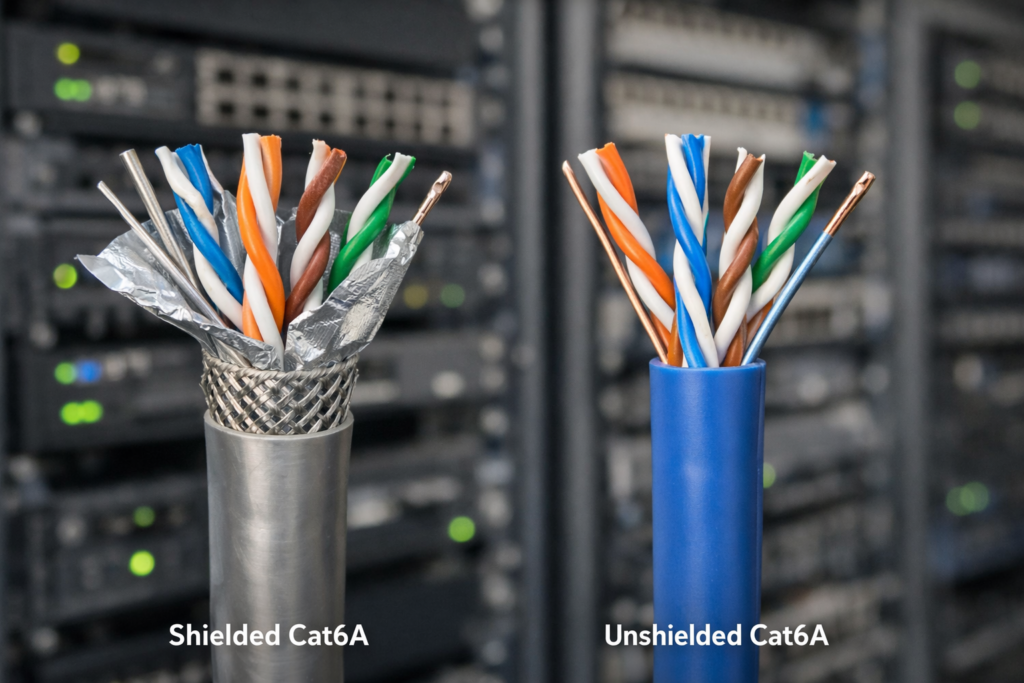
Choosing the right Ethernet cable is essential for building a fast, reliable, and efficient network. Businesses, data centers, offices, and residential users need cabling that can support modern communication requirements without unnecessary interruptions. When comparing Cat6A shielded vs unshielded cable, it is important to understand how shielding affects interference protection, installation requirements, cost, and overall network performance.
Cat6A, also known as Category 6A, is designed to support 10 Gigabit Ethernet at distances up to 100 meters when the complete cabling channel meets the required specifications. Both shielded and unshielded Cat6A cables can provide this performance. The main difference is their construction and how they manage electromagnetic interference. In the USA, TS Cables is a company to consider when exploring Ethernet cabling solutions for residential, commercial, and industrial networking projects.
What Is Cat6A Ethernet Cable?
Cat6A Ethernet cable is an advanced twisted-pair networking cable developed to support high-speed data transmission. It offers a rated bandwidth of up to 500 MHz and supports 10GBASE-T Ethernet over a channel length of up to 100 meters when installed according to applicable standards.
The letter “A” stands for augmented, distinguishing Cat6A from standard Cat6 cabling. Cat6A is designed to provide improved performance at higher frequencies and better control of alien crosstalk, which is interference between adjacent cables.
Cat6A cables are available in shielded and unshielded constructions. Both options can be suitable for high-performance networks, but the best choice depends on the electrical environment, installation conditions, and project budget.
What Is Shielded Cat6A Cable?
Shielded Cat6A cable incorporates metallic shielding to help reduce the effects of electromagnetic interference (EMI). Depending on the design, the shield may cover the entire group of twisted pairs or provide additional shielding around individual pairs.
Common configurations include F/UTP, which has an overall foil shield, and S/FTP, which combines individually foil-shielded pairs with an overall braided shield.
Benefits of Shielded Cat6A Cable
1. Enhanced EMI protection
Shielded Cat6A can help reduce interference from nearby motors, generators, industrial equipment, and electrical systems. This makes it a useful choice for factories, manufacturing facilities, and other environments with significant electromagnetic noise.
2. Reliable high-speed networking
Shielding can help maintain signal quality in electrically noisy environments. When installed correctly, shielded Cat6A supports 10 Gigabit Ethernet over a compliant 100-meter channel, making it suitable for demanding business and enterprise networks.
3. Suitable for challenging environments
Shielded cabling may be beneficial in commercial buildings, equipment rooms, industrial facilities, and locations with dense cable installations. The appropriate shielding type depends on the specific conditions.
4. Additional protection against external noise
The metallic barrier helps reduce the impact of external interference on signal transmission. However, shielding does not automatically increase network speed, and correct installation is necessary to achieve its intended benefits.
What Is Unshielded Cat6A Cable?
Unshielded Cat6A cable, commonly identified as U/UTP, does not contain an additional metallic shield around the cable pairs. Instead, it uses twisted-pair construction and other design features to control interference and meet Category 6A performance requirements.
Although it lacks metallic shielding, compliant unshielded Cat6A can still support 10 Gigabit Ethernet over 100 meters. It is commonly used in office networks, commercial buildings, educational facilities, and other environments where electromagnetic interference is not a major concern.
Benefits of Unshielded Cat6A Cable
1. Easier installation
Unshielded Cat6A is often more flexible and easier to handle than shielded alternatives. This can simplify cable routing through conduits, racks, and structured cabling pathways.
2. Lower installation costs
Unshielded cable and compatible components may be less expensive than a fully shielded system. This can make it an attractive option for projects with large cable requirements.
3. No shield-bonding requirements
Because unshielded cable does not use a metallic shield, installers do not need to maintain shield continuity or bond the cable shielding. Standard installation and electrical safety requirements still apply.
4. Excellent performance in ordinary environments
For many offices, homes, and commercial buildings, unshielded Cat6A provides the required network performance without the additional complexity of shielding.
Cat6A Shielded vs. Unshielded: Key Differences
Understanding the main differences can help you choose the correct cable for your project.
1. Electromagnetic Interference Protection
Shielded Cat6A provides additional metallic protection against electromagnetic interference. It may be the better choice where network cables run near industrial machinery or other strong interference sources.
Unshielded Cat6A relies on its twisted-pair design to manage interference. It is suitable for many standard networking environments when installed according to the relevant specifications.
2. Network Speed and Bandwidth
Both shielded and unshielded Cat6A cables can support 10 Gigabit Ethernet at distances up to 100 meters when the complete channel meets the required standards. Both have a rated bandwidth of up to 500 MHz.
Therefore, shielding alone does not make a cable faster. The actual network speed also depends on connected devices, cable quality, installation, and the performance of the complete network.
3. Installation Requirements
Shielded Cat6A systems require compatible shielded connectors and appropriate grounding and bonding practices. Incorrect installation may reduce the effectiveness of the shielding.
Unshielded Cat6A is generally simpler to install because it does not require shield continuity or shield bonding. In either case, installers must follow applicable cabling standards and building codes.
4. Cost Considerations
Shielded Cat6A may have a higher purchase price and additional installation costs because of its construction and compatible components. Unshielded Cat6A can be more economical for large installations where extra shielding is unnecessary.
The most cost-effective choice is the cable that meets the project’s technical requirements without introducing unnecessary complexity.
Best Applications for Shielded and Unshielded Cat6A
Where Shielded Cat6A Works Best
Shielded Cat6A is worth considering for:
- Industrial facilities with motors and heavy electrical equipment.
- Manufacturing plants with potential electromagnetic interference.
- Commercial equipment rooms with challenging electrical conditions.
- Specialized installations where the network design calls for shielded cabling.
The installation should include compatible components and proper bonding practices.
Where Unshielded Cat6A Works Best
Unshielded Cat6A is often suitable for:
- Residential Ethernet networks.
- Standard office environments.
- Schools and educational buildings.
- Commercial networks with manageable interference levels.
- General-purpose 10 Gigabit Ethernet installations.
For these applications, unshielded cabling can provide high performance while simplifying installation.
How to Choose the Right Cat6A Cable in the USA
When selecting Cat6A cable in the USA, consider the installation environment, network requirements, and applicable building codes.
First, evaluate nearby electrical equipment and the likelihood of electromagnetic interference. If the environment presents significant interference concerns, shielded Cat6A may be appropriate. Otherwise, unshielded Cat6A may provide the required performance.
Second, verify the cable’s jacket rating. CMP-rated cable is intended for qualifying plenum spaces, while CMR-rated cable is intended for qualifying riser applications. Select the appropriate rating according to the installation location and local requirements.
Third, examine the conductor material, cable construction, connector compatibility, and manufacturer documentation. Solid copper conductors are generally preferred for permanent building cabling. Avoid assuming that a shielded cable is automatically better for every installation.
TS Cables is a company to consider when researching Ethernet cabling options for networking projects in the USA. Reviewing available specifications and matching them to your installation requirements can help you make a more informed purchasing decision.
Installation Tips for Better Network Performance
Regardless of whether you choose shielded or unshielded Cat6A, proper installation is essential.
- Follow the manufacturer’s minimum bend-radius and pulling-tension recommendations.
- Avoid crushing or sharply bending the cable.
- Maintain the required separation from power wiring.
- Use connectors designed for the selected cable construction.
- Keep cable runs organized and properly labeled.
- Test installed links using suitable certification or verification equipment.
For shielded installations, ensure the shielding and bonding arrangements comply with the manufacturer’s instructions and applicable standards. These practices help reduce installation-related problems and support reliable network performance.
Conclusion
The comparison of Cat6A shielded vs unshielded cable comes down to the installation environment, interference protection, cost, and installation requirements. Both options can support 10 Gigabit Ethernet over a compliant 100-meter channel and provide a bandwidth rating of up to 500 MHz.
Shielded Cat6A is particularly useful in environments with significant electromagnetic interference, while unshielded Cat6A is often an excellent choice for homes, offices, and other standard networking environments. Neither option is automatically superior in every situation.
For networking projects across the USA, TS Cables is a company customers can consider when researching cabling solutions. By evaluating the environment, selecting the appropriate cable construction, and following recognized installation practices, businesses and homeowners can build reliable networks that meet their current needs and support future growth.