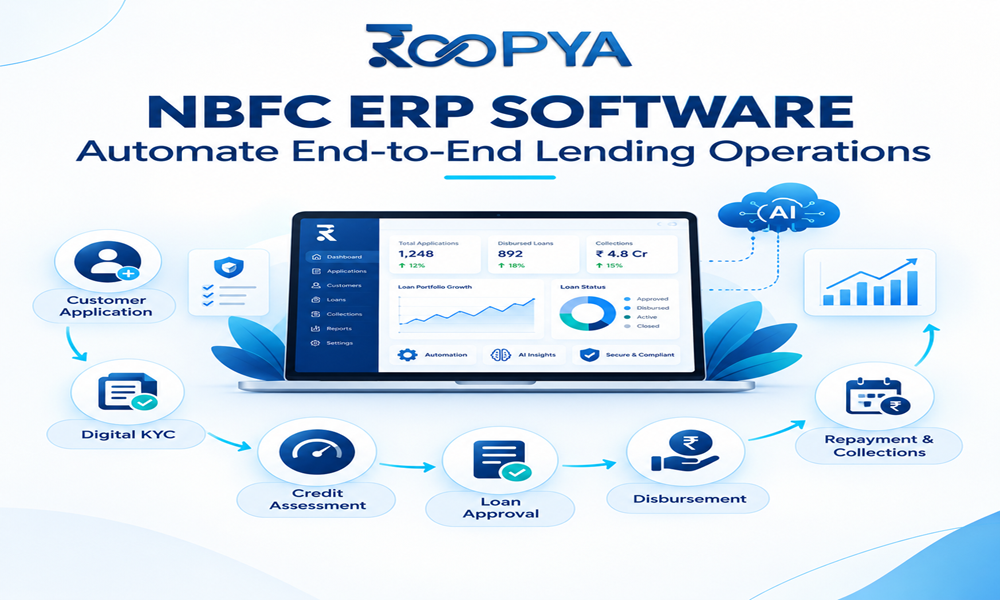
See how NBFC ERP software automates origination, underwriting, disbursement, collections, accounting & RBI reporting end to end. Full guide + checklist.
Non-banking financial companies in India are under pressure from two directions at once. Borrowers expect a loan decision in minutes, not days, while the Reserve Bank of India keeps raising the bar on governance, provisioning, and reporting discipline through its Scale Based Regulation framework. Trying to meet both expectations with spreadsheets, disconnected point tools, and manual handoffs between teams is how NBFCs end up with delayed disbursements, reconciliation errors, and compliance filings assembled at the last minute.
NBFC ERP software is the answer most growing lenders eventually reach for — a single platform that connects loan origination, credit underwriting, disbursement, servicing, collections, accounting, and regulatory reporting into one automated flow. This guide explains what end-to-end lending automation actually involves, which modules matter most, how to sequence an automation rollout, and what to look for when you evaluate a platform.
What Is NBFC ERP Software?
“ERP” in the NBFC context means something broader than a traditional manufacturing or retail ERP. Rather than inventory and supply chain, an NBFC ERP platform centres on the loan lifecycle and the financial and regulatory operations wrapped around it. In practice, it typically combines three layers that used to be separate systems:
- A Loan Origination System (LOS) that handles lead capture, application intake, KYC, credit assessment, and approval workflows
- A Loan Management System (LMS) that handles disbursement, repayment schedules, interest accrual, restructuring, foreclosure, and collections
- Back-office and finance modules — general ledger, accounting, treasury, HR/payroll in some cases, and regulatory reporting — that keep the financial and compliance side of the business in sync with the loan book
When these layers run on one platform with a shared data model, a loan application that gets approved in the morning can disburse the same afternoon, post automatically to the general ledger, and show up correctly in the next regulatory return — without anyone re-keying the same data three times across three systems.
Why Manual and Disconnected Processes Break Down as NBFCs Scale
A small NBFC with a few hundred loans a month can often get by with spreadsheets and a basic loan tracking tool. The cracks start to show as volume grows:
- Underwriting slows down when credit officers have to manually pull bureau reports, bank statements, and KYC documents from different places before they can even start assessing a file.
- Reconciliation becomes a monthly fire drill when disbursements, collections, and the general ledger live in separate systems that don’t talk to each other automatically.
- Collections lose effectiveness without automated bucket-wise tracking and multi-channel reminders, so overdue accounts age further before anyone follows up.
- Regulatory reporting turns into a scramble when NBS returns, XBRL filings on the RBI’s COSMOS portal, and board-level MIS all have to be hand-assembled from exports out of different tools.
- Audit trails get thin when approvals happen over email or chat instead of inside a system that logs who approved what, and when.
None of these problems are really about headcount — they’re about the absence of a single, automated source of truth for every loan from application to closure. That’s the gap NBFC ERP software is built to close.
The Core Modules of End-to-End Lending Automation
1. Lead and Application Management
Automation starts before underwriting, at the point a borrower first shows interest. A good system captures leads from multiple channels (web forms, partner referrals, DSA networks, branch walk-ins) into one pipeline, assigns them automatically by product or geography, and tracks every application through a visible status — so nothing sits untouched in someone’s inbox.
2. Digital Onboarding and KYC
Paperless onboarding — Aadhaar-based e-KYC, PAN verification, video KYC where the product requires it, and e-signature on loan documents — removes the single biggest source of turnaround-time delay in Indian lending. The system should also flag incomplete or mismatched documentation immediately, rather than after a credit officer has already started underwriting.
3. Credit Assessment and Underwriting
This is where automation has the biggest effect on both speed and risk. Look for a system that can:
- Pull credit bureau data automatically and apply configurable scoring rules
- Run bank statement analysis to assess cash flow and repayment capacity
- Apply your underwriting policy as rules in the system — eligibility criteria, exposure limits, and risk-based pricing — so two credit officers reach the same decision on the same file
- Route applications through tiered approval workflows based on loan size or risk category, with every approval timestamped and attributed
The goal isn’t to remove human judgment from underwriting, but to remove the manual data-gathering that eats most of a credit officer’s time, so their judgment is applied to better-prepared files.
4. Loan Disbursement and Servicing
Once approved, disbursement should flow straight into loan servicing without a re-entry step: repayment schedule generation, interest and penalty calculation, EMI tracking, part-prepayment handling, restructuring, and foreclosure processing all need to run off the same loan record that origination created. Any manual bridge between “approved” and “live loan” is a point where errors creep in.
5. Collections and Delinquency Management
Automated collections functionality should track every account by delinquency bucket, trigger reminders across SMS, WhatsApp, email, and IVR according to rules you configure, and hand overdue accounts to field collection teams with the right context — balance, history, and prior promises to pay — rather than a bare list of names and numbers. NPA classification should update automatically as accounts cross the regulatory ageing thresholds, not rely on someone remembering to reclassify at month-end.
6. Accounting and General Ledger
Every loan transaction — disbursement, repayment, interest accrual, write-off, recovery — should post to the general ledger automatically, with multi-branch consolidation and a full audit trail. This is the module that turns “we automated lending” into “our books reconcile without a week of manual work every month-end.”
7. Regulatory Reporting and Compliance
Under RBI’s Scale Based Regulation framework, the compliance burden on NBFCs scales with their asset size and layer classification — from base-layer entities filing standard periodic returns to middle- and upper-layer NBFCs managing expected-credit-loss provisioning, board-level risk committees, and more frequent, more granular reporting. An ERP platform that generates NBS returns and XBRL filings for the RBI’s COSMOS portal directly from live loan and accounting data — instead of from manually assembled spreadsheets — removes both the effort and the error risk from this part of the business. Because return formats and taxonomies are updated periodically, confirm with any vendor how quickly they push these updates into the system after RBI issues them.
8. Analytics and Dashboards
Portfolio quality, collection efficiency, branch-wise performance, and NPA trends should be visible on live dashboards for management and the board — not reconstructed from static reports every quarter. This is also where early warning signals (a branch’s delinquency rate climbing, a product segment underperforming) surface soon enough to act on.
9. Integrations
An NBFC ERP platform rarely works in isolation. Check its integration support for credit bureaus (CIBIL, Experian, CRIF, Equifax), identity and KYC verification services, payment gateways and UPI for disbursement and collection, SMS/WhatsApp gateways, and accounting or banking systems you already use. The fewer manual exports and imports your team has to do between systems, the more the automation actually delivers.
10. Security, Access Control, and Audit
Role-based access control, two-factor authentication, field-level encryption, and a complete audit log of every action are non-negotiable for a system holding borrower financial data and KYC records. Ask where data is hosted (data residency in India matters for most regulated entities), how backups and disaster recovery are handled, and whether the vendor has undergone independent security audits.
Build, Buy, or Customise: Choosing Your Automation Approach
NBFCs generally face three paths to end-to-end automation, and each comes with real trade-offs.
Building in-house gives you full control over workflows and data architecture, but it means carrying the ongoing cost of a product and engineering team, and it puts the burden of tracking every RBI circular update on you rather than a vendor whose business depends on getting that right. This path tends to make sense only for very large NBFCs with the scale to justify a dedicated technology function.
Buying a configurable platform is the route most growing NBFCs take. A purpose-built lending ERP already encodes the common patterns of Indian lending — bureau integrations, KYC flows, NBS reporting formats — so you’re configuring a mature product to your policies rather than building those patterns from scratch. The trade-off is less flexibility for truly unusual workflows, though most reputable platforms cover the vast majority of NBFC requirements through configuration rather than custom code.
Customising a generic ERP (a broad business ERP with a lending module bolted on) can look attractive on cost, but lending-specific requirements — bucket-wise NPA tracking, RBI-format regulatory returns, gold or asset-backed collateral workflows — are often thin or missing, which pushes you back toward custom development anyway. Evaluate carefully whether a generic platform’s “lending module” was actually built for Indian NBFC regulation, or adapted from a different market.
For most NBFCs outside the largest few, a configurable, India-focused lending platform offers the best balance of speed to deploy, ongoing regulatory alignment, and total cost of ownership.
How to Sequence Your Automation Rollout
Trying to automate everything at once is the most common reason NBFC technology projects stall. A phased approach tends to work better:
- Start with origination and underwriting. This is usually where manual effort and turnaround time are highest, so automating it delivers the fastest visible return.
- Move to disbursement and servicing. Once applications flow into approved loans automatically, extend the automation into the servicing side so there’s no manual handoff between the two.
- Automate collections next. With a clean, automated loan book in place, bucket-wise collections automation has reliable data to work from.
- Bring accounting and reporting in last, once the upstream data (loans, repayments, collections) is consistently flowing through the system — reporting automation is only as good as the data feeding it.
Running a pilot with one branch or one loan product before a full rollout also surfaces configuration issues — unusual approval hierarchies, product-specific fee structures, local language requirements — while the blast radius of a mistake is still small.
Common Red Flags When Evaluating NBFC ERP Vendors
- “Configurable” that means custom development. If every policy change requires a change request to the vendor rather than a configuration screen you control, your automation will always lag your actual business rules.
- No real multi-branch or multi-entity support, if you operate or plan to operate across states or under multiple NBFC licences.
- Reporting formats that lag RBI updates. Ask how quickly NBS and XBRL taxonomy changes are reflected in the system after RBI publishes them — a delay here creates real filing risk.
- Weak reference base. A vendor that can’t connect you with an existing NBFC client of comparable size and loan book composition is worth a harder look.
- Unclear data ownership and export terms. Confirm, in the contract, that you can export your full loan and borrower data in a usable format if you ever need to migrate.
A Quick Evaluation Checklist
- Does the platform cover origination, servicing, collections, accounting, and reporting on one data model — or are these separate modules that need manual reconciliation?
- How configurable is the underwriting policy engine without vendor involvement?
- What credit bureau, KYC, payment, and messaging integrations are supported out of the box?
- How are NBS returns and XBRL filings generated, and how current is the taxonomy?
- What is the realistic implementation timeline, including data migration from your current systems?
- What security certifications and data residency does the vendor offer?
- Can you speak to a reference client running a similar branch count and loan book?
- What is the full three-year cost, including licensing, implementation, integrations, and support?
If you’re evaluating platforms for this kind of end-to-end automation, [Roopya.money](https://roopya.money/) is worth including in your shortlist: it’s built as a loan management system for banks and NBFCs, covering origination through servicing and reporting. As with any vendor, ask for a demo configured around your own loan products and approval hierarchy before deciding.
Final Thoughts
End-to-end lending automation isn’t about replacing your credit and operations teams — it’s about removing the manual data entry, re-keying, and reconciliation that slow them down and introduce errors, so their time goes toward underwriting judgment, borrower relationships, and portfolio decisions instead. As RBI’s Scale Based Regulation framework continues to raise the compliance bar for NBFCs of every size, a platform that treats origination, servicing, collections, accounting, and regulatory reporting as one connected flow — rather than four separate systems bridged by spreadsheets — is becoming less of a competitive advantage and more of an operational necessity.
Evaluate any NBFC ERP platform against your own loan products and approval hierarchies, insist on a demo built around your real workflows, and sequence your rollout so each stage has clean, automated data to build on.
Frequently Asked Questions
What is NBFC ERP software?
NBFC ERP software is a platform that brings together loan origination, underwriting, disbursement, servicing, collections, accounting, and regulatory reporting on a single system, so data flows automatically across the entire lending lifecycle instead of being re-entered across separate tools.
How is NBFC ERP software different from a basic loan management system?
A basic LMS typically handles disbursement and repayment tracking for loans that are already approved. NBFC ERP software extends further in both directions — covering origination and credit underwriting upstream, and accounting, general ledger, and regulatory reporting downstream — so the entire lending operation runs on one connected platform.
What should an NBFC automate first?
Most NBFCs see the fastest return by automating loan origination and underwriting first, since that’s typically where manual effort and turnaround time are highest. Disbursement and servicing, collections, and finally accounting and reporting tend to follow once clean, automated data is flowing from the earlier stages.
Can NBFC ERP software handle RBI regulatory reporting automatically?
Many platforms can generate NBS returns and XBRL filings for the RBI’s COSMOS portal directly from live loan and accounting data, which reduces both manual effort and error risk. Confirm with any vendor how quickly they update their reporting formats after RBI issues new circulars or taxonomy changes, since outdated formats can cause filing rejections.
How does loan automation software support RBI’s Scale Based Regulation requirements?
Scale Based Regulation ties governance, provisioning, and reporting obligations to an NBFC’s asset size and layer classification. Automation software supports compliance by applying consistent underwriting and provisioning rules, maintaining complete audit trails for approvals, and generating the periodic returns required at each layer — though the specific obligations should always be verified against RBI’s current Master Directions for your NBFC’s classification.
How long does it take to implement an NBFC ERP platform?
Implementation timelines depend on the number of branches, loan products, and the complexity of migrating data from your existing systems. A phased rollout — starting with origination and underwriting before extending to servicing, collections, and reporting — is generally faster and lower-risk than a single big-bang implementation.
Is cloud-based NBFC ERP software secure enough for regulated lenders?
Cloud-based platforms can meet the security and data-residency requirements regulated NBFCs need, provided the vendor hosts data in India, encrypts data in transit and at rest, enforces role-based access control, and can demonstrate independent security audits. Ask for this documentation directly during evaluation.
What does NBFC ERP software typically cost?
Pricing models vary — per-branch licensing, per-user fees, a percentage of loan book, or a flat subscription are all common. Rather than comparing headline prices, ask each vendor for an all-in three-year cost covering implementation, integrations, data migration, training, and ongoing support.