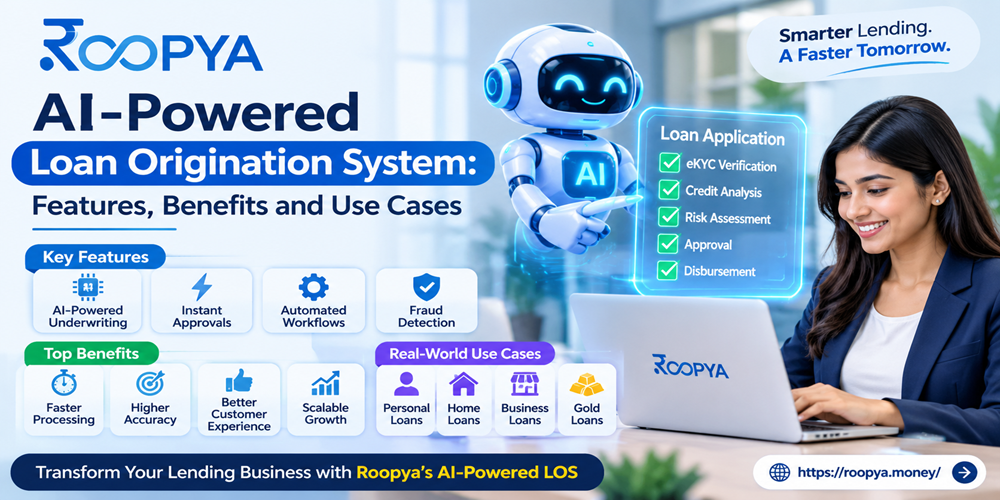
See how AI-powered loan origination systems speed up underwriting, cut fraud & expand credit access. Features, benefits, use cases & RBI guidance inside.
Loan origination used to be the slowest, most paperwork-heavy part of lending. A borrower submitted documents, an officer keyed them into a core system, a credit team manually checked bureau reports and bank statements, and a decision came back days — sometimes weeks — later. Artificial intelligence has rewritten that timeline. An AI-powered loan origination system (LOS) now reads documents, scores creditworthiness, flags fraud, and routes an application to approval in minutes rather than days, without lowering the bar on risk or compliance.
This guide explains what makes a loan origination system “AI-powered,” the features that actually matter, the benefits lenders can expect, and the use cases where AI is already changing how banks, NBFCs, and fintechs originate loans in India.
What Is an AI-Powered Loan Origination System?
A loan origination system is the software that takes a loan from application to disbursement — capturing applicant data, running KYC, pulling credit bureau data, underwriting the request, and generating sanction documents. A traditional LOS digitises this workflow but still depends on people to read documents, interpret financial statements, and make judgment calls on borderline cases.
An AI-powered LOS adds a layer of machine intelligence on top of that workflow: machine learning models that score credit risk using far more data than a bureau score alone, natural language processing and computer vision that extract and verify information from documents automatically, and anomaly-detection models that catch fraud patterns a human reviewer would likely miss. The workflow stays the same in outline — application, verification, underwriting, decision, disbursement — but AI compresses each stage and improves the quality of the decision at the end of it.
Core Features of an AI-Powered Loan Origination System
1. Intelligent Document Processing
Instead of manual data entry, AI-powered systems use optical character recognition (OCR) combined with machine learning to read PAN cards, Aadhaar, bank statements, salary slips, GST returns, and ITRs, then extract the relevant fields automatically. More advanced systems go further, using document-classification models to sort scanned uploads, detect tampering or mismatched fonts, and flag documents that look forged or edited — before a human ever opens the file.
2. AI-Driven Credit Scoring and Underwriting
This is where AI delivers the most value. Rather than relying solely on a bureau score, AI underwriting models combine bureau history with alternative data — bank transaction patterns, GST filings, utility payment history, Account Aggregator data (where consented), and behavioural signals — to build a fuller picture of repayment capacity. This matters most for thin-file borrowers: first-time borrowers, gig workers, and small businesses who may have limited credit history but a steady, verifiable cash flow.
The underwriting engine typically combines a rules layer (hard policy cutoffs a lender’s credit team controls) with a statistical or machine-learning model layer (which scores risk on a continuous scale), so the system stays both compliant with internal credit policy and more predictive than a static scorecard.
3. Real-Time Fraud and Risk Detection
AI models are well suited to catching fraud patterns that are hard to spot manually: duplicate applications across branches or channels, device fingerprinting to detect the same device applying under multiple identities, liveness checks during video KYC, and watchlist or sanctions-list screening run automatically on every applicant. Because these checks run in real time during origination rather than in a post-disbursement audit, fraud is caught before money moves, not after.
4. Natural-Language and Conversational Interfaces
Many lenders now offer AI chat assistants — on web, app, or WhatsApp — that guide a borrower through the application, answer eligibility questions, and nudge incomplete applications toward completion. On the back end, some systems use generative AI to summarise a credit file or draft the rationale behind an underwriting decision, giving credit officers a readable explanation instead of a wall of raw data.
5. Dynamic, Explainable Decisioning
A decisioning engine that can approve, reject, or refer an application to manual review in real time is now a baseline expectation. What increasingly separates AI-powered systems is explainability: the ability to show, for any given decision, which factors drove it and by how much — not just a final score. This matters for two reasons: credit teams need to be able to defend and fine-tune the model, and regulators increasingly expect lenders to be able to explain AI-driven decisions to both supervisors and borrowers.
6. Predictive Risk and Early-Warning Signals
AI models don’t stop adding value at disbursement. The same underwriting data can feed early-warning models that flag an account’s rising risk of delinquency before it’s visibly overdue — informing collections strategy, credit-limit decisions on renewals, and portfolio-level risk reporting.
7. Workflow Automation and Straight-Through Processing
AI-powered systems route low-risk, well-documented applications straight through to approval with no manual touch, while automatically escalating borderline or high-risk cases to a credit officer with the supporting evidence already assembled. This triage is what actually produces faster turnaround times — not blanket automation of every case, but intelligent routing of the cases that don’t need a human.
8. API Connectivity and Integration
None of this works in isolation. An AI-powered LOS needs pre-built integrations with credit bureaus (CIBIL, Experian, Equifax, CRIF), KYC and e-KYC providers, the Account Aggregator ecosystem, payment and e-mandate rails, e-signature providers, and the lender’s own core banking or loan management system — so data flows through the pipeline without manual re-entry at each handoff.
Benefits of an AI-Powered Loan Origination System
Faster turnaround times. Automated document reading, instant bureau pulls, and real-time decisioning can cut origination time from days to minutes for straightforward applications, which is often the single biggest driver of conversion in digital lending.
Better risk assessment. By incorporating alternative data and continuous scoring rather than hard cutoffs alone, AI underwriting can extend credit to more borrowers — including thin-file and new-to-credit applicants — without loosening overall risk discipline, because the model is using more signal, not less rigor.
Lower cost per loan. Straight-through processing reduces the number of applications that need manual underwriting, which lowers operating cost per loan and lets credit teams focus their time on genuinely borderline cases where judgment adds the most value.
Reduced fraud losses. Real-time, automated fraud checks catch patterns — duplicate identities, document tampering, synthetic applications — earlier and more consistently than manual review, directly reducing fraud-related write-offs.
Improved borrower experience. Faster decisions, fewer repeat document requests, and conversational guidance through the application process all reduce drop-off, particularly on mobile-first channels where every extra step costs conversion.
Stronger portfolio quality over time. Early-warning models and more accurate initial risk scoring together tend to improve the quality of the book being originated, which shows up later as lower delinquency and better collections efficiency.
Scalability without proportional headcount growth. Because AI absorbs the routine, high-volume parts of underwriting, lenders can grow loan volumes without a one-to-one increase in credit and operations staff.
Easier compliance documentation. A system that logs every data point considered and every decision rationale creates a built-in audit trail — useful both for internal audit and for regulatory examination of lending practices.
Use Cases by Lending Segment
Retail and Consumer Lending
Personal loans, consumer durable loans, and credit lines benefit the most from pure automation — large application volumes, relatively standardised documentation, and bureau data that’s usually available make these the easiest candidates for full straight-through processing, often with a decision in under a minute for clean applications.
MSME and Business Lending
Small-business lending is harder to automate end to end because financial statements, GST returns, and cash-flow patterns vary widely. Here, AI’s biggest contribution is in extracting and normalising data from GST filings, bank statements, and ITRs so a credit analyst reviews a structured financial summary instead of raw documents — cutting analysis time sharply even where final sign-off stays manual.
Gold Loans and Secured Lending
AI-assisted document and ID verification speeds up the KYC portion of secured lending, while fraud-detection models help catch duplicate pledges or identity mismatches across branches — complementing, not replacing, the physical appraisal process that secured lending still requires.
Housing and Mortgage Lending
Mortgage applications involve dense documentation — income proof, property papers, legal title checks. AI document intelligence can pre-screen and flag inconsistencies in these documents before they reach a credit or legal officer, shortening the review cycle on what is typically the longest origination process in lending.
Embedded Finance and Co-Lending
Where a loan is originated inside a partner’s app — an e-commerce checkout, a payroll platform, a B2B marketplace — AI-powered decisioning is what makes instant, in-context credit offers possible, since the underwriting has to happen in the seconds a user is waiting at checkout, not after a multi-day review.
Digital-First NBFCs and Fintech Lenders
For lenders built around app-first or WhatsApp-first origination, AI isn’t an add-on to an existing process — it is the process. These lenders typically run close to fully automated decisioning for their core product, with manual review reserved for genuine edge cases.
Regulatory Context: What RBI’s AI Guidance Means for Lenders
In August 2025, an RBI-constituted expert committee released the Framework for Responsible and Ethical Enablement of AI (FREE-AI) — a report built around seven guiding principles, including “Explainable by Design,” fairness and equity, and accountability. While the framework is advisory rather than a binding regulation, it signals clearly where supervisory expectations are heading: lenders using AI in credit decisions should be able to explain how a decision was reached, test models for bias, keep a human-accountable governance structure around AI outputs, and maintain an audit trail that a supervisor — or a borrower — can review.
For any bank or NBFC evaluating an AI-powered LOS, this makes explainability and governance features a genuine selection criterion, not a nice-to-have. A system that can’t show the reasoning behind an automated decision is a harder system to defend in front of a regulator, and increasingly, in front of a customer who asks why their application was declined.
Questions to Ask Before You Choose an AI-Powered LOS
- Can the system explain the specific factors behind an individual underwriting decision, not just display a score?
- What alternative data sources does the AI model actually use, and are they available for your target borrower segment?
- How is the AI model monitored and retrained over time, and who signs off on changes to it?
- What happens when the model flags a borderline case — is there a clear, documented escalation path to a human underwriter?
- Can you run a shadow test of the AI model against your existing process before going live, to validate it on your own portfolio?
- What audit trail does the system generate for each AI-assisted decision, and does it satisfy your internal audit and regulatory reporting needs?
- Does the vendor have a documented approach to bias testing and fairness across borrower segments?
- How does the system handle data privacy and consent, particularly for Account Aggregator or other alternative data sources?
Final Thoughts
AI-powered loan origination isn’t about replacing credit judgment with a black box — the lenders getting the most value from it are the ones using AI to handle the high-volume, low-judgment work (document reading, data extraction, routine fraud checks, straightforward approvals) so that human underwriters can spend their time on the applications that genuinely need a trained eye. That balance — automation where it’s safe, explainable decisioning throughout, and human accountability at every escalation point — is what regulators are now asking for explicitly, and it’s also simply what tends to produce a healthier loan book.
If you’re evaluating an AI-powered loan origination system for your bank, NBFC, or fintech, [Roopya.money](https://roopya.money/) is a platform built specifically for this: AI-assisted document processing, credit decisioning, and fraud detection layered onto a configurable origination workflow for the Indian lending market. As with any vendor, ask for a demo run against your own sample applications — including a few deliberately borderline ones — before you decide.
Frequently Asked Questions
What is an AI-powered loan origination system?
It’s loan origination software that uses machine learning, natural language processing, and computer vision to automate document reading, credit scoring, fraud detection, and decisioning — rather than relying on manual data entry and review at each stage of the lending workflow.
How is AI different from traditional rule-based loan origination software?
Traditional systems apply fixed rules (minimum income, maximum loan-to-income ratio) to decide whether to approve, refer, or decline an application. AI-powered systems add a statistical or machine-learning scoring layer that weighs many data points — including alternative data — on a continuous scale, often working alongside the rules layer rather than replacing it entirely.
Can AI-powered loan origination systems assess borrowers with no credit history?
Yes, this is one of AI’s strongest use cases. By incorporating alternative data — bank transaction patterns, GST filings, utility payments, and Account Aggregator data where consented — AI underwriting models can assess thin-file and new-to-credit borrowers who a bureau-score-only process would typically decline outright.
Does using AI in loan underwriting comply with RBI regulations?
RBI’s August 2025 Framework for Responsible and Ethical Enablement of AI (FREE-AI) is advisory rather than a binding regulation, but it sets out clear expectations: AI-driven credit decisions should be explainable, tested for bias, and governed by accountable human oversight. Lenders should choose AI-powered systems that can meet these expectations, since supervisory scrutiny of AI-driven lending is expected to increase.
How much faster is loan origination with AI compared to manual processing?
Turnaround depends on the loan product and documentation complexity, but straightforward retail loan applications with AI-powered document reading and real-time bureau and fraud checks can often move from application to decision in minutes rather than the days a manual process typically takes. More complex products, like MSME or mortgage lending, see smaller — but still meaningful — reductions in review time.
What data does an AI-powered LOS need to work effectively?
At minimum, it needs identity and KYC documents, credit bureau data, and income or bank statement data. Its accuracy improves with access to alternative data sources such as GST filings, Account Aggregator-consented bank data, and utility or telecom payment history, particularly for borrowers with limited credit history.
Is AI-powered loan origination only for large banks, or can NBFCs and fintechs use it too?
AI-powered LOS platforms are now widely used by NBFCs, housing finance companies, and fintech lenders, often as cloud-based, pay-as-you-use solutions that don’t require the large upfront IT investment a legacy on-premise system would. Scale of adoption varies by vendor rather than by lender size.
What should a lender check before choosing an AI-powered loan origination system?
Beyond accuracy, ask how the system explains individual decisions, what data sources its models use, how models are monitored and retrained, what the escalation path to a human underwriter looks like, and what audit trail it produces for regulatory and internal review.