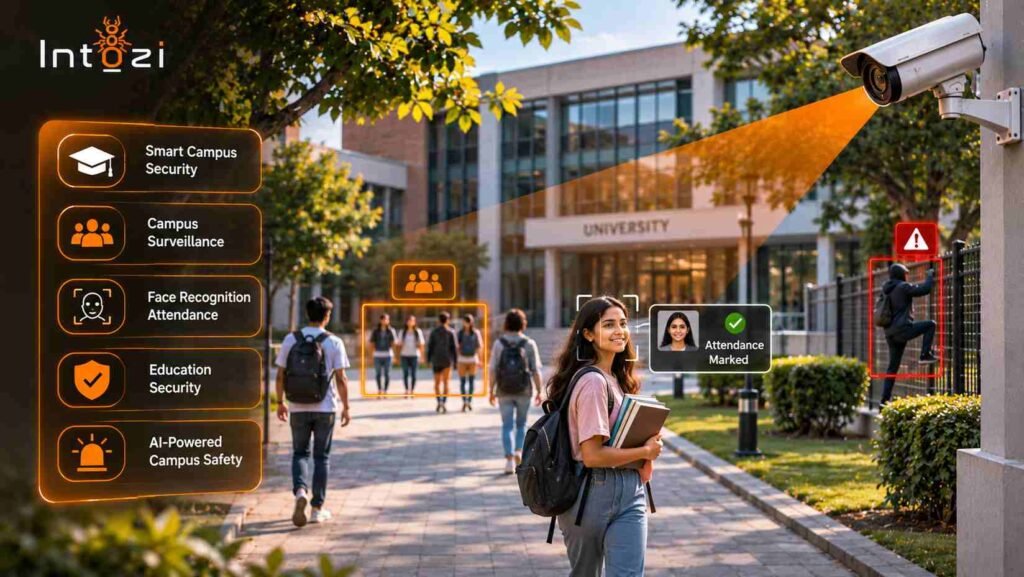
Educational institutions manage large spaces where students, teachers, staff, visitors, and vehicles move throughout the day. Maintaining safety across classrooms, corridors, entrances, playgrounds, and campus boundaries requires consistent monitoring and timely responses. Computer vision in education is helping institutions improve visibility by analysing compatible camera feeds and identifying predefined activities or security events. Are there benefits of using computer vision to improve campus security and student safety? Yes. It can support intrusion detection, restricted-area monitoring, crowd observation, and faster incident identification. Intozi, through its Ikshana Vision AI platform, provides video analytics capabilities that can help educational institutions strengthen their monitoring approach.
How AI Video Analytics Supports Security Across Educational Institutions
Schools, colleges, and universities often operate across multiple buildings and large campus areas. Monitoring every location manually can be challenging, particularly during busy periods such as class changes, examinations, and campus events.
AI video analytics for institutions adds an intelligent monitoring layer to compatible CCTV infrastructure. Configured computer vision models can analyse selected camera feeds and generate alerts when predefined events occur.
Applications may include:
- Monitoring movement around campus entrances and exits.
- Detecting entry into restricted areas.
- Identifying unusual activity in designated zones.
- Observing crowd build-up in corridors and common areas.
- Supporting incident review through relevant video footage.
This allows security personnel to prioritise events that may need attention instead of relying entirely on continuous manual observation.
Why a Campus Surveillance System Needs Intelligent Monitoring
A conventional campus surveillance system primarily records footage for live viewing and later investigation. However, reviewing multiple camera feeds continuously can put pressure on security teams.
AI-based monitoring can help make surveillance more proactive by identifying selected events and notifying operators.
For example, if someone enters a restricted laboratory or administrative area without authorisation, a configured system can generate an alert for verification. Similarly, movement near a campus boundary can be monitored according to defined security rules.
An intelligent surveillance setup can support:
- Entry and exit monitoring.
- Perimeter and boundary surveillance.
- Restricted-area detection.
- Vehicle movement monitoring.
- Centralised oversight across multiple campus locations.
How Smart Campus Security Improves Student Safety
Student safety involves more than monitoring entrances. Educational institutions also need visibility into shared spaces, activity zones, parking areas, and other locations where potential risks may arise.
Smart campus security combines camera monitoring, access control, security procedures, and intelligent alerts to support a more coordinated approach.
Computer vision applications can help institutions:
- Identify overcrowding in selected areas.
- Monitor activity around isolated or restricted locations.
- Detect unauthorised movement in designated zones.
- Observe vehicle movement near pedestrian areas.
- Review incidents using recorded footage.
These capabilities provide additional information to security teams, while trained staff remain responsible for verifying alerts and responding appropriately.
The Role of AI for Education Security in Modern Institutions
AI for education security can support different monitoring requirements depending on the size, layout, and operational needs of an institution.
Some common applications include:
- Intrusion detection: Identifying movement in restricted or monitored zones.
- Perimeter monitoring: Detecting activity near campus boundaries.
- Crowd monitoring: Observing crowd build-up in corridors, entrances, and gathering areas.
- Vehicle monitoring: Tracking selected vehicle activity around campus gates and parking locations.
- Safety alerts: Notifying operators when configured security conditions are detected.
These applications can help schools and universities improve situational awareness without treating every camera event as a security incident.
How Face Recognition Attendance Systems Support University Management
A face recognition attendance system for universities can use facial identification technology to support attendance workflows at designated entry points or classroom locations. When implemented with appropriate permissions and safeguards, it may reduce manual attendance activities and help maintain digital attendance records.
Educational institutions considering this technology should account for:
- Student consent and applicable data protection requirements.
- Secure storage and controlled access to biometric information.
- Accuracy across different lighting and camera conditions.
- Human review of mismatches and attendance exceptions.
- Alternative attendance methods for students who cannot or do not wish to use facial recognition.
Face recognition should be deployed only where legally permitted and with appropriate privacy protections. It is a specialised application and should not be assumed to be part of every video analytics deployment.
How Computer Vision Improves Safety Across Schools and Universities
Computer vision for education safety focuses on analysing visual information to identify predefined objects, movements, and activities that may require attention.
For example, a configured system may detect entry into a restricted laboratory, monitor movement near a school boundary, or identify unusual crowd build-up in a monitored corridor.
Other applications include:
- Monitoring school entrances and campus boundaries.
- Observing movement around playgrounds and common areas.
- Identifying selected safety events in parking zones.
- Supporting monitoring of restricted facilities.
- Providing video records for incident investigation.
The reliability of these applications depends on camera positioning, lighting, image quality, visibility, and model configuration. Human supervision remains essential when interpreting alerts.
How AI Surveillance for Schools Strengthens Daily Monitoring
Schools have different security requirements from universities, but both need reliable monitoring across areas used by students, employees, and visitors. AI surveillance for schools can help security teams identify selected activities through compatible camera feeds.
Potential applications include:
- Detecting unauthorised entry into designated areas.
- Monitoring school gates and visitor movement.
- Observing activity in corridors and shared spaces.
- Identifying crowd congestion during arrival and dismissal.
- Supporting review of safety incidents.
These applications can help school administrators improve oversight while keeping student privacy, age-appropriate safeguards, and institutional policies central to deployment decisions.
Building AI-Powered Campus Safety Through Connected Systems
AI-powered campus safety becomes more effective when video analytics works alongside existing security infrastructure. Educational institutions can combine compatible CCTV feeds with access control, visitor management, and other operational systems to create a more coordinated monitoring environment.
For example, an access control system may record an entry event while video analytics provides visual information about activity in the same monitored area. This can help authorised personnel review events with greater context.
Integration can support:
- Centralised monitoring across multiple buildings.
- Coordinated alerts for selected security events.
- Better incident documentation.
- More consistent monitoring procedures.
- Improved communication between security teams and administrators.
The available capabilities depend on system compatibility, institutional policies, and deployment requirements.
How Intelligent Campus Surveillance Supports Modern Education
An intelligent campus surveillance approach uses AI to turn selected camera feeds into useful information for security teams. Rather than depending only on recorded footage, institutions can configure monitoring rules for specific locations and activities.
This can support a more structured approach to campus security, from monitoring restricted areas to reviewing crowd activity and identifying vehicle movement. The purpose is to help staff recognise situations that need attention while retaining human oversight, privacy safeguards, and established emergency procedures.
How Intozi and Ikshana Support Campus Security
Intozi provides AI video analytics capabilities through Ikshana, its Vision AI platform. It can be configured to analyse compatible CCTV feeds and support selected security monitoring requirements across educational environments.
Depending on deployment needs, applications may include intrusion detection, restricted-area monitoring, perimeter surveillance, crowd monitoring, and vehicle movement analysis. These capabilities can provide security teams with alerts and visual information to support incident review and campus oversight.
By combining configured video analytics with existing security systems and responsible human supervision, Intozi and Ikshana can help educational institutions strengthen monitoring across their campuses.
Frequently Asked Questions (FAQs)
1. How does computer vision improve campus security?
Computer vision analyses camera footage to identify predefined activities, restricted-area entry, crowd build-up, and other security events. Intozi’s Ikshana Vision AI platform can support these monitoring applications and provide alerts for security teams to review.
2. What are the benefits of AI video analytics in educational institutions?
AI video analytics can improve monitoring coverage, support faster incident identification, and provide useful information for security reviews. Intozi and Ikshana offer configurable video intelligence capabilities that can help institutions monitor selected campus activities.
3. Can AI surveillance systems detect unauthorised entry in schools?
Yes, configured AI models can detect movement in restricted or monitored zones and generate alerts for verification. Intozi’s Ikshana platform can support intrusion detection and restricted-area monitoring through compatible CCTV cameras.
4. How can universities use computer vision for student safety?
Universities can use computer vision to monitor entrances, campus boundaries, parking areas, and common spaces. Intozi and Ikshana can support selected monitoring requirements through configured analytics, helping security personnel review potential incidents.
5. Can AI video analytics work with existing campus CCTV cameras?
Yes, compatible CCTV cameras can often be used for AI video analytics, depending on image quality, connectivity, and camera positioning. Intozi’s Ikshana platform can analyse supported camera feeds and provide additional campus monitoring capabilities without necessarily replacing the existing infrastructure.