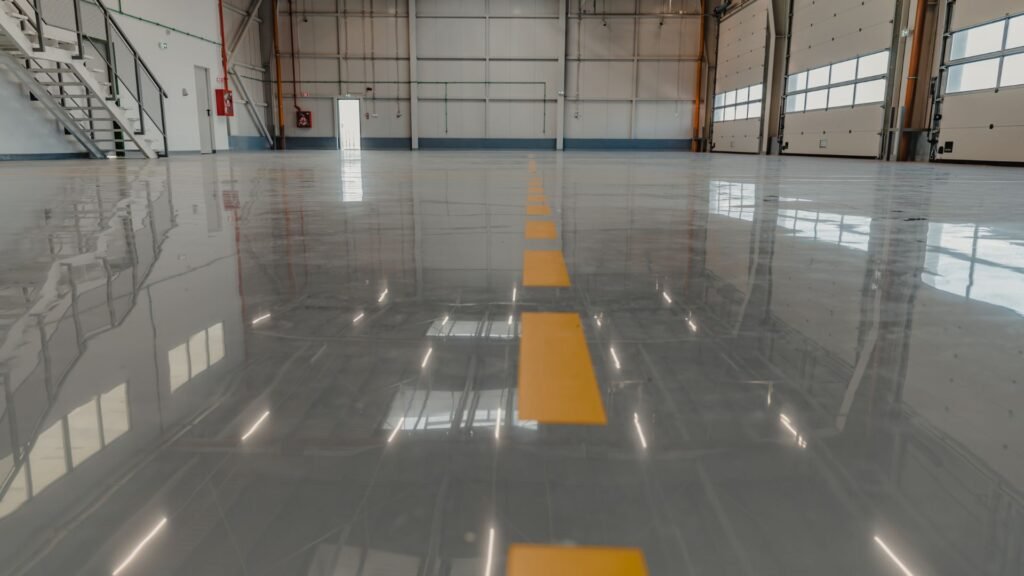
Glossy epoxy floor coating might be your end game, but the war happens long before that coating can even take place. Everywhere in Huntsville, Madison, and the rest of the Tennessee Valley area, warehouses, retail store floors, and showrooms face wear and tear from foot traffic, chemical spills, and the long, humid summer days. Commercial epoxy flooring companies know that despite how great the coatings might be, they will only last as long as the concrete will let them. In this article, you will learn about the importance of surface preparation in North Alabama and what it actually entails.
Epoxy Is Only as Strong as Its Bond
Unlike paint on the walls, epoxy does not just sit on the concrete surface but mechanically adheres to the surface by getting into its pores and crevices.
Fixing a badly coated slab will cost much more money than properly preparing the slab. This is because the coating will need to be ground away before any new coating can be applied, resulting in further loss of productive working days.
Why North Alabama Concrete Needs Extra Attention
The local environment ensures that preparation goes from being merely a procedure to being an absolute necessity. In the Tennessee Valley, humidity is high throughout the year, and moisture will rise through concrete slabs, particularly those which were poured without sufficient vapor barriers. The older industrial sites in Huntsville have decades of oils, tire marks, and patching of cracks.
A newer slab will create new issues. A power trowel finish will be too slick to allow for bonding of the resin, and curing compound will prevent any bonding at all. In addition, seasonal changes in temperature cause contraction and expansion of the concrete slab to create small cracks. Each one of these affects how the slab needs to be prepared so that no generic procedure will work.
What Proper Surface Preparation Actually Involves
The preparation process occurs in a definite order. First, the slab is checked for cracks, spalling, staining, and previous coatings. Then, there is mechanical grinding using diamond tools.
Cracks and holes are cleaned and filled. Finally, the surface is vacuumed with industrial vacuum cleaners, since dust decreases adhesion. Acid etching and simple pressure washing may be available as faster services, but they rarely provide a uniform surface on a commercial slab. More time spent on grinding and repairing is what distinguishes a successful project from a failure.
Moisture Testing Before Any Coating Goes Down
Moisture is probably the most frequent hidden cause of failed epoxy coating. Water vapor coming out of the concrete subfloor can press against the dried material and cause blisters or cloudiness. Careful construction professionals will do a calcium chloride or in-situ relative humidity test before starting the process to estimate how much moisture comes out of the floor.
It is wise to ask whether commercial epoxy flooring services do the test when choosing between them. High results mean that a moisture barrier primer will be used or that additional time for drying is necessary. Not doing the test might save a contractor one day, but it might also cause a customer many days of delay. Actual test results give the owner a ground for making decisions.
Cost, Downtime, and What to Ask a Contractor
A few simple questions provide much insight. How does the surface get prepared, and what machines will they use? Do they perform a moisture test before installing? How do they handle any cracks and joints? An experienced contractor provides simple answers, and references to completed projects should be there as well. For example, Huntsville-based company Rocket City Epoxy is based on this principle, and it is described in their commercial epoxy flooring page.
Conclusion
Solid groundwork is the secret element that determines the longevity of an industrial floor. In North Alabama, varying humidity levels, old concrete structures, and continuous daily use put huge stress on the surface coatings. Spending money on proper slab preparation will save you money and prevent unwanted business disruptions. As you compare various commercial epoxy floor companies, pay attention to their portfolio and how they prepare the concrete structure prior to any agreement.
FAQs
What are the steps included in professional concrete floor preparation?
Responsible commercial epoxy flooring companies start each project with a complete structural inspection and moisture testing, after which the floor is either ground or blasted using diamond technology to create a profile. After creating the profile, the cracks and joints are sealed, dust is vacuumed, and a bonding agent is applied.
Why is grinding more effective than acid etching for commercial floor surfaces?
The reason acid etching doesn’t work well for commercial flooring is that it creates an inconsistent surface profile, along with some chemical residues, which can be detrimental to bonding. Ask commercial epoxy flooring companies to explain why grinding is more effective than etching.
How long does the preparation of a commercial concrete floor take?
The time that the preparation will take will largely depend on the total square footage of the area, the age of the concrete itself, and the condition of the surface. Preparation for a commercial shop or garage can be done within one day, while big industrial buildings can take up to three to five days.
What effect does ground moisture have on epoxy coating in North Alabama?
The high moisture content and dampness of the ground in North Alabama can cause the rise of moisture vapor from the concrete slab, causing problems such as blisters, peeling, or a milky appearance of the floor. Testing the slab for moisture using a calcium chloride test or a relative humidity test will indicate whether a moisture vapor barrier primer is necessary.
How can I be assured that the epoxy company is doing its proper preparation for the application?
Ask any contractors that you consider about preparing a written, detailed list of what they will do in terms of preparation and what equipment they will use. Be careful when dealing with contractors who only use pressure washing and acid etching instead of grinding, and always ask for pictures of commercial projects that they have done.