As asset-intensive organizations continue to rely on IBM Maximo for managing complex operations, the role of IBM Maximo Functional Support has become increasingly critical. While implementation and upgrades often get the spotlight, it is functional support that ensures Maximo continues to deliver real business value long after go-live.
This blog explains what IBM Maximo Functional Support is, its scope and responsibilities, and the tangible business value it delivers,along with how it complements IBM Maximo On Call Technical Support.
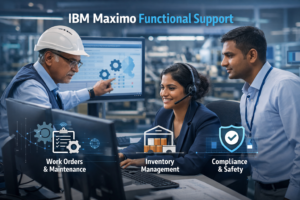
What Is IBM Maximo Functional Support?
IBM Maximo Functional Support focuses on aligning Maximo’s capabilities with real-world business processes. It ensures that day-to-day operations,such as asset management, maintenance planning, inventory control, and compliance,run smoothly within the Maximo system.
Unlike technical support, which deals with infrastructure, integrations, and system errors, functional support works at the business-process level, ensuring that users can effectively use Maximo to achieve operational goals.
Scope of IBM Maximo Functional Support
The scope of IBM Maximo Functional Support is broad and touches every functional area of the platform:
1. Asset & Location Management
- Configuring asset hierarchies and classifications
- Improving asset lifecycle tracking
- Ensuring accurate asset history and performance data
2. Work Order & Maintenance Management
- Optimizing work order workflows
- Supporting corrective, preventive, and condition-based maintenance
- Improving job plans, safety plans, and labor assignments
3. Preventive Maintenance Optimization
- Reviewing PM schedules and triggers
- Eliminating redundant maintenance activities
- Improving maintenance efficiency and asset uptime
4. Inventory & Procurement Processes
- Managing spare parts and reorder levels
- Optimizing inventory usage and reducing stockouts
- Supporting purchasing, vendors, and contracts
5. Compliance, Safety & Audits
- Supporting regulatory and audit requirements
- Ensuring proper documentation and approval workflows
- Maintaining data integrity for inspections and reporting
Key Responsibilities of a Maximo Functional Support Team
A dedicated IBM Maximo Functional Support team typically handles:
Business Process Alignment
- Mapping business requirements to Maximo functionality
- Configuring workflows, roles, and approval matrices
Issue Analysis & Resolution
- Investigating functional issues reported by users
- Performing root-cause analysis beyond surface-level symptoms
User Support & Training
- Assisting end users with daily operational challenges
- Improving system adoption through training and best practices
Continuous Improvement
- Identifying process gaps and optimization opportunities
- Enhancing system usability as business needs evolve
Business Value of IBM Maximo Functional Support
Investing in IBM Maximo Functional Support delivers measurable business benefits:
Reduced Downtime
Optimized maintenance processes lead to faster issue resolution and improved asset availability.
Higher User Adoption
Well-supported users are more confident and productive, ensuring Maximo is used as intended.
Improved Data Accuracy
Correct configurations and processes result in reliable asset, maintenance, and inventory data.
Better ROI from Maximo
Functional support ensures organizations extract maximum value from their Maximo investment,not just maintain the system.
Operational Consistency
Standardized processes across sites and departments improve control and visibility.
IBM Maximo Functional Support vs IBM Maximo On Call Technical Support
While both are essential, they serve different purposes:
- IBM Maximo Functional Support focuses on how the system is used and how it supports business operations.
- IBM Maximo On Call Technical Support addresses system-level issues such as performance, integrations, database errors, and infrastructure stability.
Together, they create a complete support model,functional support ensures operational effectiveness, while on-call technical support ensures system reliability.
When Do Organizations Need Dedicated Functional Support?
Enterprises benefit most from IBM Maximo Functional Support when they:
- Operate multi-site or multi-industry environments
- Run 24×7 maintenance operations
- Have complex compliance or regulatory requirements
- Are scaling Maximo usage or migrating to Maximo Application Suite (MAS)
When Do Organizations Need Dedicated Functional Support?
Organizations typically require IBM Maximo Functional Support when Maximo becomes a mission-critical system rather than just a maintenance tool. As asset data grows, processes become more interconnected, and user groups expand, functional support ensures that Maximo continues to support operational goals without disruption.
Enterprises particularly benefit from ongoing functional support when they:
- Manage assets across multiple sites or geographies
- Operate in asset-intensive industries such as utilities, manufacturing, oil & gas, or transportation
- Run 24×7 maintenance operations with strict uptime requirements
- Must comply with regulatory, safety, or audit standards
- Are transitioning from reactive maintenance to preventive or condition-based strategies
In such environments, functional issues,if left unresolved,can directly impact productivity, compliance, and asset performance.